



This article is a sponsored feature from Mining.com.au partner SAGA Metals. It is not financial advice. Talk to a registered financial expert before making investment decisions.
Vancouver-based SAGA Metals (TSX-V:SAGA) has bared its teeth, with CEO and Director Mike Stier declaring that its Wolverine Project will be “one to watch” in North America’s competitive rare earths sprint.
SAGA Metals delivers critical minerals in North America through six strategically positioned, 100%-owned properties in premier mining jurisdictions.
The company aims to help meet spiralling demand in defence, energy, and digital infrastructure industries. High-value resources in its sights include titanium, vanadium, uranium, lithium, high-purity iron ore, and rare earth elements.
“Canada has joined the race to shore up supply and security of these critical minerals,” Stier says.
“I think that we are in a very good position to become one that the federal government can and should formally support as among the top projects in Canada. That support will be solidified when we put a resource out.
“Given the geological setting, the mineralised potential that we know we have, plus the logistical geographical location, we are ticking a lot of the boxes to be that project to watch in the very near term.”
The demand for rare earths
According to Stier, it has never been more critical to concentrate on rare earths, given how few countries are operating in that mining space.
“It’s important to remind and reiterate to people why it’s so important now, more so than ever, to shore up rare earths, especially heavy rare earth resources in Western nations,” he says.
“Especially since China has demonstrated its willingness to weaponise from a geopolitical standpoint and create a bottleneck or choke point for the release of some of these raw materials, affecting many downstream applications.
Despite such challenges in the current global climate, he says that these have also presented positive opportunities for the company.
“It’s supporting that narrative of moving away from this globally centric industrial supply chain model that we’ve shaped ourselves into in the last few decades and into a nationalistic, strategic supply chain initiative,” he says.
Canada’s position in the race
Stier is somewhat critical of the speed at which Canada has adopted and embraced the rare earths industry.
“I think Australia has done a very good job in the last several years in terms of prioritising its mining and exploration industry where Canada has fallen a little bit short and now we’re left with playing catch-up despite the fact we have swathes of high-potential ground all over the country,” he says.
He adds that with proper prioritisation of initiatives, “Canada could easily win the game,” citing the recently announced Sovereign Wealth Fund as an example.
“It really takes initiatives of companies like SAGA Metals to find high-potential ground which is classified as a greenfield because there are no major companies in the area,” he says.
“We have to define a brand-new resource and that takes guts and efforts and money and support, and I think the country has fallen short in getting behind these projects.
“It’s something they should have done five or 10 years ago, not in 2026.”
The Wolverine Project
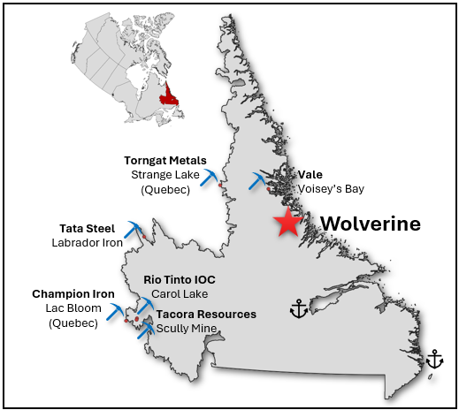
In mid-April, SAGA Metals signed a definitive agreement to acquire the Wolverine Heavy Rare Earth Element (REE) Project in Labrador on Canada’s remote east coast.
Three days later, it expanded the project through a title transfer agreement, enabling it to acquire three contiguous mineral licences comprising 534 mineral claims across 1,350 hectares.
The company also staked 202 mineral claims within one licence to form a contiguous land package across 29,450 hectares.
The acquisition adds to SAGA’s Flower River Igneous Suite portfolio, with plans for Wolverine to focus on diamond drilling for resource validation and metallurgical test work.
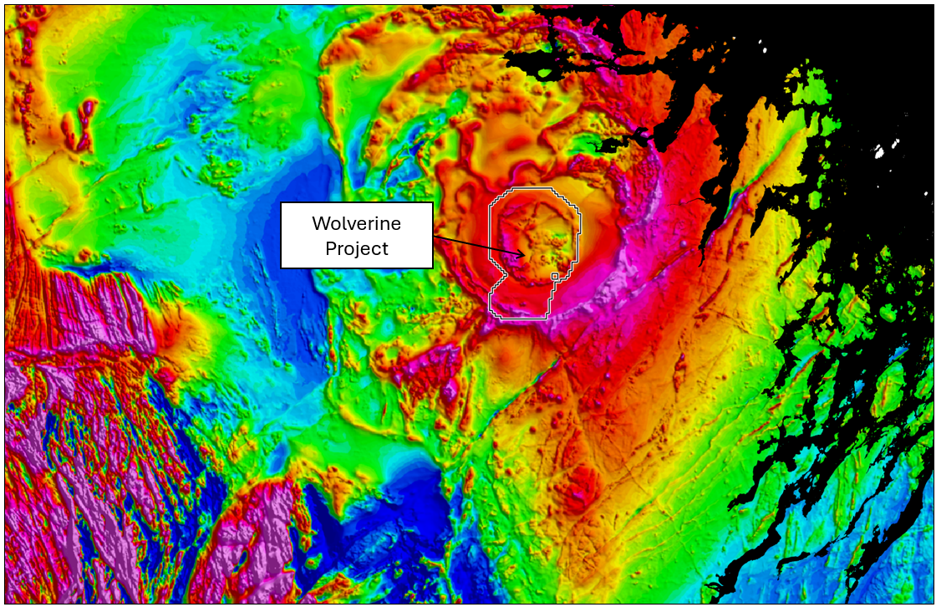
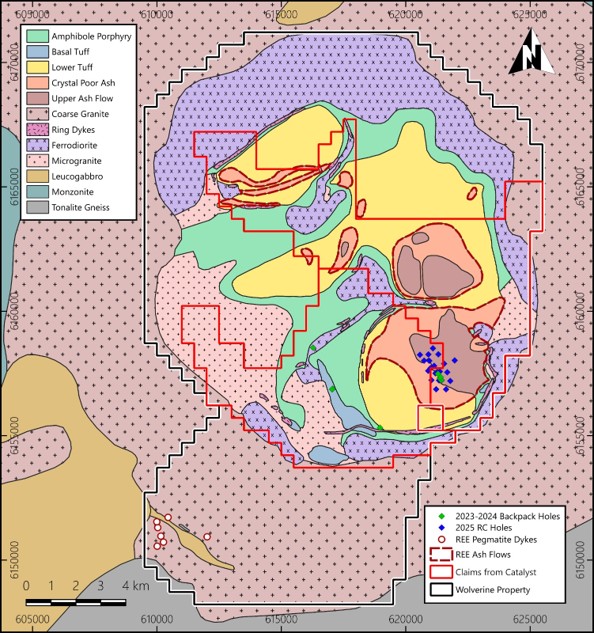
In 2025, reverse circulation (RC) drilling confirmed broad, near-surface REE mineralisation across a 1.7km by 1.2km area hosted within a significant peralkaline caldera system.
At the same time, 537 samples returned consistent mineralisation, supporting strong continuity across the drilled footprint.
Key intercepts included WOLRC25-003: 48.8 m @ 0.77% total rare earth oxides (TREO) from 1.5 m, including 18.3 m @ 1.06% TREO; WOLRC25-006: 38.1 m @ 0.71% TREO from surface, including 4.6 m @ 1.53% TREO; and WOLRC25-002: 51.8 m @ 0.52% TREO from surface, including 33.5 m @ 0.67% TREO.
Peak assays reached 2.03% TREO, with an average heavy rare earth oxides (HREO) contribution of 28%, highlighting strong heavy rare earth enrichment.
The timeline
Stier says that while they don’t currently have a resource on the project, there is “significant enough data” to model in-house.
“We are going to do a major drill program this summer in order to put out a maiden mineral resource estimate within the next six months,” he says.
“We’ve identified more than 26km2 of mineralised potential which we can go after in terms of trying to define a larger scale system.
“The plan is to do a 4,000m drill program in the heart of the main zone, plus some prospecting and further analysis of the remainder of the 26km2.”
“The target this summer is to garner additional data to beef up the data we already have into a more robust resource.”
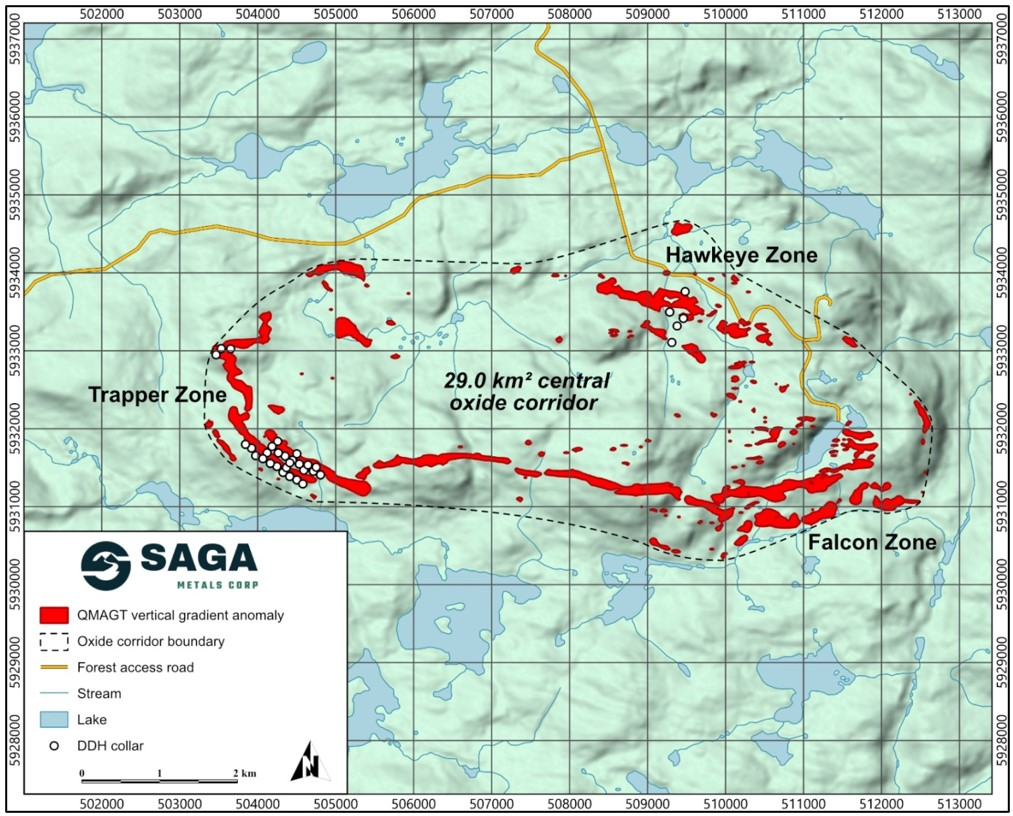
Aside from Wolverine, SAGA Metals has five other projects, including the Radar Titanium Project, also in Canada’s Labrador region. The Radar Project hosts a 29km² central oxide corridor with significant infrastructure in place. The company is also advancing a maiden mineral resource estimate for the Radar Project with more than 20,000m of drilling nearly complete.
In April, it received C$225,000 ($229,331) under the Junior Exploration Assistance (JEA) program to advance mineral exploration across Newfoundland and Labrador, focusing on new discovery and development of projects toward defined mineral resources.
“We are a diversified critical minerals company. We are that one-stop shop and we’ve done a great job of proving to the market we are able to advance multiple projects at one time,” Stier says.
“In the next six to nine months we hope to have two resources on two projects.”
Write to Christine Retschlag at Mining.com.au
Images: SAGA Metals


