


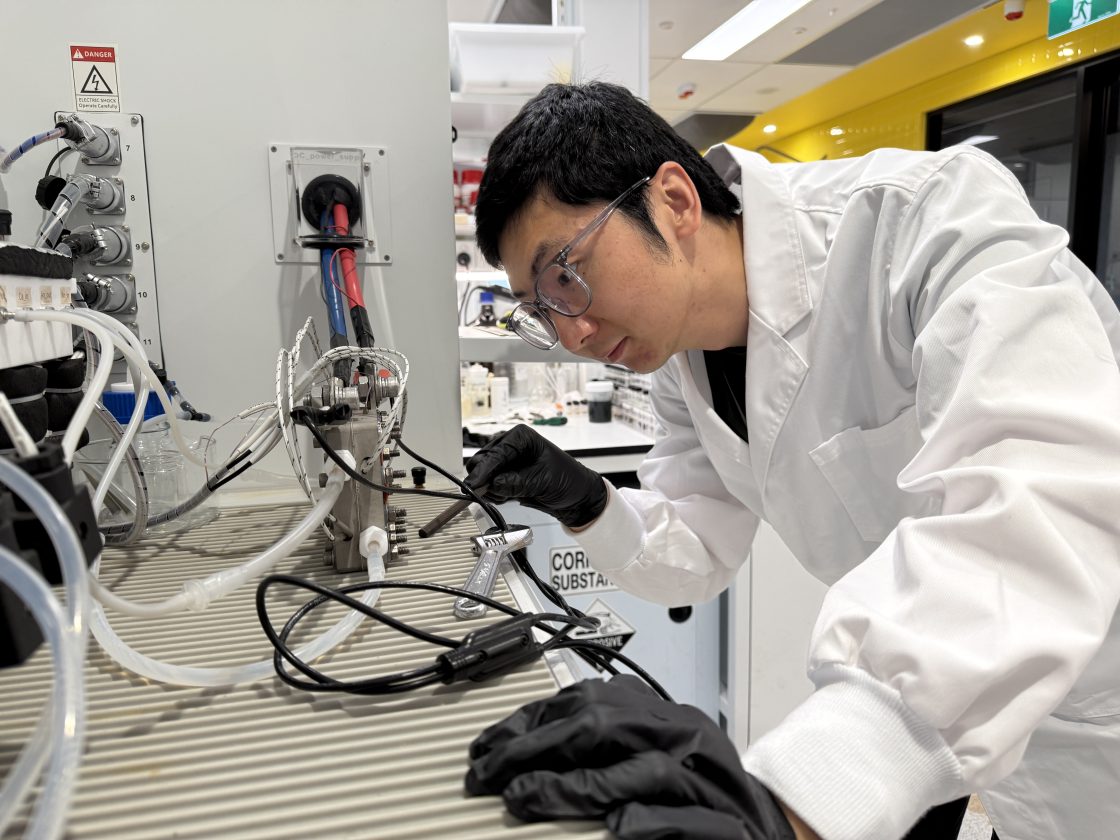
Adelaide University researchers have developed a ‘simple and scalable’ way to generate hydrogen with impure water, such as seawater and industrial wastewater.
Hydrogen is currently generated via electrocatalysis which requires pure water. In a dry country such as Australia, the problem is to access that water. In impure water form, especially seawater, contaminants such as magnesium, chloride, and calcium ions quickly destroy the electrocatalytic system.
Adelaide University has developed a protective coating for the catalysts in electrocatalytic systems that act like a smart gate.
The coating, a type of polymer called an ionomer, lets through the ions necessary for the electrolysis of water, but blocks the harmful ions that attack and destroy the catalysts and the electrocatalytic system.
Ionomer is an ion-conducting polymer typically used as a binder or glue to hold catalyst particles together or to improve mechanical contact within the electrode.
Lead author and ARC Centre of Excellence for Carbon Science and Innovation (COECSI) research fellow Feiyue Gao says this approach lets seawater-fed electrolysers run for over 1500 hours with durability comparable to pure-water systems.
“We have gone beyond proof of concept. Our system works. The remaining challenges are to optimise long-term stability, scalability and system integration to meet commercial requirements,” Gao says.
“At the same time, our results highlight an opportunity for the field to develop next-generation ionomers with even better selectivity and durability.”
Hydrogen is considered crucial to carbon intensive industries, such as mining, steel making, and fertiliser production. Use of green hydrogen, produced using renewable energy to split water via electrocatalysis, is considered a way to help such industries decarbonise.
In recognition of Clean Energy Day (26 January), the Association of Mining and Exploration Companies (AMEC) acting CEO Neil van Drunen told this news service there is no easy fix to solve the decarbonisation battle.
“And it’s not an easy equation for complicated mining operations,” van Drunen says.
Remote locations, energy-hungry processes, and the need for reliable power make rapid decarbonisation a formidable challenge.
For instance, the stakes are high for uranium miners – not only to cut their own emissions, but to help supply one of the world’s most powerful low-carbon energy sources.
Bruce Lane, CEO of American Uranium (ASX:AMU), says the company’s focus on in-situ recovery (ISR) already gives it a lower footprint than conventional mining methods, but acknowledges there is more work to do.
“For uranium miners like us, ISR already offers a much lower footprint than most conventional mining methods, but further reductions in diesel use, electricity sourcing, and emissions from drilling and exploration still present opportunities,” Lane tells Mining.com.au.
Write to Aaliyah Rogan at Mining.com.au
Images: Adelaide University


