

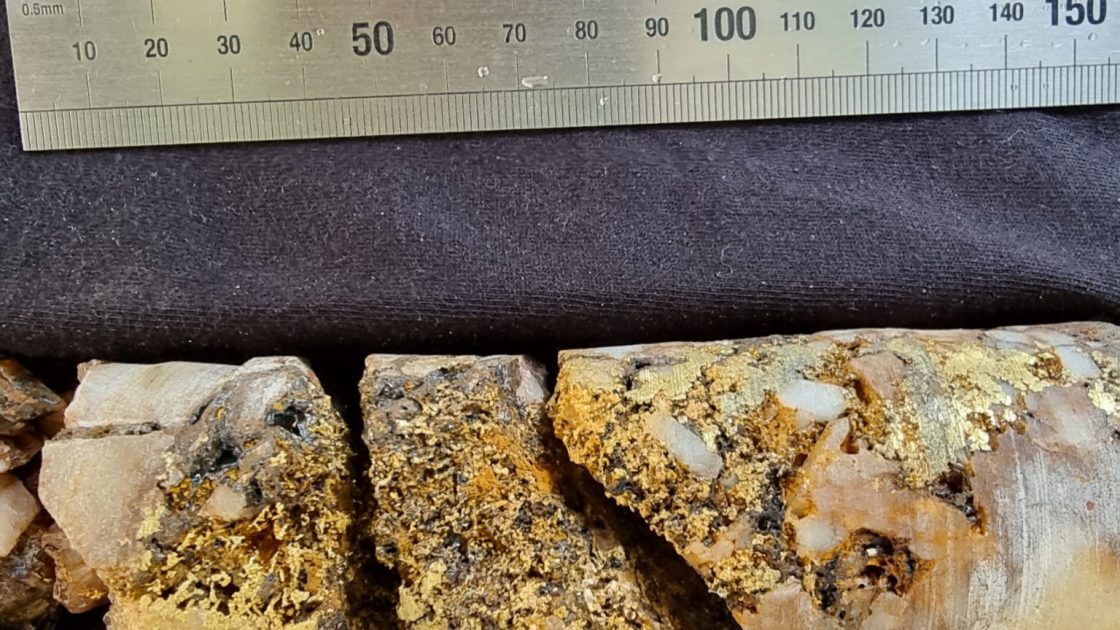
Peregrine Gold (ASX:PGD) has identified auriferous paleo gravels extending up to 4km south of the Peninsula Prospect at its Newman Gold Project in Western Australia.
Following the results, the company has lodged a mining lease application MLA 52/1097 covering 202 hectares over the newly named Capricorn Prospect, immediately south of the Peninsula Prospect.
Initial bulk sampling of seven 500kg gravel samples confirmed gold particles in panned concentrates up to 120m south of a previously mapped auriferous quartz vein. The company completed systematic geochemical sampling across the paleo gravels with 61 channel samples collected at 100m spacings.
Results from 36 samples show gold values ranging from below detection to 6,344 parts per billion (ppb) in fine fractions, with coarse fraction results up to 2,000ppb. The remaining 25 samples are with the laboratory.
Mapping suggests the paleo gravels range from 43m to 185m wide, with an average thickness of 1m. The gravels comprise poorly sorted material ranging from cobble to clay size within the flood plain of the main creek running north-south through the Peninsula Prospect.
Technical Director George Merhi says the discovery highlights a new zone of potentially significant near-surface gold mineralisation that could provide a low-cost pathway to early-stage gold extraction.
“The identification of auriferous paleo gravels extending over a 3–4km corridor south of the Peninsula Prospect highlights a new zone of potentially significant near-surface gold mineralisation that if confirmed with further testing, could provide the company with an additional, potentially low-cost pathway to early-stage gold extraction,” Merhi says.
The company notes both fine and coarse gold particles in pan concentrates, necessitating bulk sampling to estimate grade and gold particle size distribution. Follow-up bulk samples will also test the suitability of dry blowing as a processing technique.
Dry blowing is a processing method that does not require grinding, water, reagents, or wet tailings. Peregrine says it may support lower-cost processing.
“It is highly unusual for such a large spatial dispersion of anomalous gold in gravel not to have a primary bedrock source in close proximity. We expect to evaluate the potential for concealed bedrock sources of gold in the process of exploiting this paleo gravel system,” Merhi says.
Peregrine Gold plans to receive the remaining geochemical results, undertake additional bulk sampling, trial dry processing of the paleo gravels, and prepare a mining development and closure proposal for small mining operations, subject to program of work and heritage approvals.
The company holds the Newman Gold Project through exploration licences E52/3850, E52/3396, and E52/3370 via subsidiary Pilbara Gold Exploration.
Write to France Pinzon at Mining.com.au
Images: Peregrine Gold