



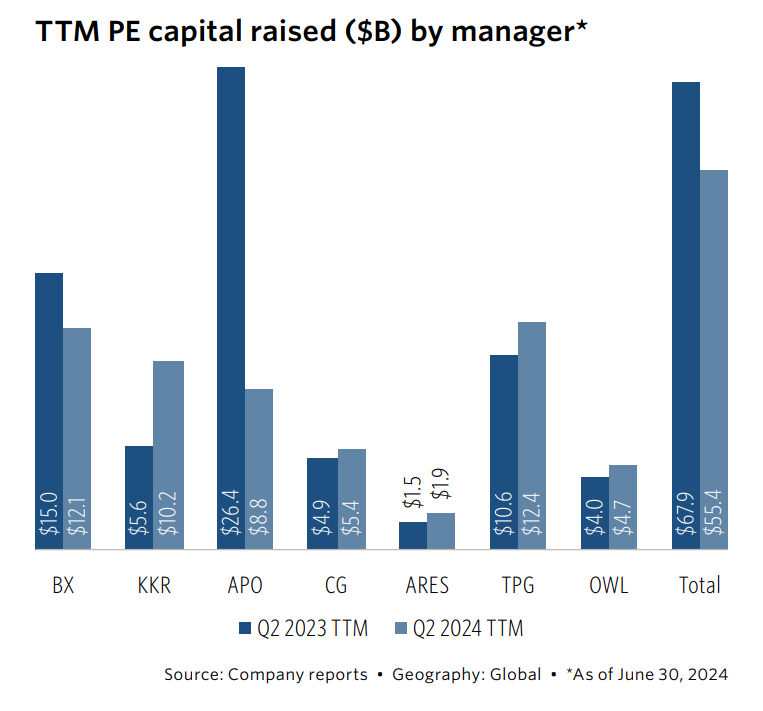
Private equity fundraising in Q2 2024 moderated from a bounce in the previous quarter but remains ahead by 9.5% year-to-date, with Blackstone bucking the trend to remain in the market, according to the latest data from PitchBook.
Most PE managers wrapped up fundraising efforts towards the end of last year or early 2024, the Q2 2024 US Public PE and GP Deal Roundup reports.
Blackstone is the exception and remains in the market with its Fund IX, which just crossed its US$20 billion ($29.42 billion) target and recently activated its investment period where it’s seeking to raise additional capital.
Blackstone led Q2 2024 fundraising with $39.4 billion, representing a 15.7% increase from Q1.
The PE firm’s credit and insurance segment led all inflows, which PitchBook reports totalled $18.6 billion in the quarter, “driven primarily by the $8.3 billion raised for its direct lending strategy”. The second-best segment for inflows in the quarter was Global PE, totalling $12.1 billion, with infrastructure and real estate fundraising leading the way.
Blackstone has launched or expects to launch fundraising in the next few quarters for the new vintages in several strategies, including successors for its $5 billion life sciences fund, $9 billion private credit opportunistic strategy, $22 billion PE secondaries fund, and $6 billion PE Asia fund.
An active fundraising quarter
Meanwhile, KKR is reported to have raised $32.4 billion during the second quarter – an increase of 6% sequentially and 153.7% higher year-on-year (YoY).
“This pushed the TTM total to $106.6 billion, up nearly 100% YoY. Q2 was the second-most-active fundraising quarter in KKR’s history. Unlike recent quarters where credit fundraising accounted for the lion’s share of fundraising, real assets took the crown in Q2, raising $18 billion or 55.6% of the quarter’s capital,” according to the Q2 Roundup.
“Real assets increased as the firm launched Global Infrastructure Investors V, which has already raised $8.3 billion. Credit was responsible for $12.3 billion of inflow in the quarter, accounting for 38.0% of capital raised.
“Apollo saw record inflows in the first quarter of $39.8 billion and followed it up in Q2 with $39.0 billion. This record-level fundraising from Apollo comes in a ‘non-PE’ year for the firm after wrapping up its flagship buyout Fund X late in 2023.”
Trailing 12-month (TTM) fundraising for the firm is 11.5% ahead of the prior corresponding period. PitchBook notes second quarter fundraising included a record amount of third-party capital raised in yield and robust hybrid inflows.
“Some of the more significant drivers by strategy included ABF, large-cap direct lending, opportunistic credit, and infrastructure equity. For Ares, the second quarter was the firm’s best in its history, with $26 billion of gross capital inflows, bringing YTD fundraising to $43 billion,” the Roundup adds.
“A driver of this record activity was the closing of its third US Senior Direct Lending fund (SDL), with $33.6 billion of investment capacity, and is roughly double the total investment capital raised in SDL II.
“SDL III raised $6.4 billion of capital in Q2 and an additional $1.8 billion in July. In addition, the firm priced five new CLOs (collateralised loan obligations) in Q2. YTD, Ares has priced seven CLOs, raising $3.6 billion and exceeding its full-year record of seven CLOs for $3.3 billion in 2022. For the remainder of the year, Ares expects to have 35 funds in the market across 17 strategies and will continue to see strong inflows.”
Carlyle is reported to have added $12.4 billion of assets in the second quarter – more than double the total inflows seen in Q1 2024. The previously firm stated at the beginning of 2024 it had a goal of $40 billion in total fundraising for 2024. After the first six months of this year, Carlyle is on track having raised $17.8 billion so far.
Like Q1 2024, global solutions fundraising remains a key driver, which PitchBook says is supported by demand for Carlyle’s secondaries and co-investment fund.
The firm is also “very active in fundraising within credit, raising $5 billion in the quarter, and capped off one of the busiest first six months in its 20-plus year CLO history”.
Fort Worth, Texas-based TPG, meanwhile, raised $6.3 billion in Q2, with more than 70% of capital raised (or $4.5 billion), across its credit strategies. This activity was headlined by the final close of US direct lender Twin Brook’s fifth drawdown fund, raising $3.9 billion.
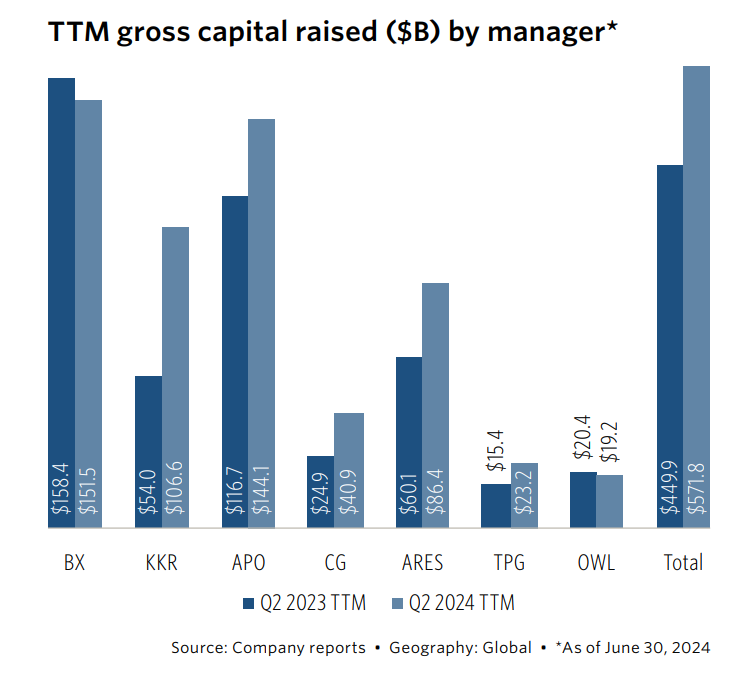
Asset management firm Blue Owl on the other hand raised $5.4 billion in Q2, up 13.9% sequentially and up 88.6% YoY. TTM fundraising of $19.2 billion was also up sequentially but down 5.9% YoY. Credit led the way for Blue Owl fundraising, raising $3.6 billion in the second quarter.
“The strategy was primarily driven by its diversified and first-lien lending strategies, of which $1.7 billion came from its nontraded business development company (BDC) OCIC,” PitchBook adds.
“Liquid credit and GP lending secondaries were other drivers in credit. Blue Owl also saw fundraising activity in its nontraded REIT, ORENT, increase as Q2 flows were 130% higher than a year ago.”
Founded in 2016, Blue Owl Capital is a New York-based asset management firm that focuses on private equity, real estate, debt, and secondaries asset classes across North America and Europe. In October 2021, Blue Owl Capital acquired Oak Street Real Estate Capital.
According to PitchBook’s Q2 2024 US Public PE and GP Deal Roundup, through the end of the second quarter, Blackstone’s Fund IX raised $20.1 billion. Other firms are focusing their PE fundraising on sub-strategies such as Asia-Pacific or middle-market funds.
“However, KKR is bucking the trend and re-entering the market for its next vintage flagship buyout fund”
“However, KKR is bucking the trend and re-entering the market for its next vintage flagship buyout fund. In June, KKR launched its 14th North America flagship fundraise, seeking $20 billion in capital. Looking at the second quarter, PE fundraising for KKR was driven primarily by its perpetual capital K-Series suite discussed below,” PitchBook reports.
“Also, within PE, the firm’s middle market strategy, called Ascendant, has already achieved its fundraising goal of $4 billion and has not yet held its final close. The fund is approaching its $4.6 billion hard cap and is cutting back on allocations to investors as a result.”
Like several of its peers, PitchBook notes TPG is not in the market with its flagship buyout however, the firm expects total PE and infrastructure fundraising in 2024 to grow compared to the $12.8 billion it raised in 2023.
This growth is expected to be driven by TPG’s ongoing campaigns for its Growth and Rise Climate funds and the launch of its climate transition infrastructure strategy.
“Moreover, its recently closed flagships, TPG IX and Healthcare Partners II, have combined to have signed or completed 10 investments and have deployed nearly 50% of the capital raised for the two vehicles,” the Roundup notes.
As a result, the successor funds of TPG X and Healthcare Partners III will likely be back in the market, raising sometime in H1 2025.
PitchBook goes adds that while Carlyle is not in the market with its flagship buyout fund, it remains focused on areas such as Asia. In Japan, Carlyle closed its fifth Japan buyout fund in Q2 2024, which is some 70% larger than its predecessor.
Carlyle’s Global Private Equity business is one of the world’s largest and most diversified PE platforms, spanning various industries, geographies, and strategies.
“Apollo closed its tenth flagship buyout fund at $20 billion in Q3 2023 and does not plan to launch the next vintage this year. However, the firm did say that based on how deployment for Fund X is tracking, it expects that by the end of next year, the fund will be largely deployed and look to launch fundraising for Fund XI,” PitchBook reports.
“Ares remains out of the market with its flagship buyout fund. The only capital in the firm’s PE group was for its PE secondaries group, which raised $400 million.
“Blue Owl does not operate a traditional PE strategy like its peers. However, its GPSC funds—formerly known as Dyal Capital—have a 10-year track record of buying GP stakes in private market fund managers, half of which are PE managers.
“For GPSC, Blue Owl raised $1.3 billion in Q2 across its large cap strategy and co-investment vehicles. Additionally, for the firm’s latest GP Stakes fund, total invested commitments, including agreements in principle, are more than $11.5 billion of capital, with a line of sight into more than $3 billion of opportunities.”
Blue Owl closed on an additional $1 billion for the latest vintage of the strategy in Q2 and anticipates that fundraising in Q3 2024 for the vehicle could be similar to Q2 based on current visibility.
However, PitchBook notes Blue Owl is seemingly not concerned with the timing of closes quarter-to-quarter and remains confident in achieving its $13 billion goal over the next 18 months.
In Q2, gross inflows across all strategies and seven firms totalled almost $161 billion, representing a sequential increase of 17.8% and an increase of 50.8% year-on-year. Year-to-date, fundraising increased by 43.7% versus YTD 2023.
“Adjusting for the acquisition of Angelo Gordon, we estimate that fundraising grew by 40% on a like-for-like basis,” PitchBook adds.
“Credit strategies accounted for 58% of all capital raised in Q2, a drop from the 69.8% seen last quarter, but by far and away still the most sizable driver of inflows for these firms.
“After accounting for nearly the same share of fundraising in Q1, real estate fundraising accounted for 21.2% of all Q2 inflows, while PE represented 11.6% of Q2 inflows, with other strategies making up the remaining 9.2%.
“On a TTM basis, fundraising continues to increase, totalling $571.8 billion across these managers, up substantially from the TTM fundraising of $449.9 billion for the TTM period ended Q2 2023.”
Write to Adam Orlando at Mining.com.au
Images: iStock & PitchBook


