



Vancouver-based explorer Opawica Explorations (TSX-V:OPW) has intersected wide zones of gold, including visible gold, in recent drilling at its Bazooka Property in Québec.
The company reports an intercept of 76m from a depth of 285m down to 361m, where it contacts with a graphitic horizon up to 2m in width.
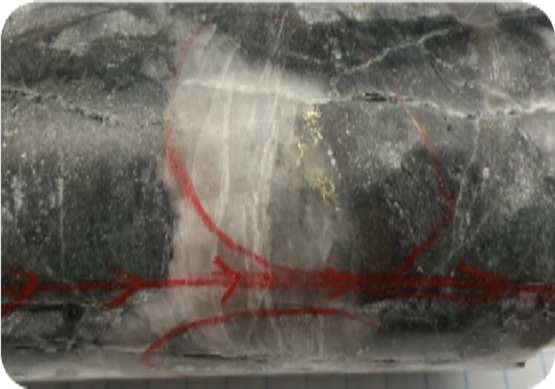
Visible gold was observed within the interval at a depth of 348.5m, along with consistent occurrences of arsenopyrite, fuchsite, and quartz veining – indicators of the potential presence of gold mineralisation – throughout.
The Cadillac-Lake Larder Fault Zone, also known as the Cadillac Break, is located in a region hosting several multi-million ounce gold deposits.
The fault zone is a 150m wide major structure that controls the location of gold deposits within the Abitibi Greenstone Belt, which extends from Quèbec into neighbouring Ontario and has produced over 200 million ounces of gold since the early 1900s.
Opawica’s project is located in the Rouyn-Noranda region of the Abitibi Gold Belt in Québec.
The junior explorer, which has a market capitalisation of C$5.3 million ($6 million), has so far drilled 2,000m across 10 holes, with 610 core samples submitted for assaying.
CEO Blake Morgan says it is encouraging to encounter visible gold at such an early stage of the program.
Opawica notes that of the 10 drill holes completed, the Cadillac-Larder Fault was intersected multiple times, revealing “promising mineralisation” that enhances the company’s understanding of local mineralisation patterns.
Earlier in April, the company reported results of 118.5m @ 2.20% arsenic, 190 parts per million (ppm) gold, 1,061ppm nickel and 4,117ppm chromium from x-ray fluorescence (XRF) readings.
XRF is a non-destructive analytical technique used to determine the elemental composition of materials such as drill core.
Analysers determine the chemistry of a sample by measuring the fluorescent (or secondary) x-ray emitted from a sample when it is excited by a primary x-ray source.
The results only provide an indication of the amount of minerals present. Certified assaying of the core samples is still required to accurately determine the amount of base metal and precious metal mineralisation.
The results confirmed Opawica’s expectations of both mineralisation and width.
“Based on previous data and past results, the team was confident that we could find significantly thicker intercepts, and that expectation has been confirmed,” Morgan said earlier in April.
“With over 10,000m of high priority targets on the Bazooka Property and 10,000m of high-priority targets at Arrowhead, we still have a long way to go.”
Opawica has a portfolio of precious and base metal properties within the Rouyn-Noranda region of the Abitibi Gold Belt in Québec.
Write to Angela East at Mining.com.au
Images: Opawica Explorations


