Gold steadied on Wednesday after softer-than-expected US inflation data reduced some of the pressure for another Federal Reserve interest rate hike in October.
Spot gold rose as much as 0.7% to move back above US$4,200 ($6,041) per ounce before easing, while US gold futures held gains above US$4,240 per ounce.
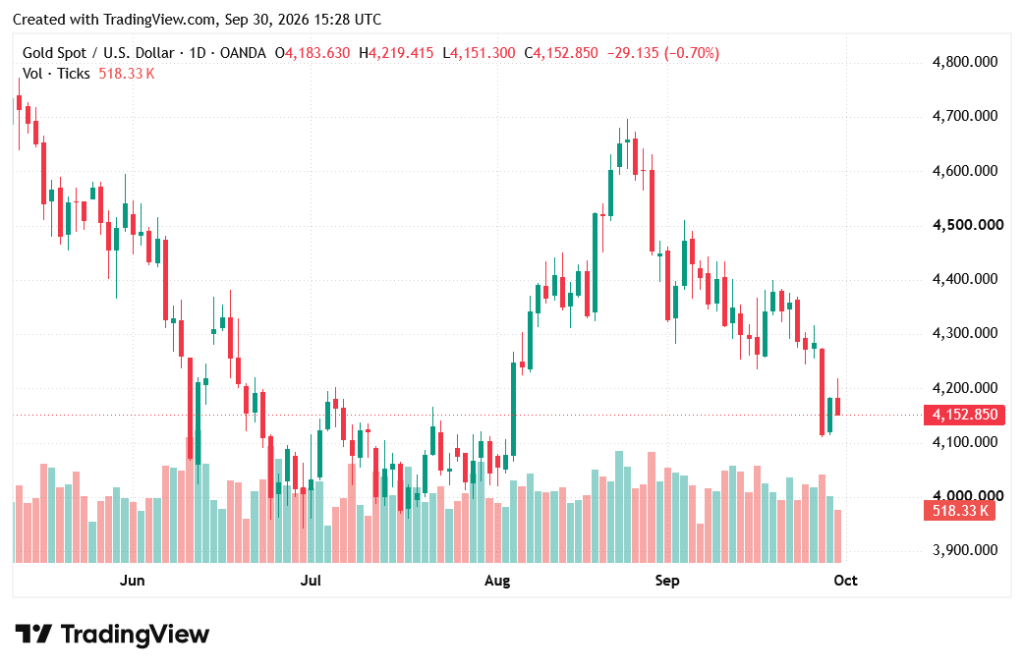
Despite the rebound, bullion remains on track to finish September around 5% lower after the Federal Reserve’s first rate hike since 2023 weighed on the metal.
The move followed the release of the US Personal Consumption Expenditures (PCE) price index, which rose 0.3% in August. Annual inflation came in at 3.4%, while core PCE rose 0.2% for the month and 3% year-on-year, data from the Bureau of Economic Analysis also showed.
The softer annual and core readings reduced expectations of another rate hike at the Fed’s October meeting.
“This is good news for investors worried about the recent surge in bond yields, and it bolsters the case for not hiking in October,” TradeStation Global Head of Market Strategy David Russell tells CNBC.
The US dollar also extended its losses after the data, making gold cheaper for buyers using other currencies.
“Core PCE a tenth below consensus, and a lower revision of last month’s figure, have boosted gold and may have put a short-term bottom at US$4,100, which was Monday’s low,” says independent metals trader Tai Wong.
“The Fed is explicitly focused on inflation right now, and this should further reduce the likelihood of an October rate hike,” Wong tells Reuters.
Markets lowered the probability of an October rate increase to around 37% following the data, from about 45% beforehand, according to CME’s FedWatch Tool.
New York Fed President John Williams also said on Tuesday that one more rate increase later this year may be appropriate, but indicated there was no urgency to move again immediately.
Longer-term demand supports gold
Tighter monetary policy has pushed long-dated government bond yields higher, increasing the opportunity cost of holding gold.
The yield on the 30-year US Treasury reached its highest level since 2002 on Tuesday, while the 10-year yield climbed to its highest since 2007.
Despite those headwinds, demand from longer-term investors has remained resilient. Holdings in bullion-backed exchange-traded funds have increased by around 63 tonnes this month, according to Bloomberg data.
Demand from long-term investors and central banks has offset some of the bearish macroeconomic factors, leaving gold “without a clear directional catalyst”, Macquarie Group (ASX:MQG) analysts wrote in a note cited by Bloomberg.
Several major banks also remain constructive on gold over a longer horizon.
BMO Capital Markets recently joined others in saying gold could continue rising even in a tightening environment as concerns over sovereign debt and monetary debasement provide longer-term support.
Goldman Sachs (NYSE:GS), meanwhile, has maintained its end-2027 gold target of US$5,400 an ounce despite revising down its end-2026 target.
Junior gold explorers show resilience
While bullion has fallen sharply in September, some gold equities have shown greater resilience.
The VanEck Junior Gold Miners ETF (NYSEARCA:GDXJ), for example, remains higher for the year, highlighting continued investor interest in junior gold companies despite the recent pressure on bullion.
Against that backdrop, several Canadian explorers are continuing efforts to expand existing discoveries and identify new gold mineralisation.
Opawica Explorations (TSX-V:OPW) reported ‘high-grade’ results from its Bazooka property in Québec’s Abitibi Gold Belt in 2025.
The project is adjacent to Agnico Eagle’s (TSX:AEM) Wasamac gold project, which contained 1.38 million ounces of probable gold reserves at the end of 2025.
Historical drilling at Bazooka between 2003 and 2005 returned gold grades as high as 316.23 grams per tonne over 1m, according to Opawica.
More recent drilling reported 19 gold-mineralised zones, with 15 returning grades above 0.55g/t gold (Au) and reaching as high as 6.12g/t Au. Opawica says around 7,000m of high-priority targets remain to be explored, while nearly 80% of the property remains undrilled.
Signature expands Lingman Lake
In neighbouring Ontario, Signature Resources (TSX-V:SGU) is focused on expanding its Lingman Lake Gold Project in the Red Lake district.
The company reported final results from its 2025–26 drilling program, which it says improved its understanding of the deposit’s mineralisation and highlighted areas that remain open for further exploration.
Signature’s updated geological model suggests gold mineralisation at Lingman Lake is more widespread than previously thought, with earlier exploration in the region largely focused on smaller, high-grade, near-surface deposits.
The project’s initial mineral resource estimate contains 95,200 ounces of indicated gold at 1.38g/t Au and 674,320 ounces of inferred gold at 1.14g/t Au, totalling around 770,000 ounces.
With gold facing near-term pressure from elevated interest rates but longer-term demand supported by central bank buying and concerns over sovereign debt, exploration companies continue to target new ounces that could benefit from renewed strength in the precious metal.
Write to Jackson Chen at Mining.com.au
Main Image: Pixabay