

Copper explorer Odin Metals (ASX:ODM) has expanded the geophysical signature strike length at its Koonenberry Copper Project in New South Wales by 6km through geophysical work programs.
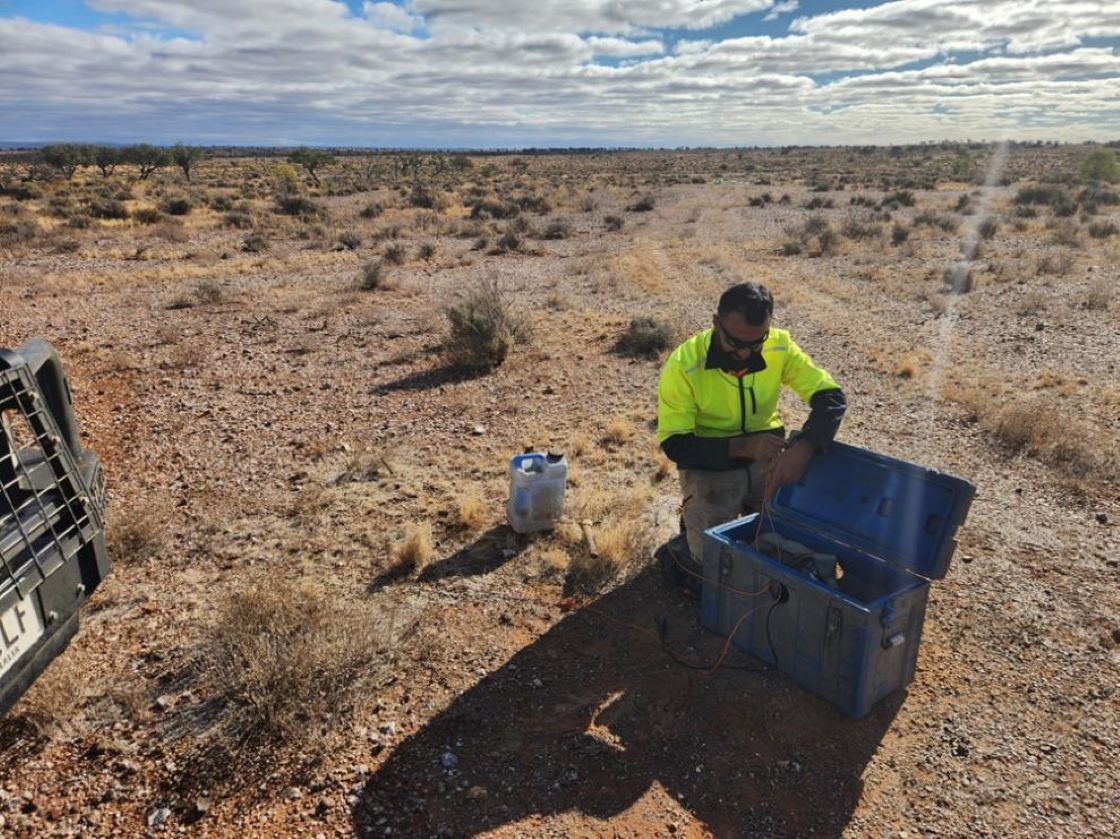
The $11.98 million market capitalisation company reports a controlled source audio-frequency magnetotellurics (CSAMT) survey was undertaken in May and June 2023 to identify zones of sub-surface electrical resistivity and conductivity, representing silica and clay alteration related to mineralised systems.
Initial surveys conducted by Zonge Geophysical confirmed the geophysical response on sections where historical mineralised intercepts included GSRD029, which returned 9m @ 4.38% Cu from 46m, and GSRD042, which recorded 7m @ 3.04% Cu from 53m.
Odin says the results of the CSAMT are ‘encouraging’ as they have defined several contiguous linear kilometre-scale, resistive zones. These CSAMT signatures are vertically ‘extensive’ on several of the survey lines and remain open in all directions.

The company reports a 2,000m to 3,000m reverse circulation (RC) drilling program is being designed to test the geophysical signatures defined by the CSAMT survey, and further regional soil sampling will be undertaken on parallel structures.
Odin will also be investigating the possibility of using further CSAMT surveys to extend and define the Wilandra Copper Corridor and is also considering the suitability of various other geophysical exploration methods to delineate further mineralised trends across its prospects.
Commenting on the findings of the CSAMT survey, Odin Metals Executive Chairman Simon Peters says: “Odin has now identified multiple targets, effectively increasing the number of potentially mineralised structures over a strike length of 10km.
“Odin has now identified multiple targets, effectively increasing the number of potentially mineralised structures over a strike length of 10km”
HeliTEM and soil anomalies highlight an additional 20km of potential strike extents. The existence of parallel CSAMT signatures coincident with soil anomalies is highly encouraging.
Odin will now advance these targets towards drill testing, with future soil geochemistry and CSAMT work to the north being scheduled as well. The results of this latest work by Odin provide further encouragement that additional mineralisation and targets will be identified in the remaining 20km of underexplored corridor, which incidentally sits within the 175km long Koonenberry ground held by Odin.
Odin’s work continues to enhance the prospectivity of the Koonenberry region in Western NSW, providing all of Odin’s shareholders with multiple opportunities to participate in a new significantly sized copper, nickel, and other base and precious metals discovery.”
Odin says the geophysical programs completed during May and June 2023 focused on a 10km section of the larger 30km Wilandra Copper Corridor, which is part of the broader 175km Koonenberry fault system with the company’s tenure.
Odin Metals is a Melbourne-based copper explorer that holds the Koonenberry Project, which covers 3,300km-square across 10 exploration licences and 2 exploration licence applications in Western New South Wales.
The project features more than 175km strike of the Koonenberry Belt, which is considered ‘highly prospective’ for volcanogenic massive sulphide (VMS)-hosted copper-zinc-silver-gold, magmatic nickel-copper-platinum group element (PGE), epithermal silver-lead-copper, and orogenic gold.
As of 31 March 2023, Odin had $3.52 million cash at hand, according to its latest quarterly report published on 28 April 2023.
Write to Harry Mulholland at Mining.com.au
Images: Odin Metals Ltd