We may be weeks away from witnessing one of the biggest IPOs in history.
Anthropic, the company behind the Claude AI platform, is reportedly preparing for its long-awaited public debut. Bloomberg reports it could begin formally marketing the offer as soon as the week of 9 November.
The company is seeking a valuation of around US$2 trillion ($2.87 trillion). That would place it among the world’s most valuable publicly traded companies and potentially make the offering the largest IPO on record.
Whether that valuation is warranted remains up for debate, but it highlights the scale of investor appetite for sectors expected to benefit from rapidly growing electricity and computing demand.
Case in point: Anthropic was valued at US$965 billion in its most recent private funding round in May.
While the San Francisco-based AI giant is getting all the investor hype, another potential IPO that has attracted attention for its soaring valuation is Westinghouse Electric.
Westinghouse valuation surges
As a world leader in nuclear energy technology, Westinghouse represents a more established name with a much longer history than those in the AI space.
Founded in 1886 by inventor and industrialist George Westinghouse, the company later emerged as a pioneer of commercial nuclear power, developing pressurised water reactor technology that became widely adopted globally.
Westinghouse’s flagship AP1000 is a Generation III+ pressurised water reactor already deployed internationally. Its technology is also used across a large portion of the world’s operating nuclear fleet.
However, the company’s history has not been without problems. Cost overruns and delays at AP1000 projects in the US contributed to the company filing for Chapter 11 bankruptcy protection in 2017.
Brookfield Business Partners acquired Westinghouse the following year for US$4.6 billion. It then sold the company to a partnership involving Cameco (TSX:CCO) and Brookfield Renewable Partners (TSX:BEP-M) in 2023.
Cameco paid US$2.1 billion for its 49% interest, while Brookfield retained the remaining 51%.
That investment could now deliver a substantial return.
Bloomberg reported last month that Westinghouse is targeting a valuation of more than US$50 billion in a potential US IPO, with a public filing possible as soon as October.
At that valuation, Cameco’s stake in the company would be worth about US$24.5 billion — more than 10 times what the Canadian uranium producer paid for the stake three years ago.
The potential valuation also represents a significant increase from the roughly US$30 billion figure previously reported by Bloomberg.
Nuclear pipeline expands
The jump comes as Westinghouse looks to build a much larger pipeline of potential reactor projects.
Cameco says Westinghouse is pursuing opportunities involving as many as 91 AP1000 reactors globally, including projects in the US, Poland, Bulgaria, and Ukraine.
Washington is also providing financial support to accelerate the rollout.
In June, the US Department of Energy made a conditional commitment for up to US$17.5 billion in financing to support the purchase of long-lead equipment for as many as 10 AP1000 reactors.
While it remains to be seen whether Westinghouse ultimately achieves a US$50 billion valuation, the proposed listing comes amid growing confidence in the outlook for nuclear energy.
Thirty-nine countries now support a pledge to at least triple global nuclear capacity by 2050, according to the World Nuclear Association.
It estimates that meeting national targets could lift global nuclear capacity to around 1,457GWe by 2050. Achieving the broader expansion could require approximately US$6 trillion of investment.
That growth, however, raises another question: Where will the uranium come from?
Uranium moves to centre stage
The 2026 World Nuclear Symposium in London last month just reinforced that issue, according to Sprott analyst Jacob White.
“The central message from London was therefore that the industry is beginning to confront what it will take to deliver the targeted growth, and that uranium sits at the front of that process,” White wrote in a research note.
Even partial delivery of the industry’s nuclear ambitions would require a substantial increase in fuel production.
White notes that while conversion and enrichment capacity can be constructed, uranium mine supply remains constrained by geology, project economics, permitting, and lengthy development timelines.
Nuclear demand is already beginning to outrun new mine supply, with Benchmark Mineral Intelligence forecasting a uranium shortfall equivalent to 18% of demand by 2027.
Meanwhile, the OECD Nuclear Energy Agency and International Atomic Energy Agency estimate annual global reactor requirements could rise from around 64,500 tonnes of uranium today to as much as 143,900 tonnes by 2050.
The problem is timing.
Sprott highlights that uranium projects typically require 15–20 years to progress from identification through permitting and development.
Although sufficient uranium resources have been identified to meet projected demand through 2050, it says those resources cannot fuel reactors unless investment decisions are made well in advance.
“The issue is not an absence of uranium in the ground, but whether enough economic production can be brought online within the required timeframe,” White writes.
Contract coverage drops after 2030
That timing becomes increasingly important as utilities enter a new contracting cycle.
US and European utilities remain relatively well covered in the near term, but their contracted uranium supply drops sharply after 2030.
Sprott estimates maximum European uranium coverage falls from 100% in 2030 to just 36% by 2034, while US coverage declines from around 60% to only 9% between 2030 and 2033.
Because uranium must be contracted, mined, converted, enriched, and fabricated into fuel years before reaching a reactor, utilities will need to address those uncovered requirements well before the delivery dates arrive.
At the same time, greenfield uranium projects continue to face long permitting periods, rising construction and financing costs, and relatively few final investment decisions.
“We believe that this discipline means that materially greater production is likely to require utilities to offer higher prices, longer contracts and better terms,” White says.
Signs of that shift are already emerging.
Uranium is entering its seasonally active contracting period with the long-term uranium price reaching an all-time high of US$96 per pound, surpassing the previous cycle high set nearly two decades ago.
Sprott emphasises that the term price is particularly important for uranium miners because most uranium is sold through multiyear contracts between producers and utilities rather than through the spot market.
US government adds another buyer
Utilities may also face competition from a new source of uranium demand.
The US National Nuclear Security Administration (NNSA), which secures nuclear materials for military programs, is assessing purchases of domestically produced uranium beginning as early as 2030.
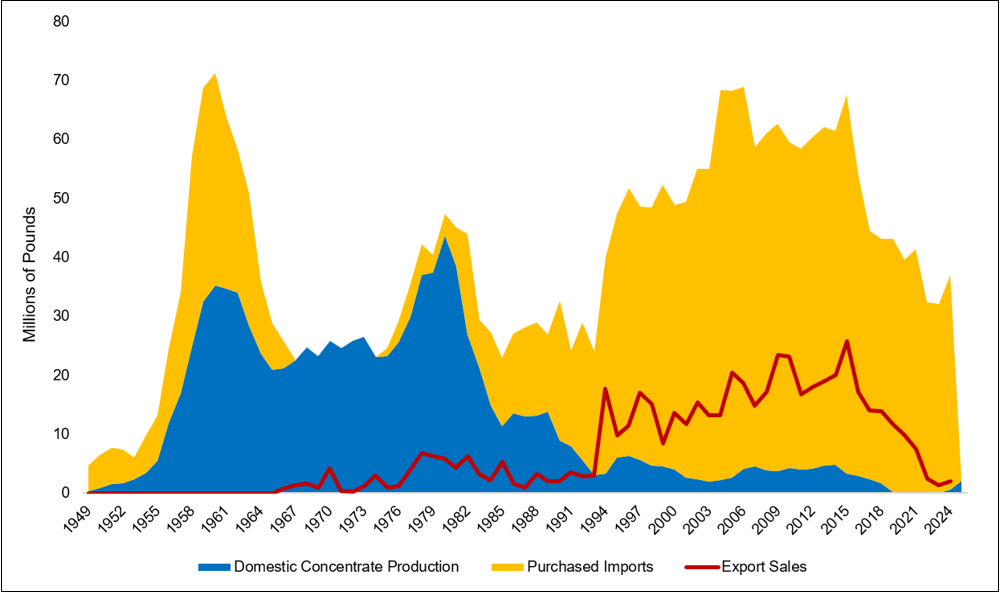
Sprott says the NNSA’s long-term requirement could reach approximately 4 million pounds of US-origin yellowcake (U₃O₈) annually for 10 years.
Imported uranium generally cannot satisfy those requirements because the material must be domestically sourced and free of foreign-use restrictions.
That annual requirement alone would represent roughly 100% of current US uranium production, potentially adding another buyer to an already tightening market.
The limited supply response to higher prices further highlights the challenge.
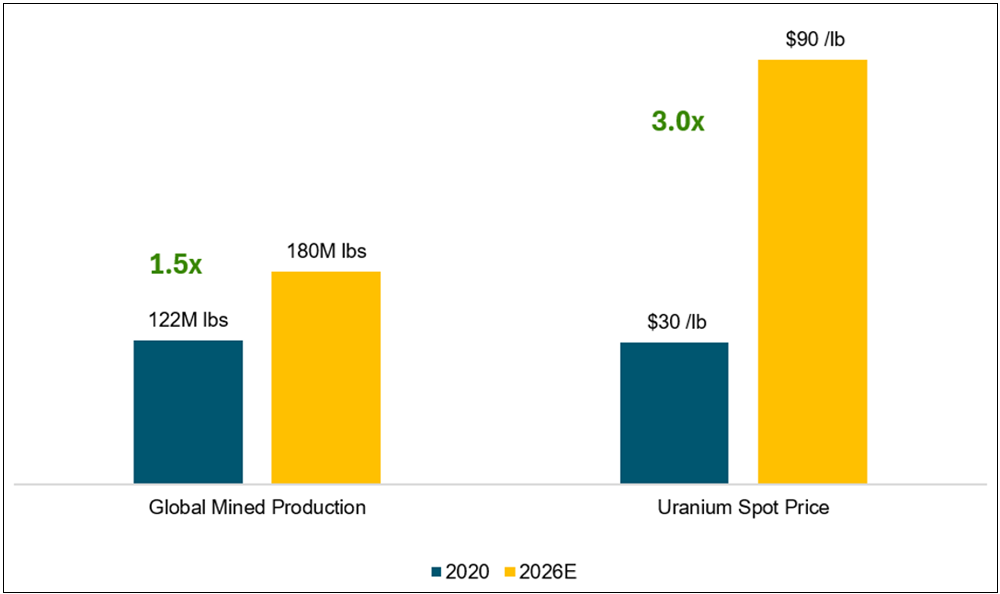
Since 2020, uranium prices have approximately tripled while global mine production has increased by only around 50%, with most of the additional supply coming from mine restarts rather than new projects.
“If uranium prices have tripled while mine supply has increased by only 50%, it raises an important question about the pricing and contract terms required for production to grow commensurately with a tripling of global nuclear capacity,” Sprott says.
The next phase of supply growth will therefore depend much more heavily on higher-cost greenfield mines.
Athabasca Basin takes focus
That brings the focus back to uranium producers such as Cameco, which has contracts requiring average annual deliveries of around 28 million pounds of U₃O₈ between 2026 and 2030.
Much of Cameco’s production comes from northern Saskatchewan, Canada.
Its Cigar Lake mine has produced around 174.5 million pounds of uranium since commissioning in 2014. Meanwhile, its McArthur River and Key Lake operations comprise the world’s largest ‘high-grade’ uranium mine and uranium mill, respectively.
All three sit within the Athabasca Basin, a region that accounts for around 13% of global uranium production and hosts some of the world’s highest-grade deposits, according to Natural Resources Canada.
With utilities approaching another contracting cycle and new mines requiring years to reach production, greenfield projects across the region could become increasingly important.
Earlier this year, Purecore Metals (CSE:PURE) optioned the large Yurchison Uranium Project, covering approximately 35,029 hectares near Cameco’s Rabbit Lake operation.
According to Purecore, Yurchison has decades of exploration history, with sampling that returned uranium values of 0.09–0.30% U₃O₈. To bring it up to date, the company is currently consolidating historical and modern geophysical data to prepare for the next phase of exploration.
The project was optioned from Skyharbour Resources (TSX-V:SYH), which already holds interests in 44 projects covering more than 682,000 hectares in the region. Its portfolio ranges from the more advanced Moore Lake and Russell Lake projects to earlier-stage exploration properties.
The company operates a prospect generator model to bring in partners like Purecore to advance some of its non-core properties.
Dark Star Minerals (CSE:BATT) is also targeting uranium projects with past exploration history in Saskatchewan, and one of those is Bleasdell Lake.
According to Dark Star, the property had seen extensive exploration in the past, including the discovery of a significant uranium deposit. About 620,700 pounds of U₃O₈ were historically delineated through an intensive drilling program.
This work, primarily conducted in the 1950s, focused on the Horn and Jackpine zones and was documented in a 1957 shareholder report that also included a resource estimate.
Historical drilling returned 2.56m @ 0.12% U₃O₈ within a 91m strike length and 1.21m @ 0.62% U₃O₈ within a 33.5m strike length, Dark Star says.
Nuclear capacity targets are rising, utility contract coverage is falling, and new uranium mines can take as long as two decades to develop. The next phase of the nuclear expansion will increasingly depend on whether projects such as these can move from exploration to production quickly enough to meet the coming demand.
Write to Jackson Chen at Mining.com.au
Main Image: Westinghouse