



Lefroy Exploration (ASX:LEX) reports it has intersected ‘significant’ copper mineralisation at its 100% owned Eastern Lefroy Gold Project, located 70km southeast of Kalgoorlie.
The recently drilled diamond hole LEFD008, located 1.5km north of the Burns gold-copper discovery intersected a 45m long interval of copper mineralisation between 130m and 275m, which contains a 42m length of hydrothermal breccia, which hosts extensive native copper and copper sulphides from 233m to 275m.
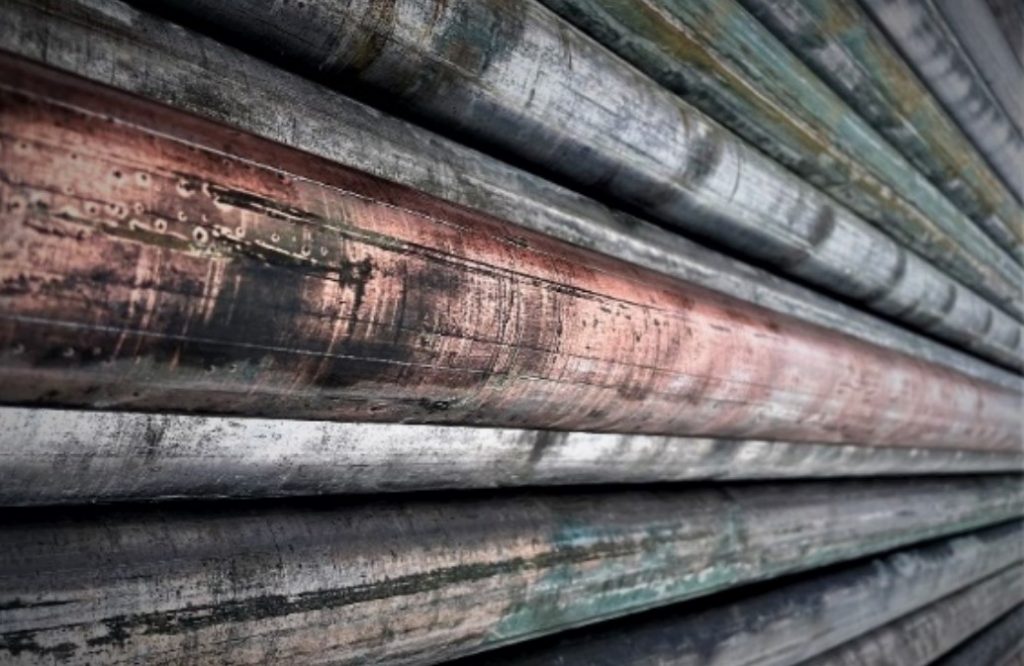
The intensity of native copper mineralisation in the breccia zone is further demonstrated by copper coating the outside of several steel drill rods from the drill string.
The breccia and native copper visuals at Lovejoy provide additional evidence that Burns and the surrounding prospects are all part of a very large, copper-gold intrusion related, hydrothermal system.
Lefroy reports LEFD008 samples have been submitted to the lab for priority assay to fast-track results, and the Company has acted immediately to advance this new discovery, with step-out hole LEFD009 underway.

Lefroy Exploration Managing Director Wade Johnson said this is a remarkable new discovery of copper mineralisation 1.5km north of Burns, which is open.
“With every hole drilled we advance and grow the overall Burns project.
“With every hole drilled we advance and grow the overall Burns project”
We believe the copper-rich breccia is a component of a larger magmatic system, the limits of which we are yet to define.
Lovejoy has always been a high priority target given its unique geophysical signature, as well as the significant results generated from LEFR297 in 2021 that ended in 1.5% copper at 258m.
We have acted immediately on this new discovery and while we eagerly await the assay results from LEFD008, we expect more encouraging visual results with follow-up diamond hole LEFD009.”
The fourth diamond hole, LEFD009 is underway, and is currently at 160m downhole (as of 19/09/2022).
The hole has a planned depth of 450m and is designed to intersect the down-dip extent of the broad copper rich breccia zone intersected in hole LEFD008. The collar position of LEFD009 is located 10m west of LEFD008.
LEFD009 is expected to be completed later this month, with assay results anticipated in November, dependent of laboratory turnaround.
Burns is a new and unique style of intrusion-related gold-copper-molybdenum-silver (Au-Cu-Mo-Ag) mineral system, hosted by Archaean age rocks in the Eastern Goldfields Province (EGP) of Western Australia.
The gold, copper, silver (and lesser molybdenum) mineralisation, which is hosted by multiple diorite-porphyry intrusives and high-magnesium basalt, is considered by the Company to be a new and unique style of gold-copper mineralisation.
Lefroy is aiming to advance the understanding of the scale and genesis of this system through its current, deep, diamond drilling program.
Three holes, LEFD006-008 have now been completed, with a fourth hole LEFD009 currently underway.
The Lovejoy prospect is the northernmost magnetic anomaly of a linear trend of discrete magnetic features, extending 200m northwest from Burns.
Each of the magnetic anomalies was evaluated by reverse circulation (RC) drillholes in 2021. All the RC holes intersected altered diorite and basalt, similar to that observed at Burns.
Lefroy reports the strongest alteration in dioritic porphyry was intersected in two RC holes completed at Lovejoy.
These holes, LEFR296 and 297 are located on the western margin of the Lovejoy magnetic anomaly on the edge of Lake Randal.
Hole LEFR297 intersected significant intervals of hematite-silica altered breccia and associated Cu-Au-Ag mineralisation.
The breccia, with angular basalt clasts in an intense hematite-silica altered matrix including strong fine disseminated magnetite and sulphides, was intersected from 228m to 250m.
Significant results from hole LEFR297 included:
- 10m @ 0.21g/t Au and 0.60% Cu and 2.5g/t Ag from 218m, including 2m @ 0.41g/t Au and 1.56% Cu and 5.5g/t Ag from 225m.
- 8m @ 0.22g/t Au and 0.51% Cu and 1.75g/t Ag from 250m to EOH, including 2m @ 0.67g/t Au and 1.53% Cu and 5.0g/t Ag from 256m to EOH.
Hole LEFR297 located on the edge of Lake Randall, was abandoned at 258m due to high flows of groundwater. The last 2m of the hole ending in strong copper mineralisation hosted by altered diorite porphyry and basalt, with associated gold and silver credits.
Importantly, the whole rock geochemistry from hole LEFR297 at Lovejoy shows a similar character to that observed at the Burns anomaly.
The end of hole (EOH) copper mineralisation and breccia host provided the framework to support and rank Lovejoy as a priority target for follow up drilling at Burns Corridor.
Diamond drillhole LEFD008 was collared 5m west of LEFR297, with the aim of extending the mineralisation at depth, beyond 258m drilled in LEFR297, but also to gain a detailed understanding of the style and geometry of the breccia-hosted mineralisation.
LEFD008 was completed at 363.8m downhole. The hole intersected basalt intruded by a suite of diorite porphyries consistent with that observed in RC hole LEFR297.
In addition, LEFD008 extended the mineral system a further 70m downhole beyond the depth that LEFR297 was abandoned.
The extended interval intersected another altered porphyry which demonstrates the growth potential of the intrusive suite.
The basalt in the upper portion of the hole is highly fractured, with variable pyrite and copper sulphides including chalcocite, digenite, and chalcopyrite. Additionally, occurrences of native copper were noted.
The company said the key purpose of LEFD008 was to evaluate the nature of the breccia identified in LEFR297. LEFD008 successfully intersected the breccia from 233m to 275m downhole.
Lefroy notes that the breccia is characterised by angular basalt clasts within a hematite-silica-biotite-magnetite altered felsic to intermediate matrix. The matrix of the breccia has distinct banding, including orbicular textures and directional banding. These textures indicate the breccia is hydrothermal in origin.
The mineralisation within the breccia consists of pyrite, chalcopyrite, chalcocite, digenite, bornite, and strong native copper. The most spectacular characteristic of the breccia is the intensity of the native copper mineralisation.
This occurs as partial to complete replacement of basalt clasts, as well as disseminations throughout the breccia matrix.
Lefroy reports the intensity of the copper mineralisation was demonstrated by the residual copper coating on the outside of the drill rods when drilling. This was only evident once the rods had been extracted from the ground. This suggests the breccia may be an earlier phase of mineralisation of the larger Burns mineral system.
The discovery of the copper rich breccia at Lovejoy, highlights the larger scale of the Burns magmatic system, which is open. This provides further confidence to test the other magnetic anomalies, such as Skinner and Smithers, along the Burns Corridor.
Multiple sample batches from the drillhole have been submitted to the laboratory for gold, copper, and multi-element analysis.
Due to sample processing delays at the laboratory in Perth, assay results are not expected until November.
Lefroy Exploration is a Western Australia-based and focused explorer taking a disciplined methodical, and conceptual approach in the search for ‘high-value’ gold deposits in the Yilgarn Block of Western Australia.
Key projects include the Lefroy Gold Project to the southeast of Kalgoorlie, and the Lake Johnston Project 120km west of Norseman.
The 100% owned Lefroy Gold Project contains mainly granted tenure and covers 534km-square in the heart of the world class gold production area between Kalgoorlie and Norseman.
This project is in close proximity to Gold Fields’ St Ives gold camp, which contains the Invincible gold mine located in Lake Lefroy, and is also immediately south of Silver Lake Resources’ (ASX:SLR) Daisy Milano gold mining operation.
The project is divided into the Western Lefroy package, subject to a farm-in agreement with Gold Fields that commenced in June 2018.
Gold Fields can earn up to a 70% interest in the package by spending up to a total of $25 million on exploration activities within 6 years of the commencement date.
Images: Lefroy Exploration Ltd

