


The emerging hydrogen economy will be a major catalyst for growth of transition metals platinum and palladium, which are critical to the green energy transition, says Clean Air Metals (TSX-V:AIR) CEO Mike Garbutt.
Speaking to Mining.com.au about the summer drill campaign at its flagship Thunder Bay North Critical Minerals Project, Garbutt says the “significant grades at shallow depths” position the company to capitalise on this ‘exciting’ emerging market.
With the potential of a revised preliminary economic assessment (PEA) in 2025, Clean Air is now considering extracting a bulk sample to test the metallurgy on a larger scale to further de-risk the project in Ontario.
“We’re in early stage development, but we’ve done a lot of work – we have some extensive metallurgical work and we’re advancing this project through advanced exploration,” the CEO tells this news service.
“We are really excited about platinum in particular, although it’s still used quite a bit as an autocatalyst, but we see that changing … because of its unique properties, there’s constantly people working on new uses and exciting new uses for both platinum and palladium.”
Known for their purity, high melting points (and resistance to heat), and unique catalytic properties, platinum group metals (PGMs) exhibit properties such as softness and resistance to corrosion and oxidation.
Platinum is mainly used in the catalytic converters of internal combustion engine vehicles, which consume more than 70% of supply. In recent years, the green energy movement has opened new opportunities for transition metals such as platinum and palladium.
As Garbutt tells Mining.com.au future demand for these transition metals will be coming from the hydrogen economy and green hydrogen in particular as technology constantly evolves.
“Overall, platinum and palladium are critical to the green energy transition and to reach our net zero goal, many people are focused on electrification and battery as the solution, but you cannot find anyone that believes there will be enough cobalt, nickel, copper, lithium to cover the traditional battery metals to meet those net zero goals,” he says.
“The green energy transition or even just thinking about climate change, PGEs are critical to that – and there is no perfect solution. So a lot of these energy transition solutions will require transition metals.”
Thunder Bay is accessible by road, next to established infrastructure and hosts two deposits — Current and Escape — which are only 2.5km apart. Together, the deposits host a 13.8 million tonne indicated mineral resource containing 2.4 million platinum-equivalent ounces with significant potential for expansion down-plunge.
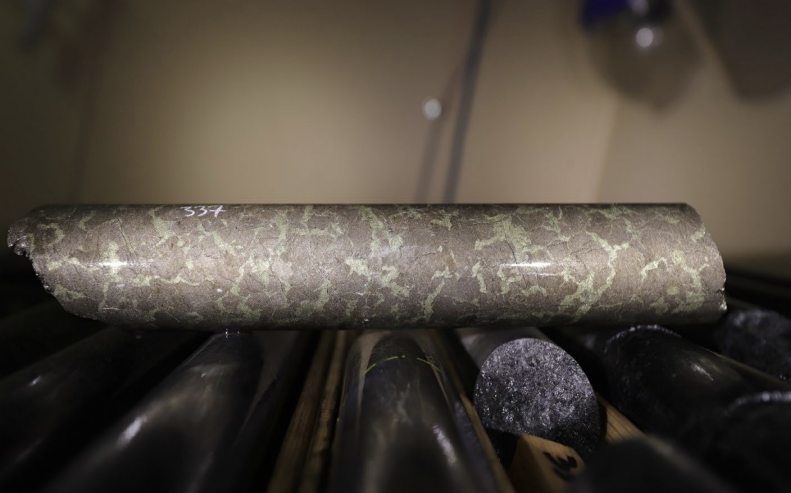
Recent drilling at Current returned intersections of 50.7m @ 4.52 grams per tonne(g/t) platinum, 4.38g/t palladium, 0.99% copper and 0.53% nickel – or 13.74g/t platinum equivalent and 4.36% copper equivalent – from 82m, as reported earlier this month.
The project path forward for Clean Air Metals includes a smaller tonnage, high-grade, and low-capital cost mine plan, which Garbutt says is buoyed by the results from the latest drill program.
As mentioned, a bulk sample is under consideration as part of a move towards advanced exploration designation. The goal for the bulk sample will be to validate the high-grade mining approach, as well as quantify the metallurgical performance of a toll milling scenario on a larger scale.
PGMs – sometimes referred to as platinum group elements – comprise six white-silver coloured metals including platinum, palladium, rhodium, iridium, ruthenium, and osmium, and are used in everything from aircraft turbines and smartphones to jewellery making, medical tools, and glass production.
The global PGMs sector reached more than US$40 billion ($59.39 billion) in size during 2023. The market could top US$55 billion by 2032, exhibiting a CAGR growth rate of 3.5% during 2024-2032, according to the International Market Analysis Research and Consulting Group.
Write to Adam Orlando at Mining.com.au
Images: Clean Air Metals & Fortescue