


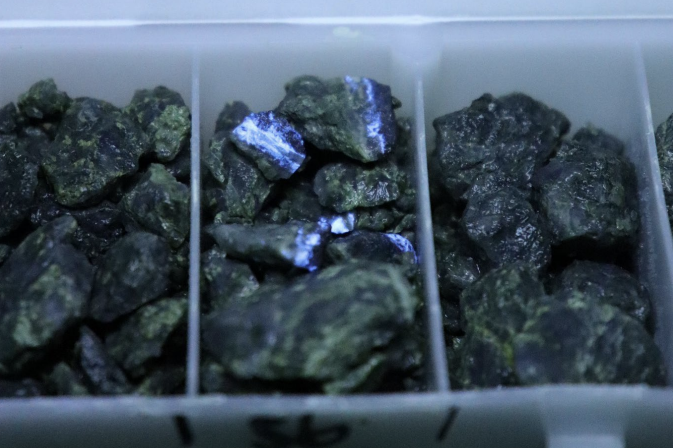
Larvotto Resources (ASX:LRV) reports initial tungsten resources for mineralisation contained within the gold/antimony zones which form the current mineral resources at its Hillgrove Antimony and Gold Project in New South Wales.
Tungsten, mainly within the mineral scheelite, has traditionally been mined with gold and antimony ore at Hillgrove as a byproduct, but to date has never been a focus and often was not assayed for during drilling.
The company says at lower tungsten prices there was often little interest in extracting the metal. However, at the current, considerably higher tungsten price of around US$48,000 per tonne, Larvotto considers the tungsten to be a viable byproduct to its gold and antimony production at Hillgrove.
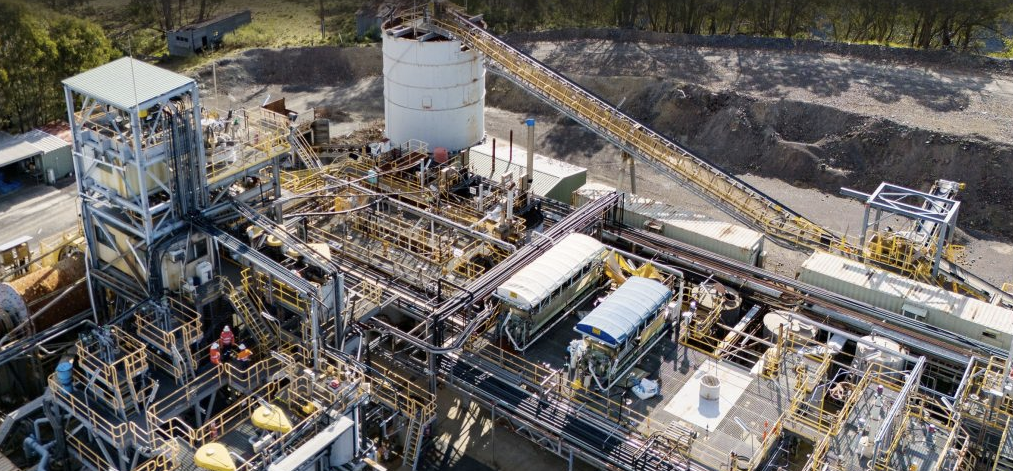
The current process plant configuration already has a tungsten extraction circuit. As part of the mineral resource calculations undertaken for the recent Definitive Feasibility Study (DFS), tungsten was also modelled and interpolated, but has not been factored into the DFS. The focus was on gold and antimony, but it will become a near-term focus for upcoming detailed metallurgical studies.
Only tungsten within the gold and antimony envelopes has been included in the resource, the company adds.
These historical results and resource modelling from recent drilling highlight the potential for tungsten within the Hillgrove mineral field.
Larvotto says while mining specifically for tungsten is currently unlikely, the coincident and peripheral tungsten mineralisation associated with the gold and antimony mineralisation observed across the Hillgrove system, may allow for tertiary processing of ore to produce a tungsten concentrate.
“This additional potential revenue source could further de-risk the operations and bolster the local supply of yet another strategic metal to the local market,” the company adds.
At Hillgrove, tungsten mineralisation is present in the mineral scheelite (CaWO4). Along with the gold and antimony mineralisation, the tungsten mineralisation is hosted within and adjacent to steep shear and breccia structures.
It is spatially associated with the gold and antimony, however, it does not always have a direct correlation. Variable concentrations of scheelite are identifiable in all of the deposits at Hillgrove, in particular at Clarks Gully and Brackins Spur, where concentrations of scheelite are seen to have sufficient tenor and continuity to allow tungsten to be reported as a potential byproduct to the gold-antimony mineral resource.
Tungsten is a highly durable, grey-white metal with the highest melting point of all pure metals. It is a critical element used in various industrial applications, particularly in cemented carbides (tungsten carbide), alloys and as filaments in incandescent light bulbs.
It is commonly used in heavy metal alloys such as high-speed steel, from which cutting tools are manufactured. It is also used in the so-called ‘superalloys’, to form wear-resistant coatings. Due to tungsten’s properties, it is difficult to process in its pure form, where tungsten trioxide is a stable, non-volatile compound that is much easier to handle and store and to use in chemical reactions or material synthesis.
The evaluation of the 2025 Hillgrove mineral resource is based on a gold equivalent considering gold and antimony modifying factors. Tungsten is reported as a potential byproduct. In addition to the defined zones of ‘high-grade’ tungsten mineralisation, further mineralised areas have been identified within the current resource models, presenting potential for resource expansion pending additional evaluation and modelling.
Larvotto says scheelite has the potential to be recovered as a viable byproduct at both the Clarks Gully and Brackins Spur deposits, however, additional work such as drilling, modelling, metallurgical and economic studies are required to fully understand the tungsten potential at Hillgrove.
Write to Adam Orlando at Mining.com.au
Images: Larvotto


