

MDF Global MDF Global
Apple’s iPhone boom highlights critical minerals powering smartphones•Presenting a united front for Queensland’s copper sector•Thailand seeks Myanmar mine access amid arsenic pollution•Egypt to set up state-backed company to license artisanal gold miners, free detainees•Brixton closes $7.4 million raise for Thorn, Langis projects•Heliostar banks record $78.7 million for Ana Paula push•Mining giants bet billions on 2030 supply crunch•Gunnison Copper reports Q3 output, revenue surge•Triumph Gold targets $15.46 million for Yukon push•African Rainbow Minerals faces a jobs dispute at Nkomati mine•Angola seeks 10% stake in De Beers under Anglo’s proposed exit•Gold price rebounds but heads for biggest weekly loss since June•Teck copper strike reaches BC port as operator sues union•Copper benchmark rocked by miner-smelter tug-of-war•Zimbabwe mining bill targets community, environmental safeguards•Mount Isa critical minerals hub secures Feasibility Study funding•Eramet initiates $814.5 million capital raise to reduce debt•Richemont backs natural gemstones, declines De Beers comment•‘Tis the season for administration as Comlek falls a second time•OceanaGold Philippines trials wireless blasting at Didipio mine Apple’s iPhone boom highlights critical minerals powering smartphones•Presenting a united front for Queensland’s copper sector•Thailand seeks Myanmar mine access amid arsenic pollution•Egypt to set up state-backed company to license artisanal gold miners, free detainees•Brixton closes $7.4 million raise for Thorn, Langis projects•Heliostar banks record $78.7 million for Ana Paula push•Mining giants bet billions on 2030 supply crunch•Gunnison Copper reports Q3 output, revenue surge•Triumph Gold targets $15.46 million for Yukon push•African Rainbow Minerals faces a jobs dispute at Nkomati mine•Angola seeks 10% stake in De Beers under Anglo’s proposed exit•Gold price rebounds but heads for biggest weekly loss since June•Teck copper strike reaches BC port as operator sues union•Copper benchmark rocked by miner-smelter tug-of-war•Zimbabwe mining bill targets community, environmental safeguards•Mount Isa critical minerals hub secures Feasibility Study funding•Eramet initiates $814.5 million capital raise to reduce debt•Richemont backs natural gemstones, declines De Beers comment•‘Tis the season for administration as Comlek falls a second time•OceanaGold Philippines trials wireless blasting at Didipio mine

‘Hell to pay’ if RBA wrongfoots market: Economist

There will be “hell to pay” if the Reserve Bank of Australia (RBA) wrongfoots the market and households again in August, cautions Oliver Hume Chief Economist Matt Bell.

The economist says yesterday’s (30 July) consumer price index (CPI) is great news for mortgage holders and home buyers.

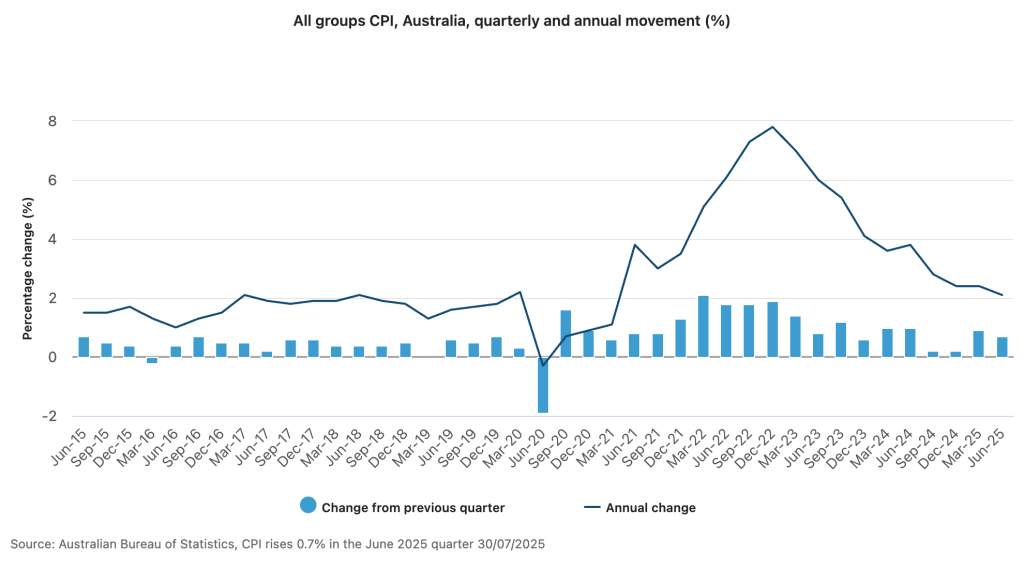
The latest data from the Australian Bureau of Statistics (ABS) shows CPI rose 0.7% in the June 2025 quarter and 2.1% annually.

Markets are pricing in 92% chance of a cut at the next RBA meeting on 12 August. 

Bell says many households were “bitterly disappointed” with the decision to leave rates on hold on 8 July, with the RBA deciding to wait for yesterday’s inflation release before moving again.
“(Yesterday’s) data pretty much locks that cut in,” says Bell.

ABS head of prices statistics Michelle Marquardt says annual inflation to the June 2025 quarter of 2.1% was down from 2.4% to the March quarter. 

“This is the lowest annual inflation rate since the March 2021 quarter,” Marquardt says.

Bell adds that the RBA’s preferred underlying inflation measure is now safely within the 2-3% target band for the second consecutive quarter, while headline inflation moved to the bottom of the range, falling from 2.4% in March to 2.1%.

“This result, combined with some loosening in the labour market as demonstrated by the rise in the unemployment rate to 4.3% in June, probably cements the August 12th cut,” he says.

“There will be hell to pay if the RBA wrongfoots the market and households again in August.”

Quarterly housing inflation eased from +1.7% down to 1.2%, as did rents, down from 1.2% to 1%. The closely watched services inflation component, which drove most of the post-pandemic inflation bounce, eased further in June, falling from 3.7% to 3.3%.

The consumer price index is regarded as Australia’s key measure of inflation. It is an important economic indicator that measures the change in the price of a ‘basket’ of goods and services, which account for expenditure by households in capital cities.

IIt is widely used to inform governments, businesses, and the community about the change in inflation facing Australian households. The CPI provides policy and decision-makers with data and insights necessary to inform monetary and fiscal policy settings.

It is the measure used by the Reserve Bank of Australia for its inflation target.

Write to Adam Orlando at Mining.com.au

Images: ABS

Add to Watch List:
Author Image
Written By Adam Orlando
Mining.com.au Editor-in-Chief Adam Orlando has more than 20 years’ experience in the media having held senior roles at various publications, including as Asia-Pacific Sector Head (Mining) at global newswire Acuris (formerly Mergermarket). Orlando has worked in newsrooms around the world including Hong Kong, Singapore, London, and Sydney.