

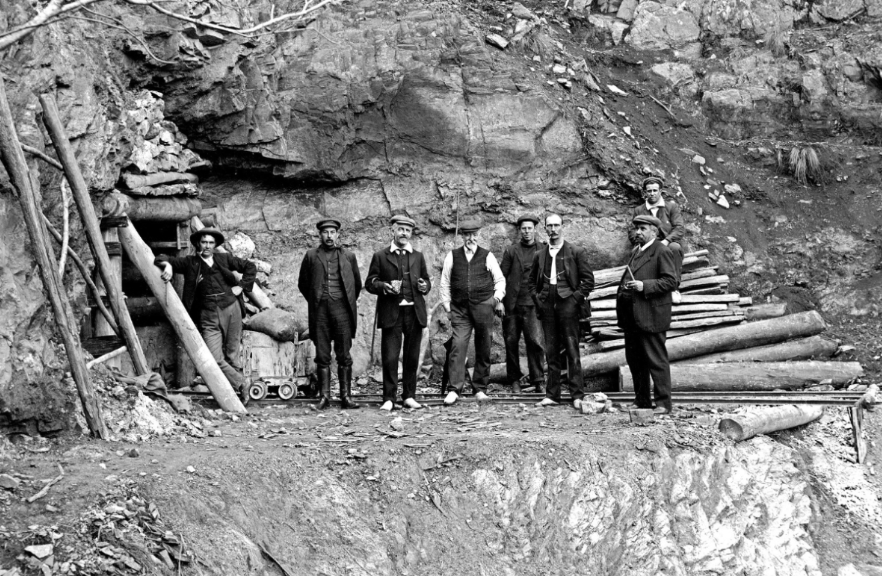
This year – 2025 – celebrates the 150th anniversary of the Geological Survey of NSW as a government agency.
In the 1840s the discovery of copper at Carcoar, Molong, and Bathurst, iron ore at Berrima, and unconfirmed reports of gold west of the Blue Mountains, prompted the government to take action.
On 1 March 1849, the Governor called for the appointment of a Geological Surveyor to the Colony of New South Wales, covering the geographic area that is currently New South Wales, Queensland, and the Northern Territory.
The following year, Samuel Stutchbury arrived from England to start his appointment carrying out a mineralogical and geological survey of the Colony of NSW. After publishing his findings, Stutchbury returned to England in 1855.
After Stutchbury, there was no official Geological Surveyor in New South Wales until 1874, when the discovery of significant mineral resources prompted the creation of a Department of Mines – today known as NSW Resources.

In 1874, the New South Wales Government passed the Department of Mines Act, transferring responsibilities from the Department of Lands to the newly formed Department of Mines. This move centralised oversight of mining activities on Crown Land, ensuring better regulation, safety, and efficiency.
The 1874 Act also authorised the creation of key institutions, such as the School of Mines, which would later become a pivotal educational institution for future generations of mining professionals; and the mineralogical museum, which built a repository of knowledge and artefacts from the state’s rich mining history.
The department introduced a new system of mining districts and appointed mining wardens to enforce regulations, safeguarding the mining industry by including worker safety and the environment.
On 1 January 1875, the Geological Survey of New South Wales was established, with Charles Smith Wilkinson in charge.
In the late 1800s, the Geological Survey of NSW was tasked with preparing geological maps of the colony, which provided information to assist in the exploration for new mineral fields and underground water resources, as well as to collect rock and fossil samples for the Mining Museum.

The scientific data was released in reports and publications, accompanied by a wide range of maps and plans.
Fast-forward to 2004, the head office of the Geological Survey of NSW relocated from Sydney to Maitland. At this point the survey had around 50 staff in specialist roles such as regional mapping, minerals systems and petrography.
By 2023, Dr Phillip Blevin had been appointed to the role of Chief Geoscientist and Head of the Geological Survey of NSW after 18 years with the department.
As part of the 150th anniversary, upcoming events in 2025 include ‘Exploration in the House’ at Parliament House (9 May); a symposium and dinner marking the anniversary of the at NEX Newcastle (18 June); and National Science Week (9-17 August), which is a series of events supporting geoscience education and showcasing the latest geoscientific technology supporting exploration for critical minerals at the WB Clarke Geoscience Centre in Londonderry.
Milestones and achievements
- 1875: the GSNSW published its first geological map. Compiled by C.S. Wilkinson, it covered the Hartley area
- 1879: The Museum of Mining was established.
- 1882: The collections were devastated by fire, but rebuilt and the museum re-opened to the public in 1886 as the Mining and Geological Museum
- 1883: Discovery of the Broken Hill ore deposit
- In the 1880s the need for many materials in eastern NSW saw surveyors (geologists) from the Geological Survey actively involved in helping the growing mining industry
- In the late 1880s and 1890s, extensive droughts saw the Geological Survey actively involved in identifying underground water supplies
- 1923: A major publication, ‘The Mineral Industry of N.S.W.’ was issued
- 1930s: Aerial mapping began and a departmental car was used in the field. The vehicle was a Chevrolet 6-cylinder roadster
- 1950s: A systematic geological mapping program began mapping standard 1:250,000 sheet areas
- 1974: The first NSW map showing structure and tectonic history based on plate tectonic theory was published
- 1995: The mining museum closed and collections were re-distributed, with the prized Albert Chapman Minerals Collection sent to the Australian Museum. The museum had been in The Rocks since 1909
- 2002: Release of MinView, a web map application making geoscientific data accessible to industry, government and the public. This award-winning product set a new standard in geoscientific data delivery and is much praised by customers
- 2004: the head office of GSNSW was relocated from Sydney to Maitland
- 2018: Release of v1 Seamless Geology, a statewide dataset that has created a paradigm shift in the way that geological maps and associated data are created and compiled.
From its humble beginnings in 1874-75 to its present-day focus on ensuring a balance between resource extraction and environmental sustainability, NSW Resources has played an important role in shaping the future of New South Wales. As the department looks ahead, “it remains dedicated to supporting the state’s primary industries, fostering innovation, and ensuring the health of its natural resources for future generations”.
In 2025, the Geological Survey of NSW celebrates its 150th anniversary and as part of the celebrations is sharing stories of its history, projects and achievements over the years. If you have a NSW mining story worth sharing email this reporter at adam.orlando@mining.com.au.
Write to Adam Orlando at Mining.com.au
Images: Geological Survey of NSW