


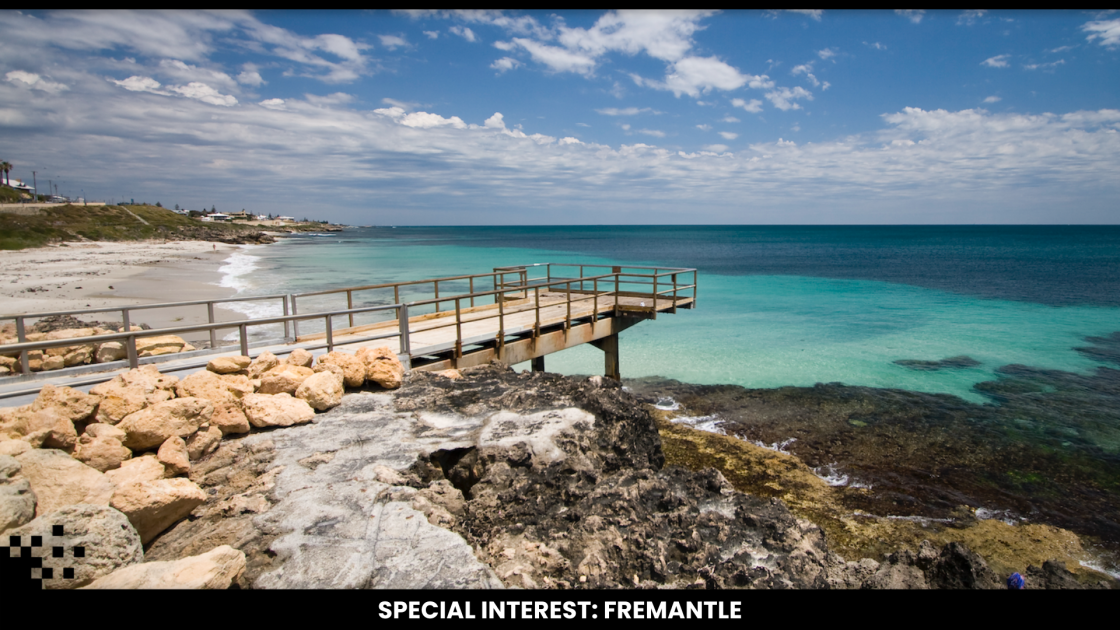
Fremantle, or ‘Freo’, in Western Australia is a port city renowned for its meticulously preserved 19th century Victorian and Edwardian architecture, bustling Fremantle Markets, Fishing Boat Harbour, and the UNESCO World Heritage-listed Fremantle Prison.
This week, Fremantle is host to the RIU Explorers Conference being held from 17-19 February at the Esplanade Hotel. Mining.com.au is an official media partner of this year’s event.
It’s fitting that Fremantle hosts such a major Australian forum for the exploration and mining resources sector given how the port city rode the gold rush and has been intertwined with one of Australia’s defining economic booms – the Western Australian gold rush of the late 19th century.
Though gold was mined hundreds of kilometres inland, its discovery transformed Fremantle from a modest settlement into a bustling gateway to the state’s richest fields and an enduring testament to the economics of resource opportunity.

From colony to gold gateway
Fremantle was established in 1829 as part of the Swan River Colony – a free settlement that sought to emulate British prosperity on Australia’s western edge. Initially, it developed slowly. Early infrastructure such as the Fremantle Round House and the railway connection with Perth helped anchor the settlement long before gold dominated headlines.
However, the discovery of gold inland in the 1890s changed everything. Gold was discovered near Southern Cross, Coolgardie, and ultimately Kalgoorlie – unleashed an unprecedented wave of migration and trade.
News of new finds rippled through the colonies and attracted prospectors, merchants, and labourers from Britain, Europe, and eastern Australia, all seeking fortunes or supporting the miners who did.
By attracting prospectors and enabling trade to grow, the gold rush increased agricultural output and generated extraordinary wealth. The flood of goods and gold seekers brought many new businesses to the port, which is still today a thriving and affluent community. The gold rush also brought the first major arrival of willing immigrants ready and able to work. The style of some of the buildings of that period are clearly reflected with a higher level of luxury and splendour such as the Esplanade Hotel, which today still offers top class luxury accommodation in Freo and hosts the annual RIU Explorers Conference.
As FremantleWesternAustralia.com.au reports, inland goldfields drew thousands of people and Fremantle’s significance as a port and rail terminus intensified. The completion of the Fremantle-Perth railway in 1881 ensured the port city became the primary entry point for goods and people destined for the goldfields, reinforcing its role as Western Australia’s commercial heart.
Before the gold rush, the colony’s economy predominantly rested on agriculture and wool, but the influx of prospectors and capital swelled the population and demand for goods. Fremantle’s port and rail links enabled supplies from food to heavy equipment to flow inland, building a robust trade network that reached deep into the state’s interior.
By the turn of the 20th century, Western Australia was among the world’s largest gold producers, and Fremantle played a pivotal role as the first port of call for many of those headed to the lucrative but arid goldfields. The gold rush also generated enough wealth to fund major infrastructure projects across the colony, including the construction of Fremantle Harbour in 1897, which was a transformative milestone that further cemented the port’s importance.
As the gold rush propelled economic growth, Fremantle saw booming commerce and population increases. The number of residents soared from just a few thousand in the early 1880s to almost 15,000 by 1901, supported by the rail line and the steady arrival of immigrants and goods, as per Freotopia.

The rail and the rush
Fremantle’s built environment today still reflects the boom period ushered in by the gold rush. As mentioned, wealth flowing through the port spawned a wave of construction – banks, hotels, warehouses, and trading houses – many still standing as heritage-listed reminders of that era.
For example, the West End of Fremantle comprises a remarkable collection of late Victorian and Edwardian architecture directly linked to the gold boom and subsequent commercial expansion, with buildings such as the Westpac Bank Building (completed in 1893) and Central Chambers (1907) showcasing the prosperity of the period.
However, the role of rail was central to Fremantle’s position at the heart of the gold rush. The Fremantle railway station, which first opened in 1881 as the terminus of the Eastern Railway, became a vital conduit for miners heading inland and for goods moving between the port and the burgeoning goldfields.
After its opening, extensions of the Eastern Railway in the mid-1890s connected Fremantle more directly with Perth and the goldfields, allowing cargo and passengers to traverse hundreds of kilometres with unprecedented efficiency. This network not only supported mining activities but also stimulated broader economic growth in Western Australia.
Yet Fremantle’s exposure to the gold rush was not just commercial – it was profoundly social. The influx of hopeful prospectors brought with it a wave of new cultural influences. The port city welcomed migrants from across the British Empire and beyond, many of whom would settle in the state rather than pursue gold directly.

The introduction of convicts and the regular arrival of so-called ‘bride ships’ – vessels carrying women recruited to balance the predominantly male population – led to a surge in immigrant labour that helped shape Fremantle’s multi-layered society. The Western Australian Museum says this era saw the emergence of new neighbourhoods, businesses, and community organisations that would define the region’s culture for decades.
By the early 20th century, Fremantle’s population and industry reflected this diversity. Immigrants brought skills and enterprise that helped diversify the local economy beyond gold-driven trade, particularly in maritime services, commerce and urban development.
Perth’s population had grown slowly until the discovery of gold, first in the north near Marble Bar and then latterly out in the desert near Kalgoorlie. This brought about the greatest internal migration yet seen in Australia – the arrival of 500,000 people to a city that until then hosted a population of 48,000.
Even after the peak of Western Australia’s goldfields boom, Fremantle’s identity remained anchored in the legacy of the gold rush. The port’s infrastructure continued to serve a thriving trade environment, and its architectural character became a touchstone for heritage preservation efforts throughout the 20th and 21st centuries.
Today, Fremantle’s historic streetscapes, grand old buildings, and maritime heritage tell a story of transition — from a remote colonial outpost to a gateway that welcomed the world during Western Australia’s most transformative economic era. Those physical reminders, from the harbour to the West End’s commercial edifices, continue to shape its identity and draw global interest in its past.
In the context of Australian mining history, Fremantle’s role was not that of a gold producer itself, but of an enabler – a dynamic port city whose growth was propelled by the lure of gold inland and whose prosperity became inseparable from the rush that shaped a state.

Bulk exports and minerals
Fremantle Port remains a central artery in Western Australia’s trade network, handling a diverse array of minerals, metals, and other commodities each year. Through its dual-harbour configuration – the Inner Harbour at Fremantle and the Outer Harbour at Kwinana – the port facilitates the movement of both containerised goods and bulk commodities vital to the state’s economy and national supply chains.
Although Fremantle is not the state’s largest resource export port – that distinction belongs to Pilbara ports handling iron ore – it still moves substantial volumes of commodities tied to Western Australia’s broader mineral complex.
The Inner Harbour primarily processes containerised trade, motor vehicles, livestock exports, and general cargo. It operates around the clock and serves as the first point of contact for a wide array of imports and exports, as reported by Fremantle Ports.
Meanwhile, the Outer Harbour, situated at Kwinana about 22km south, focuses on handling bulk commodities such as petroleum products, mineral sands, grain, and fertilisers, among others. It is one of Australia’s major bulk cargo ports handling grain, petroleum, liquid petroleum gas, alumina, mineral sands, fertilisers, coal, sulphur, iron ore, and other bulk commodities.

Three of the jetties in the Outer Harbour are operated by private companies, generally under Special Agreement Acts with the state. They are the Alcoa (NYSE:AA), BP (LSE:BP), and CBH Group jetties. Kwinana Bulk Jetty and the Kwinana Bulk Terminal are operated by Fremantle Ports.
Fremantle Ports handle $3.6 million worth of trade every hour 24/7. Its trade performance remains strong, recording a profit before tax of $63.4 million in 2025 although overall tonnage through the port is slightly lower at 29 million mass tonnes.
The important container trade in 2025 grew by 3.6% on the previous year, with a throughput of 887,514 containers (TEU) in what was a record for the Port of Fremantle. The new motor vehicles trade also had a record year, with trade increasing by 3.3% on the previous year.
Overall trade volumes for the Port of Fremantle declined slightly in 2024-25 compared to 2023-24, down from 29.73 million tonnes to 28.98 million tonnes. Fremantle Ports notes this fall was primarily driven by a decline in alumina exports and the absence of silica sand exports.
“Despite this, trade remained strong across most categories in Fremantle and Kwinana. Both the container trade and new motor vehicle trade set record throughputs this year, reflecting a resilient WA economy,” Fremantle Ports notes in its latest annual report.
Write to Adam Orlando at Mining.com.au
Images: Alcoa, Esplanade Hotel, Freoview & Fremantle Ports


