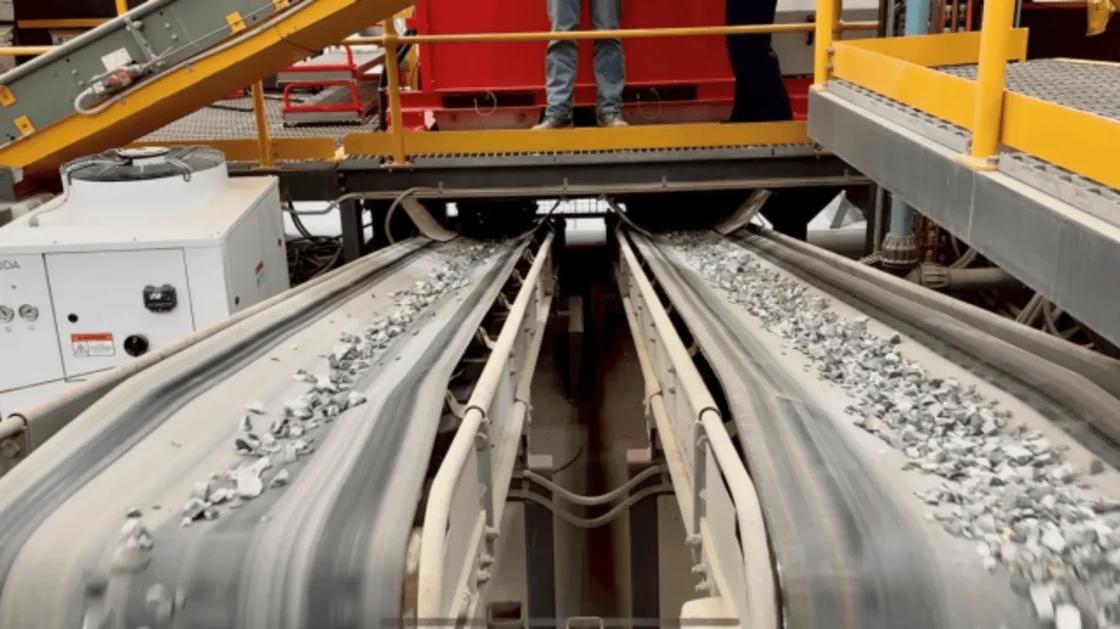
Elementos (ASX:ELT) has increased its tungsten grades, sourced from the Cleveland Project in Tasmania, by 410% through x-ray transmission (XRT) ore sorting testwork.
Tungsten recovery is now marked at 87%, while mass rejects are at 79%, leaving Elementos to consider the implementation of XRT ore sorting to optimise tungsten recovery.
This workstream was conducted at the TOMRA Sorting Solutions Facility in Castle Hill, using samples from drillhole C2124A.
Samples were split into two bulk samples, with sample W2 comprising 387kg of material and a head grade of 0.24% tungsten trioxide, and sample W1 holding 437kg of material with a head grade of 0.06% tungsten trioxide.
The hole was drilled to a depth of 1,122m to test extensions to the known resource estimate within the Foleys Zone.
Each sample went through two passes of the ore sorting process, producing a “high grade” in the first pass before the second pass acts as a scavenger on waste produced the first time around.
Elementos is considering multiple grade options between higher and lower-grade products to be assessed in future studies of an optimised flowsheet.
Managing Director Joe David says ore sorting tests illustrate a potential to increase the Cleveland Project’s tungsten resources and plant feed grades.
“All this is being identified whilst tungsten prices have surged above US$61,500 per tonne, highlighting tungsten as one of the most critical and in demand minerals currently in the world,” David says.
“We are currently re-estimating the mineral resources, further evaluating the co-mineralised critical minerals which sit alongside the tungsten, and will soon proceed with metallurgical testwork on these elements.
“These are the key blocks of data that will then allow us to evaluate the true economic potential of the project.”
Write to Maddison Elliott at Mining.com.au
Images: Elementos