


Eclipse Metals (ASX:EPM) reports it has received ‘encouraging’ early rare earth element (REE) results from maiden drilling and trenching at its Ivigtût multi-commodity project in Greenland.
The company says and XRF analysis of composite drill and trench samples collected at the Ivigtût and Grønnendal targets have returned values for praseodymium (Pr) and neodymium (Nd) radios indicating the Grønnendal carbonatite complex could be ‘significant’ on a global basis with respect to its Pr and Nd content.
At the Grønnendal Carbonatite target, pXFR readings conducted at the Greenland sample preparation facility taken on 5 1.5m composite samples from drillhole L3-9 returned an intersection average of 7.5m @ 0.8% La2O3 + Ce2O3 + Pr2O3 + Nd2O3 (4REO), with praseodymium/lanthanum and neodymium/cerium ratios of about 1.2 to 1, as well as 0.49% zinc + lead + nickel.
Although these pXFR results are preliminary, Eclipse has interpreted them to indicate that the commercially more valuable REE praseodymium and neodymium are ‘significantly’ enriched in drillhole L3-9 relative to lower value lanthanum (La) and cerium (Ce), an observation that is consistent with academic studies as well as previously received laboratory results.
Eclipse reports overall, the Grønnendal rock chip samples demonstrated ‘unusual’ patterns for Pr/La and Nd/Ce ratios compared to other REE-mineralised carbonatite complexes such as Mountain Pass in California and Mt Weld in Western Australia.
the Grønnendal rock chip samples demonstrated ‘unusual’ patterns for Pr/La and Nd/Ce ratios compared to other REE-mineralised carbonatite complexes
The lower La and Ce contents measured by pXRF, if confirmed by laboratory assay results across Grønnendal would indicate that REE mineralisation at the target contains a ‘higher’ proportion of the commercially more valuable magnetic REE Pr and Nd, with the latter often termed the ‘magnetic feed’ REE which are critical elements for ‘high-performance’ magnets used by the automotive sector and for wind turbines that is in high demand.
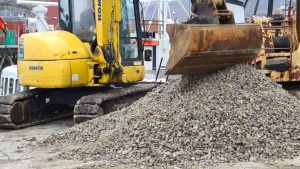
Eclipse says it bulk sampled 5 mineralised waste dumps (ROM size) from the Ivigtût historical cryolite mine to assess the mineral and chemical content, and these dumps contained a ‘substantial’ volume of mineralised material that may be suitable for processing to recover saleable products.
Previous laboratory assessments have indicated the polymetallic nature of mineralisation in the pit from which the large volume of mineralised waste was produced, as shown in earlier results.
The company’s previous surface sample I21012 conducted in March provided results including 165g/t Ag, 0.15% Cu, 3.83% Pb and 0.37% Zn, and a laboratory assessment of a historical drill core samples IVT21-11 from November last year returned 9.86% Zn.
Eclipse states laboratory results from the mineralised waste dumps returned relatively low TREO values, ranging from 2.26ppm to 161.44ppm, however the ratio of ‘high-demand’ heavy to light REE is considered to be very encouraging, and chemical and petrological assessment of the bulk samples in Australia will provide the company with data to estimate commercial potential in the waste dumps.
The company is considering a ground penetrating radar (GPR) survey for the Ivigtût precinct to assist with an assessment of the potential volume of mineralised waste material.
By calculating the size of the open pit and access tunnels and subtracting the cryolite concentrate that has been exported, the company estimates that 2 million tonnes to 5 million tonnes of ROM waste was deposited in the dumps as well as for landfill purposes during a century of mining, and there has been no comprehensive commercial assessment for other critical metals.
The company says the drill and trench samples collected from Grønnendal and Ivigtût are booked for shipment to a laboratory in Australia for comprehensive analysis.
Eclipse Metals is an Australian exploration company focused on exploring south-western Greenland, the Northern Territory and Queensland for multi-commodity mineralisation.
The company has a portfolio of assets prospective for cryolite, fluorite, siderite, quartz, REE, gold, platinum group metals, manganese, palladium, vanadium and uranium mineralisation.
Its assets include the Ivigtût Project in Greenland, the Mary Valley Manganese Project, the Liverpool Uranium Projects, the Ngalia Basin Uranium Projects, Ranger Mines, Tunderball Uranium, Caramal Uranium, Nabalek Uranium and the Ngalia Basin Uranium Projects in the Northern Territory as well as the Bauxite Project in New South Wales.
Images: Eclipse Metals Ltd