

Exploration is a key activity for resource companies across the globe, playing a detrimental role in the success of the company.
In the June 2025 quarter, Australian mineral companies spent $968 million on exploration activities, representing a 2.3% increase to the previous quarter according to the Australian Bureau of Statistics.
A number of resources companies have announced drilling results early week (25 November), including Octava Minerals (ASX:OCT), which is mobilising a drill rig after identifying up to 860 parts per million (ppm) indium from the Sweeneys prospect within the Federation Project in Tasmania.
The company recently re-assayed rockchips from historical work at Sweeneys, in conjunction with a fixed loop electromagnetic (FLEM) survey.
Octava says the survey, completed by Australian Geophysical Surveys, indicated “good connectivity” between sulphide-rich mineralisation types. Mineralisation includes greisen style disseminated tin mineralisation and steeply dipping base metal sulphide mineralisation.
Receiver stations recorded mid-to-late time responses from the Sweeny conductor from a single electromagnetic (EM) line of the survey.
The plate model extends 65m by 35m with a conductance of 300 siemens, not reflecting the full extent of interpreted mineralisation as a single EM receiver line survey is not able to extend beyond 65m.
Octava is now mobilising a diamond drill rig to the site for an upcoming drilling campaign, with drillholes to be cased for a later downhole EM survey.
Search radius is expected to extend as much as 150m from drillholes based on host rock and sulphide mineralisation. The company also intends to conduct an airborne EM survey in early 2026 across the greater project to target direct detection techniques.
Drill to upgrade
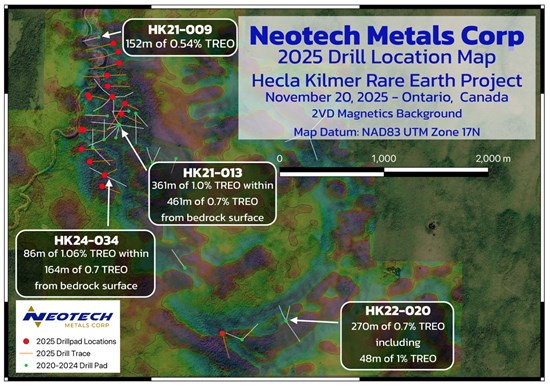
Neotech Metals (CSE:NTMC) has completed its resource definition and delineation drilling campaign at the Hecla-Kilmer Rare Earth Project in Ontario, Canada.
The company covered 8,000m of ground in this drilling campaign, with the core currently being logged, sampled, and processed on site.
This campaign intends to infill, expand, and refine the rare earth element (REE) mineralisation boundaries to test and confirm continuity of mineralisation ahead of a maiden resource estimate.
Assays are expected to be announced in the coming weeks.
Neotech has also submitted almost 2,000m of historical drill core from earlier campaigns at Hecla-Kilmer for rare earth element analysis to strengthen the geological dataset.
Historical assays will be included in a maiden resource estimate, currently scheduled for 2026.
Meanwhile, Neotech is focused on further developing its engagement with Indigenous Nations at the Hecla-Kilmer Project, with regular communication, on-site participation, and united planning to align with the Ontario Environmental Assessment process.
This will ensure engineering, land-use planning, and future permitting pathways are conducted in coordination with Indigenous Nations wishes.
Neotech CEO Reagan Glazier says the advancement of the Hecla-Kilmer Project validates the company’s confidence in the geological system.
“The steady stream of assays and technical updates over the coming months will support a disciplined path toward our maiden resource estimate, while meaningfully reducing technical risk and enhancing the long-term strategic value of the project,” Glazier says.
Drill to start
Patagonia Lithium (ASX:PL3) has begun drilling at its Formenta concession well JAM 2025-5 in Coranzuli in the Jujuy province of Argentina as of 22 November, following a false start with the drill pad.
The company will drill to a depth of 600m, targeting an increase in the updated mineral resource. Patagonia’s previous deepest well was drilled to a depth of 401m at JAM 24-04.

Executive Chairman Phillip Thomas says the company was able to rebuild the drill pad “in quick time” after it delayed the mounting of the rig while awaiting for certain supplies which took longer to arrive than anticipated.
“We are excited to be able to drill this 600m well, as the geophysics indicate a depth of low resistivity down to 1,000m,” Thomas says.
“This will increase our resource if the brines assay lithium and high porosity continues as it has in other wells.”
“This well is 300m and 1,000m from our other wells in the southern section of the concessions enabling us to increase the confidence of the resource.”
Using borehole magnetic resonance, Patagonia will follow up drilling with a seismic survey to determine the basement-porosity measurements.
Write to Maddison Elliott at Mining.com.au
Images: Octava, Neotech & Patagonia