


Shares in Dreadnought Resources (ASX:DRE) have taken a tumble after ‘unseasonable weather, bush fires and rig breakdowns’ left its latest Western Australian drilling program ‘largely incomplete’.
Announced at the end of September, the proposed 27-hole program — totalling 4,300m — featured 2 objectives: to prove the scale of mineralisation at the multi-element Tarraji-Yampi Project in WA’s Kimberley region through the discovery of additional massive sulphide bodies, and to test the depth extent of the project’s Orion target.
“The long-anticipated drill program to follow up on the 2021 Orion Cu-Ag-Au-Co massive sulphide discovery is finally here,” Managing Director Dean Tuck said at the time.
“The intervening period has been used wisely to identify 13 Orion look-alike targets that are equal to or better than Orion at the same stage. These are all attractive drill targets that could lead to discoveries.”
Ultimately, only 11 reverse circulation and 2 diamond drill holes were completed — totalling 1,289m — and just 4 of the original 13 targets were tested. Dreadnought said in a statement that neither of its 2 primary objectives were achieved and that the program will be completed in 2024.
Shares in Dreadnought had subsequently sunk 19.05% to $0.034 as of 3:00pm AEDT.
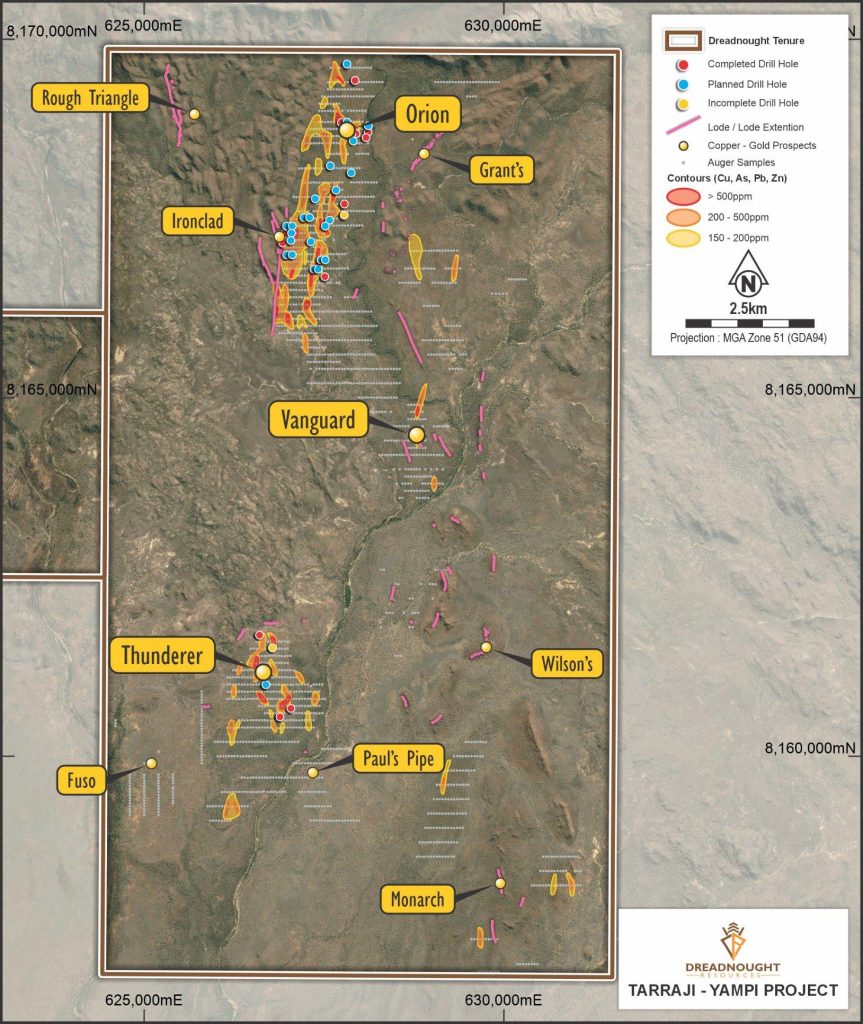
At Orion, 2 diamond drill holes sought to test mineralisation at depth. The first — KMRD056 — was drilled into the southern edge of the target, while the other — KMRD057 — hit the centre. Both intersected the conductive target, confirming that Orion extends to roughly 250m in depth and remains open.
Meanwhile, 5 reverse circulation holes were drilled at Orion look-alike targets. One was abandoned due to poor ground conditions, while the others intersected anomalous sulphide mineralisation similar to that which surrounds the Orion target itself. Dreadnought says it considers these holes ‘near misses’ that require further drilling.
At the Thunderer target to the south of Orion, 4 reverse circulation holes tested electromagnetic plates at Thunderer East along with a mineralised quartz vein at Thunderer North. Of the 3 at Thunderer East, one was abandoned due to ground conditions, one intersected no significant mineralisation, and one intersected anomalous mineralisation but was considered another ‘near miss.’
The last 2 reverse circulation holes intersected mineralised quartz-sulphide veins at the Ironclad target.
“This year’s drilling program in the Kimberley has been challenging due to unseasonable weather, bush fires, and rig breakdowns. As a result, the program remains largely incomplete as originally intended with only a handful of targets effectively tested,” Tuck says.
“On the positive side, mineralisation at Orion has been extended and remains open at depth, thanks to diamond drilling supported by the GSWA’s co-funding Exploration Incentive Scheme.”
“On the positive side, mineralisation at Orion has been extended and remains open at depth, thanks to diamond drilling supported by the GSWA’s co-funding Exploration Incentive Scheme”
In addition to continued exploration for copper, silver, gold, and cobalt mineralisation at Orion and Thunderer, Dreadnought says it will reassess the Tarraji-Yampi Project for Ruins Dolerite-hosted nickel, copper and PGE mineralisation.
Outcropping mineralisation was first discovered at Tarraji-Yampi in 1905, and the site was ultimately mined for copper from 1907 to 1920. Exploration since then has been sparse, partly for the project’s location within the Yampi Sound Training Area — Commonwealth land that was exempt from mineral exploration from 1978 to 2013.
The only historical exploration to have been undertaken in the area was by WMC Resources in 1958 and Australian Consolidated Minerals in 1972.
Write to Oliver Gray at Mining.com.au
Images: Dreadnought Resources