

Cosmos Exploration (ASX: C1X) has identified a ‘strong’ 1,000m x 350m concentric Ni-Cr-Cu-PGE anomaly coincident with magnetic-high “bullseye” features during Phase 1 multi-element soil sampling at its Byro East Project in Western Australia.
The company says that the geochemical signature indicates underlying mafic/ultramafic host lithologies and potentially higher-grade nickel, copper and PGE mineralisation.
Addressing the update, Cosmos Exploration Executive Chairman Jeremy Robinson said: “While patiently waiting for the first of the assays to be returned from last year’s soil sampling program, we have been actively progressing both the Byro East project and the Orange East Project.
“These results are a very good start and confirm our belief in the region to host world-class Ni-Cu-PGE deposits”
These results are a very good start and confirm our belief in the region to host world-class Ni-Cu-PGE deposits. These results are expected to be the first of many across both our projects in the coming months.”
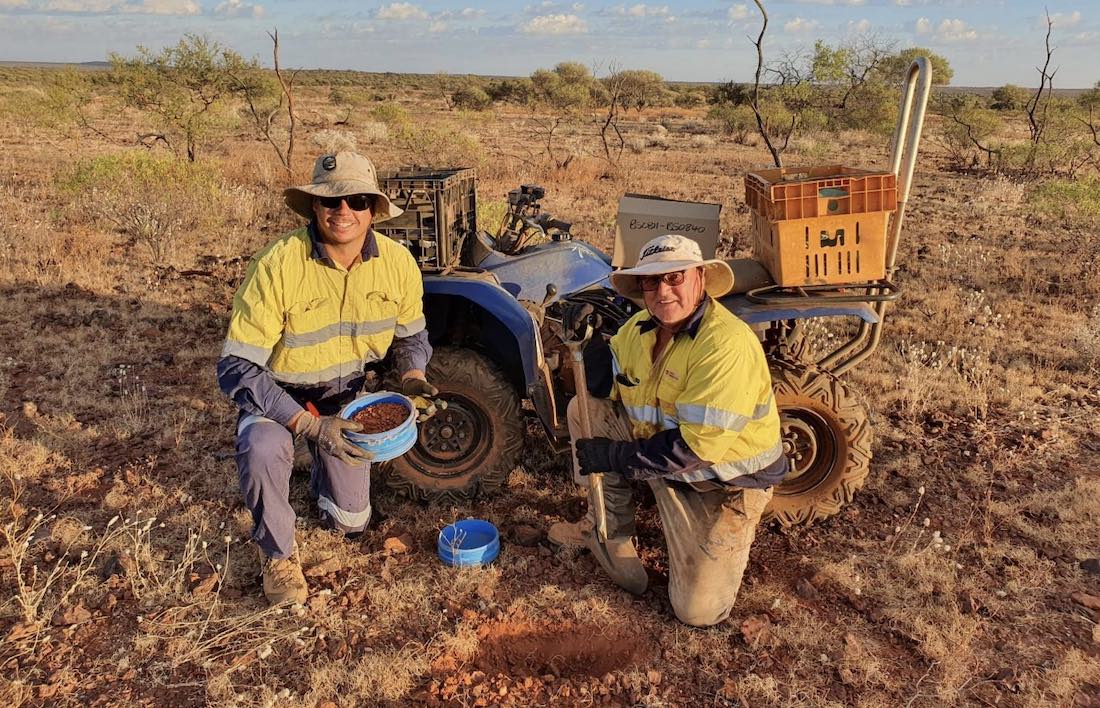
The company had commenced a multi-element soil survey in December 2021, covering 37km² of prospective mafic/ultramafic trends at Byro East. First assay results have now been reported from less than 5% of total samples from the Dottyback Prospect, with remaining results expected over the coming 1 to 6 weeks.
Results received have highlighted a coherent and concentric Ni-Cr-PGE and Cu anomaly at Dottyback, with peak values up to 2250 ppm Ni, 1840 ppm Cr, 23 ppb (Pt+Pd) with semi-coincident Cu ranging from 50ppm to 147 ppm.
The company considers these results to be ‘highly encouraging’ and consistent with underlying mafic/ultramafic lithologies which are host rocks for magmatic Ni-Cu-PGE sulphide deposits.
The Byro East Project is located on the north-western margin of the Yilgarn Craton, approximately 300km northwest of Geraldton, Western Australia. The project is comprised of 5 tenements prospective for nickel, copper, PGE and orogenic gold mineralisation. Significant prospects include Leatherback, Dottyback, Blue Bottle, and Glasswing.
 Map of the Byro East Project displaying assay areas at Dottyback and Leatherback
Moving ahead, Cosmos reports that it is continuing exploration on several prospects via regional spaced-soil sampling.
Regional geochemical sampling will continue through April and May 2022, with Phase 2 work set to begin when more results are received from anomalies identified in Phase 1.
Further work will include an airborne magnetic/radiometric survey in May to infill the existing 400m-spaced dataset to 100m, and an airborne electromagnetic survey scheduled for May or June.
Images: Cosmos Exploration Limited