

Caspin Resources (ASX:CPN) reports it has recorded its best gold and molybdenum grades to date at the Duchess Prospect, located within the Mount Squires Project in Western Australia.
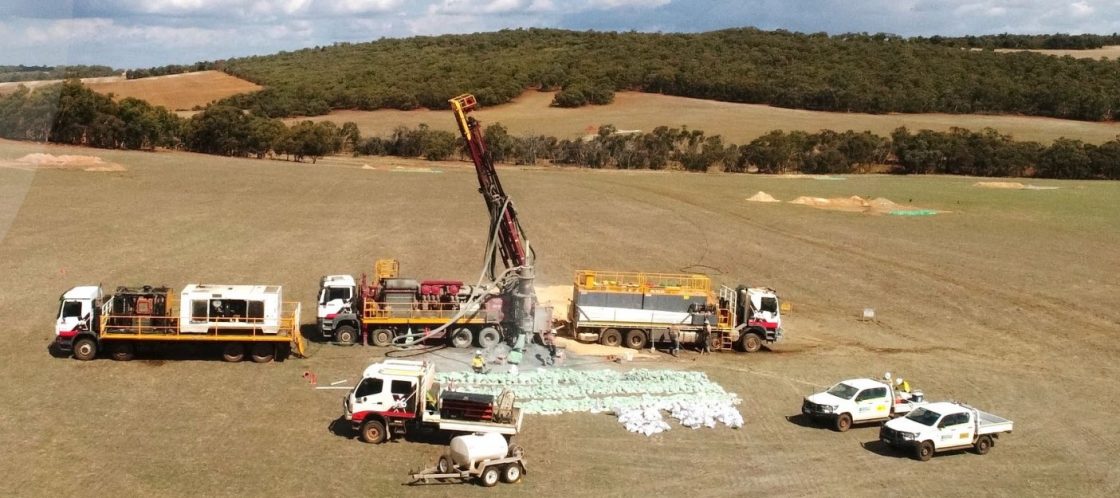
The company says these results came from second phase reconnaissance aircore drilling, comprising 132 holes for 2,729m at Duchess. This drilling identified 2 ‘clearly defined’ mineralised trends at the prospect with gold-silver found at Duchess West and copper-molybdenum at Duchess East.
It also notes this first batch of results from the second phase of drilling has returned more ‘promising’ results from both trends.

Caspin Resources CEO Greg Miles said: “We’re delighted with such impressive gold and molybdenum results at Duchess, demonstrating the rapid progress at the prospect from only a soil anomaly a few months ago.
The reconnaissance aircore program has achieved its initial goal of confirming significant bedrock mineralisation and now appears to have given us a target for deeper testing on both mineralisation targets.
“the company is already planning a new program for testing both trends with a larger capacity drill rig in the next field season”
The company is already planning a new program for testing both trends with a larger capacity drill rig in the next field season. Shareholders can look forward to further drilling results at Duchess, as well as further results from our nickel and copper exploration on the West Musgrave Corridor.”
Caspin reports several infill and extensional traverses of reconnaissance drilling have now been completed across the Duchess West trend with drillhole MSAC0121 returning a ‘standout’ result of 1m @ 6.04g/t Au and 4g/t Ag associated with quartz veining encountered from 12m, in the last metre drilled in the hole.
The company speculates this result could be part of a thicker zone of gold mineralisation yet to be tested.
The result has also reinforced Caspin’s interpretation of a consistent northwest oriented structural trend defined by all 3 of the MSAC0121 intersection, the 2.46g/t Au, 49.7g/t Ag rock chip result 200m to the south and the Handpump Prospect with thick zones of gold mineralisation at surface, over 1,500m to the north. Much of this trend is obscured by shallow transported cover and is an ‘obvious’ target for further drilling.
Recognising that mineralisation is associated with structurally controlled quartz veining, Caspin has drilled several traverses of close spaced holes near the MSAC0121 intersection, over 400m of strike to attempt to delineate the main host quartz vein, and several holes along strike to the north have also been drilled with results pending.
Whilst Caspin’s focus is on gold mineralisation, there appears to be a ‘clear’ halo of elevated silver mineralisation over 1g/t Ag associated with this trend.
‘Significant’ silver results include 3m @ 11.7g/t Ag from surface in MSAC0119, and the company says silver may provide a ‘small’ economic by-product benefit to any potential gold discovery.
At Duchess East, the drilling program tested a lithological contact between rhyolite and volcaniclastic rocks with an apparent copper and molybdenum association.
During the second phase of drilling, Caspin extended the drilling traverses further to the east than the earlier program with much success.
Drillhole MSAC0130 returned a best result of 7m @ 902ppm Mo from surface to bottom of hole, including 1m @ 3,220ppm (0.32%) Mo and 1.17% Pb from 5m.
The company says this result is a ‘magnitude’ greater than earlier drill results and suggest that grades may be increasing further to the north and east where mineralisation remains open, possibly related to more intense hydrothermal alteration of the rhyolite host rocks.
Caspin notes that the Climax and Henderson mines in the US are ‘large-scale’ open pit operations with resources grades in the order of 1,000ppm to 2,000ppm Mo.
This provides encouragement that Duchess East may be a ‘significant’ new molybdenum discovery if sufficient continuity and extensions of mineralisation can be found.
The company reports it has already drilled a further 8 holes around MSAC0130 on 50m spacings to assist understanding of mineralisation extent and controls.
Further drilling on ‘large’ step-outs, and deeper testing under the near surface mineralisation discovered so far, with a larger capacity drill rig is warranted.
The company says there remains potential for copper-molybdenum style of mineralisation to be discovered on this trend.
Caspin Resources is an Australian mineral exploration company based in Perth, Western Australia. It is focused on its flagship Yarawindah Brook Project in the West Yilgarn region, and the Mount Squires Project in the West Musgrave region of Western Australia.
Images: Caspin Resources Ltd