



Back in May, Mineral Resources (ASX:MIN) was trading for nearly $75 per share.
It’s since dropped 30%.
This multi-commodity business and services provider has been double-punched by two different commodity price falls.
Part of the reason is because lithium prices are down and iron ore remains subdued at around US$91 ($130) a tonne.
This week, we also saw evidence that China is putting pressure on fellow iron ore miner Fortescue Metals (ASX:FMG) via its central purchasing agency.
This trend may come to pass for Mineral Resources in the future. At the very least, it adds another dose of industry uncertainty to an already-under-pressure share price.
On 29 September, BreakWave Advisors reported that iron ore fundamentals continue to soften from subdued Chinese demand.
That said, there is a small bright spot in rising Indian steel production.
All this makes the recent iron ore upgrade from investment bank UBS even more notable.
The bank upgraded its long-term price expectation to US$93 a tonne from US$85, writing:
“Our US$93 per tonne long-term forecast reflects a scenario in which cost support remains elevated, demand enters a new phase, and depletion becomes increasingly important.”
Whether this more optimistic scenario plays out remains to be seen.
There’s one major hope for Mineral Resources, and perhaps the wider natural resource industry: it’s the potential for a significant Chinese stimulus as the domestic economy remains weak.
China is the only major market where bond yields remain low because they’re mired in a deflationary environment from too much debt weighing on the economy.
The 10-year yield in China is around 1.7%.
AI boom is holding up Chinese exports
China is no different to the rest of the world — the growth it’s generating is dependent on the AI boom.
This week, Katrina Northrop of The Wall Street Journal writes:
“Much of the growth comes not from domestic demand but from exports, particularly the chips and tech equipment feeding the global AI boom.
“Electronics manufacturing used for the AI sector drove more than half of the country’s quarter-on-quarter expansion in the second part of the year, according to Capital Economics, making Chinese growth highly dependent on the continuing tech bonanza.”
There is one upside to China’s current predicament: the deflationary dynamic gives the government scope to stimulate without aggravating inflationary pressure, like in Australia and the US.
Any stimulus could lift iron ore and industrial metals in response.
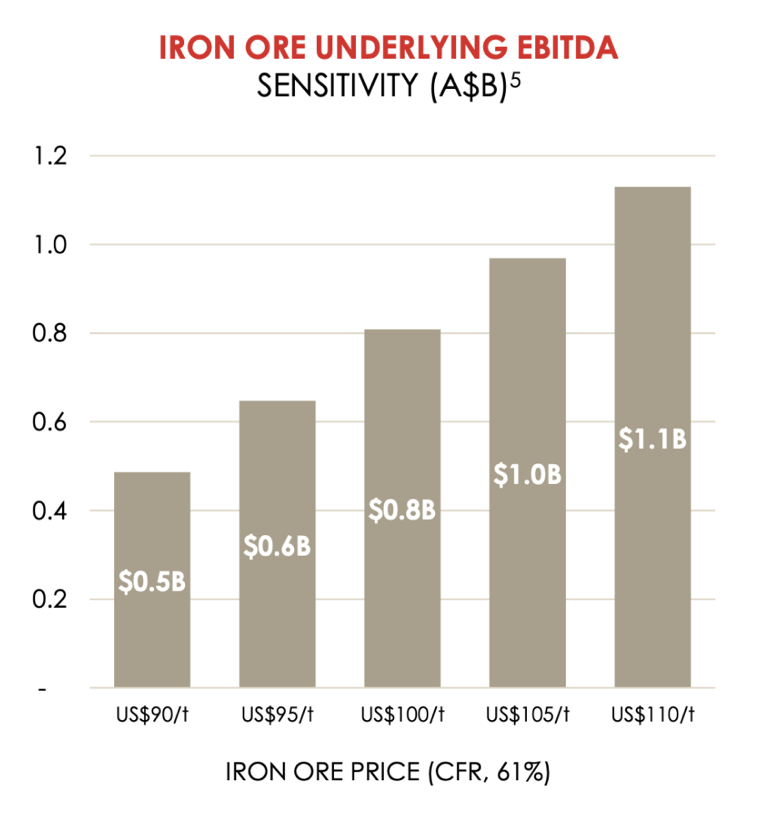
Mineral Resources modelled the effect of a higher iron ore price on its earnings in its full-year update:
Source: Mineral Resources
You can see the dramatic effect on its earnings if iron ore was to lift to US$110. This only seems likely if China were to conduct a major credit expansion.
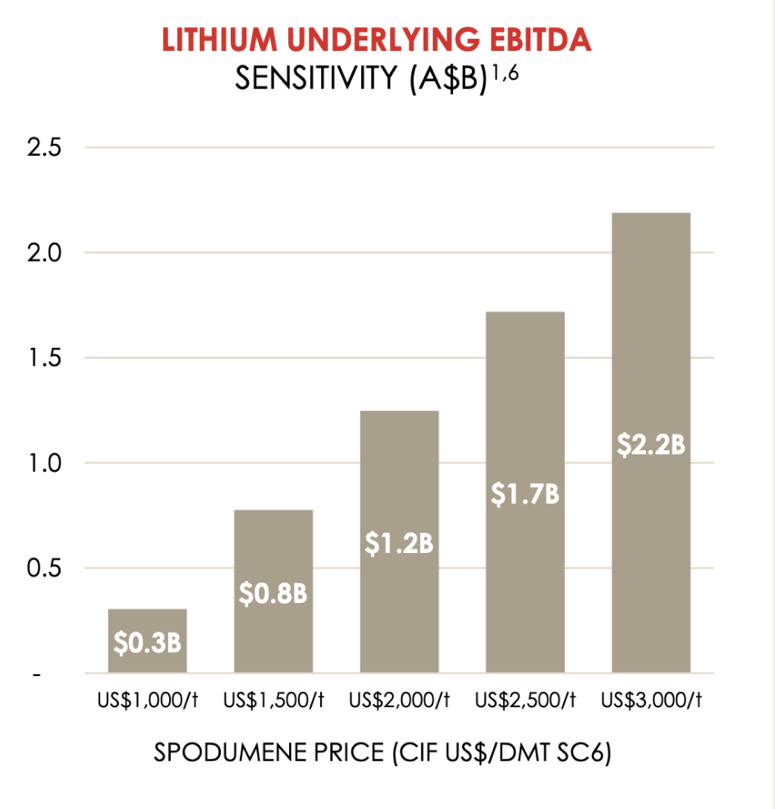
It’s a similar story with lithium, too:
Source: Mineral Resources
As it is right now, neither lithium spodumene nor iron ore are trading at the high levels on these charts.
Commodities could rally if this happens
One analyst who sees potential for Chinese stimulus is Michael Howell, who authors the Capital Wars series on Substack.
Resource investors will know if this is happening before anyone else, according to Howell.
He wrote in a recent update: “Given China’s role in global raw-material demand, the first evidence of reflation may appear in liquidity-sensitive commodities and hard assets before it becomes obvious in headline Chinese economic statistics and equity indices.”
Australians have every reason to watch the price of iron ore because it’s their number-one export — crucial to government revenue and the major miners on the ASX, such as Mineral Resources.
Any unexpected rise in the iron ore price could be a clue that China is stimulating its markets.
This would be a tailwind for global growth and could possibly help the Mineral Resources share price recover some of the recent drawdown.
Of course, should the iron ore price fall, it would be a very bearish signal that the Chinese economy is going into distress.
In that case, Mineral Resources would likely continue to fall on the ASX, alongside the broader Materials sector.
Only time can tell how the Chinese authorities respond.
Write to Callum Newman at Mining.com.au
Main image: Unsplash


