

Australian explorer Belararox (ASX:BRX) has identified 11 prospective targets at its new Toro-Malambo-Tambo (TMT) Base Metal Project in the San Juan Province of Argentina.
The company reports the targets were identified through satellite spectral imagery processed by Fathom Geophysics and a geological interpretation completed by independent hydrothermal systems specialist Dr Steve Garwin.
Now that the prospective targets have been identified, Belararox says it will move forward to upgrade historical data to a level of compliance with the JORC 2012 standard, advance environmental impact assessments (EIA), engage geophysical contractors, plan exploration fieldwork, and conduct mapping and sampling over the TMT Project.
Commenting on the targets, Belararox Managing Director Arvind Misra says: “When we first acquired the TMT Project, I said how delighted I was, as we expected it to enable BRX to pursue exploration activities in a highly prospective region in Argentina.
“While we still have a long way to go, the identification of 11 prospective targets with surface expression is a strong first step in the TMT Project meeting our expectations”
While we still have a long way to go, the identification of 11 prospective targets with surface expression is a strong first step in the TMT Project meeting our expectations.”
Belararox says the targets have been ranked across 6 categories, with the A-class category considered more prospective than the B-class. The targets within each class are then prioritised from 1 to 3.
A-class targets identified include the Tambo South, Tambo V, and Malambo, Toro, and Toro North targets. Belararox says the Tambo South, Tambo V, and Malambo targets lie along a north-northwesterly trending zone of ASTER-deduced hydrothermal alteration characterised by jarosite, pyrophyllite, and muscovite.
These alteration minerals are common in the upper portions of porphyry and epithermal systems. The company also says snow cover potentially masks part of the mineral systems at Tambo South and, as a result, fieldwork will aid in confirming the scale of hydrothermal alteration here.
Belararox reports Malambo indicates a ‘strong’ potential for hosting a porphyry-style deposit as it shows several anomalous pyrophyllite-jarosite zones that lie along an inferred north-northwesterly trending structural corridor. The abundance of pyrophyllite and minor amounts of muscovite are consistent with the exposure of the upper portions of an intrusive-porphyry system.
The geological interpretation of the Toro target is consistent with the information obtained from historical exploration reporting by steel producer Votorantim Metal Argentina, which identified D-type veins in the southernmost drillholes and a breccia unit with ‘high’ gold mineralisation that remains untested.
Meanwhile, Belararox says the Toro North target has no historical drillholes, and based on the interpreted jarosite alteration, it is considered to be ‘highly’ prospective for sulphide mineralisation.
Belararox’s Chief Technical Consultant, Argentina, Jason Ward, says: “This satellite spectral study has confirmed the presence of hydrothermal alteration at the 3 main targets at Toro, Malambo, and Tambo, and also identified 8 additional target areas.
We look forward to following up these targets with geological mapping and sampling once our environmental permits are granted.”
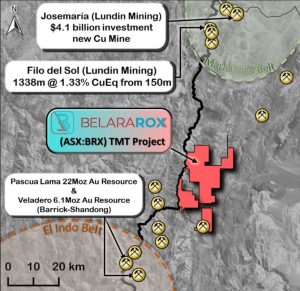
Belararox reports the remaining targets identified are prospective for high-sulphidation mineral systems or porphyry-style mineral systems and notes additional prospective targets will be evaluated at a future date.
Belararox is an ASX-listed mineral explorer focused on securing and developing resources to meet the surge in demand from the technology, battery, and renewable energy markets. The company wields a portfolio of assets including the Belara Project in New South Wales, the Bullabulling Project in Western Australia, and the TMT Project in Argentina.
Images: Belararox Ltd