


Australian mineral exploration company Belararox (ASX:BRX) has extended the mineralisation with new massive sulphide intersections at the Native Bee prospect, located within the Belara Project in central New South Wales.
The company says the recently started phase two drilling program, which will consist of 3,600m of diamond drilling, has intersected visible massive sulphides.
This extensional drilling is intended to build upon the recently announced inferred resource of 5 million tonnes @ 3.41% zinc equivalent (Zn-Eq), and determine the potential of the Belara Project and Native Bee to host commercial quantities of mineralisation.
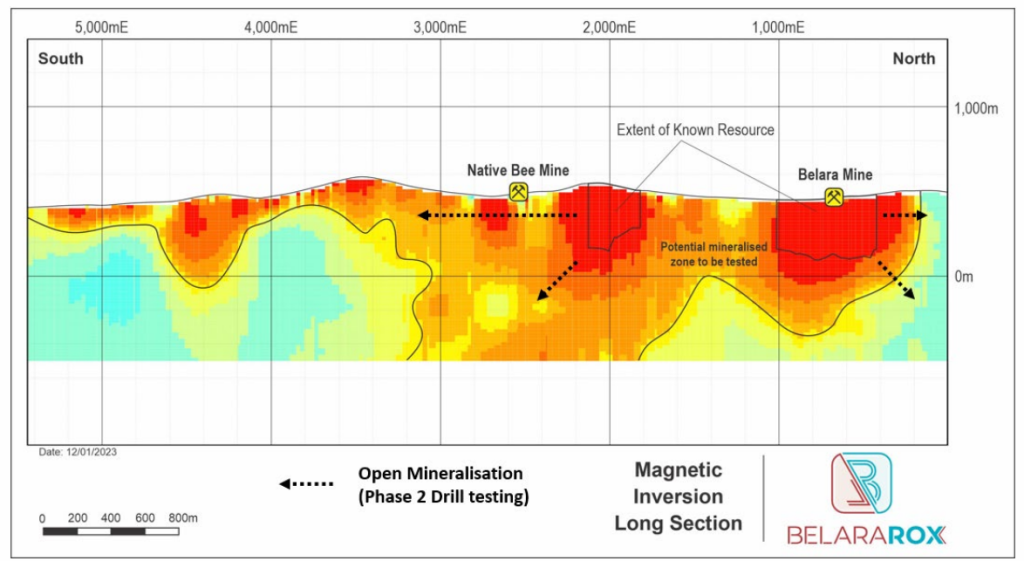
At Native Bee, phase two drilling aims to identify additional mineralisation along strike and in the vicinity of the old Native Bee mine area. It will also seek to assess further mineralisation potential identified in a coincident gradient array induced polarisation (GAIP)-airborne magnetics first derivative (1VD)-gravity anomaly, which extends from the area of the known mineral resource southwards.
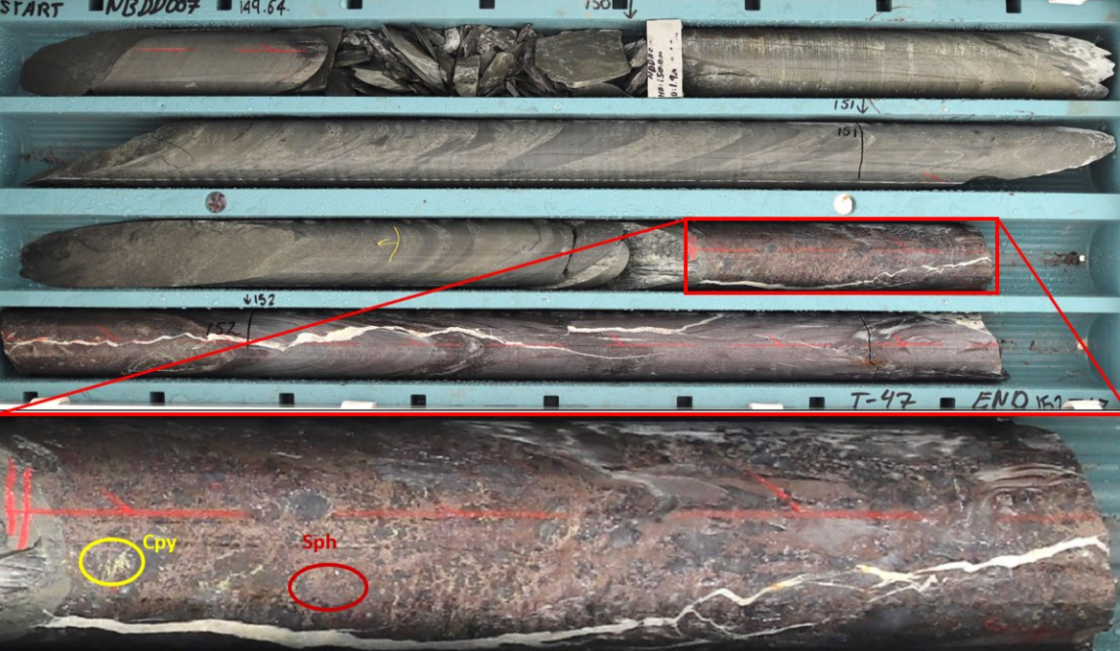
Belararox reports hole NBDD007 intersected visible chalcopyrite (copper) and sphalerite (zinc) sulphides from 151.45m to 158.70m. The company says the mineralised intersections in this hole confirms the continuity of the mineralisation down-dip of NBRC001 and to the south of NBRC002.
Hole NBDD008 intersected visible chalcopyrite and sphalerite sulphides from 205.10m to 211.23m, and confirms additional massive sulphide mineralisation extending to the south of the defined resources at Native Bee.
The company’s share price had risen 4.35% to $0.240 as of 7.30am AWST.
“We are excited that the first 2 diamond drillholes in phase two drilling at Native Bee indicate this is a highly prospective asset with more massive sulphide mineralisation discovered”
Commenting on the results, Belararox Managing Director Arvind Misra says: “We are excited that the first 2 diamond drillholes in phase two drilling at Native Bee indicate this is a highly prospective asset with more massive sulphide mineralisation discovered. Drilling of the southern extension at Native Bee continues.”
Belararox reports the mineralisation at Belara is open to the north and down-dip, and aims to identify additional ‘high-grade’ mineralisation during phase two drilling.
Drillhole BLRC019D from phase one drilling intersected ‘significantly’ wider and ‘higher-grade’ base metal mineralisation than targeted. As a result, the company says phase two drilling will target the continuation of ‘high-grade’ mineralisation intersected in BLRC019D, and from previous drilling.
Phase two drilling is expected to take about 3 months to complete with final assays expected 28 days after the end of drilling.
Belararox also reports ELA6287 was granted as EL9523 on 7 February 2023 for 5 years, and ELA617 was granted as EL9538 on 27 February 2023 for 5 years.
The company says the granting of these new applications will unlock a further 20km of prospective host rocks and structural corridor south of Belara and Native Bee where no exploration work has been carried out. This trend includes the old Ben Buckley base metal deposit.
A close-spaced airborne magnetic survey will be completed over portions of the 20km structural corridor south of Belara and Native Bee. The company expects this survey will identify targets for follow-up ground truthing which will include mapping, sampling, and ground-based geophysics.
Belararox is a mineral explorer focused on securing and developing resources for the battery and renewable energy markets. The company’s portfolio includes the Belara Project in the Lachlan Fold Belt of New South Wales, and the Bullabulling Project near Coolgardie in Western Australia.
Images: Belararox Ltd

