


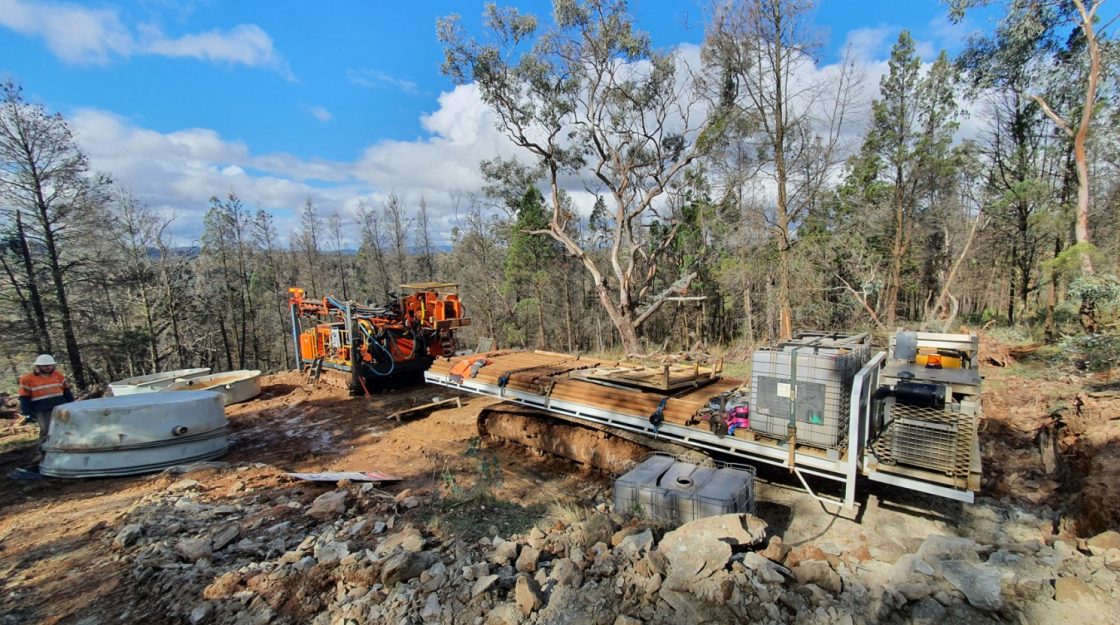
Mineral exploration company Belararox (ASX:BRX) has extended mineralisation from a phase two diamond drill program at the Native Bee mine within its Belara Project in central New South Wales.
The results, generated by several diamond holes completed at the Native Bee target, have returned the best-mineralised intersection to date and confirm the continuity of massive sulphide mineralisation at the target.
The company says mineralisation is indicated to extend more than 100m further south than the estimated resource at Native Bee and remains open at depth.
Key results include hole NBDD007 with 6m @ 4% zinc (Zn), 0.27% copper (Cu), 1.15% lead (Pb), 33.70g/t silver (Ag), and 0.37g/t gold (Au) from 151m including 3m @ 7.57% Zn, 0.06% Cu, 2.11% Pb, 58.27g/t Ag and 0.70g/t Au; and hole NBDD009 with 8m @ 2.17% Zn, 1.08% Cu, 0.14% Pb, 15.55g/t Ag and 0.16g/t Au from 175m.
Results also indicate that the thickness of the massive sulphide lode is increasing with depth, potentially adding ‘significant’ mineralisation below the known Native Bee sulphide resource.
Drilling is being conducted to identify additional mineralisation to the previously announced maiden Mineral Resource Estimate (MRE) at Belara and Native Bee, comprising an inferred resource of 5Mt @ 3.41% zinc equivalent (ZnEq). Drilling has been paused to assess the potential of thicker and ‘higher-grade’ material at depth.
Speaking on the results, Belararox Managing Director Arvind Misra says: “These results from phase two drilling at Native Bee continue to extend the mineralisation, with the best intersection to date recorded at Native Bee, and indicate this is a highly prospective asset with more massive sulphide mineralisation discovered and further exploration upside.”
“These results from phase two drilling at Native Bee continue to extend the mineralisation, with the best intersection to date recorded at Native Bee…”
The company also notes the lode appears less consistent to the south than initially expected and may not be contiguous between the north zone of the reported inferred resources and the area of historical mining at Native Bee.
Additionally, these results follow the discovery of potential lithium-caesium-tantalum (LCT) pegmatite targets at Belararox’s Bullabulling Project in Western Australia, as announced by the company earlier this week (8 May 2023).
The company reported the pegmatites were uncovered following the acquisition of aerial drone imagery and are considered prospective for lithium mineralisation.
With drilling at Belara/Native Bee currently paused, Belararox announces geological mapping and exploration targeting is ongoing to assess further mineralisation potential identified in a coincident airborne magnetics first derivative and gravity anomaly, which extends from the area of the known mineral resource 2km southwards.
Belararox is an ASX-listed mineral explorer focused on high-value clean energy metals and developing resources to meet the surge in demand from the technology, battery, and renewable energy markets. The company’s Belara project is located in the Lachlan Fold Belt of New South Wales and comprises the historic Belara and Native Bee mines that have been drilled to a depth of around 400 vertical metres.
The project is considered prospective for massive sulphide mineralisation, showing ‘significant’ intersections of zinc, copper, silver, lead and gold.
Images: Belararox Ltd


