

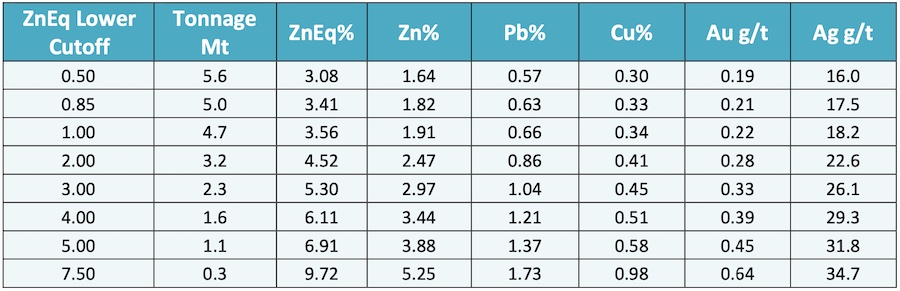
Belararox (ASX:BRX) reports it has delivered its new mineral resource estimate (MRE) of 5 million tonnes for the Belara and Native Bee prospects in central western New South Wales.
The company says phase two drill planning is underway and aims to build upon this initial inferred resource and determine the potential of the project to host significant zinc and copper mineralisation.
Belararox reports the Belara Project comprises 3 contiguous exploration licences (1 granted- EL9184 and 2 subject of applications- ELA6176 and ELA6267) in central NSW, and are prospective for volcanogenic-associated massive sulphide (VAMS) deposits, evident by the presence of 2 small historic underground mines (Belara and Native Bee) that extracted copper.
Belararox Managing Director Arvind Misra said the company is pleased to announce the results of the maiden mineral resource estimate at the Belara Project.
“The mineral resource highlights the extensive polymetallic potential of the Belara and Native Bee Project. This mineral resource estimate also now means the Company has 2012 JORC-compliant mineral resources at our flagship project.
This is an outstanding maiden resource which demonstrates the growing scale and quality of the Belara and Native Bee projects. The fact that we established such a substantial resource in about 10 months since listing in January 2022 also highlights the strength of the mineralisation and the immense ongoing growth potential.
We believe there is significant inventory growth to come, with the mineralisation open in every direction and numerous highly prospective targets to drill.
“This is an outstanding maiden resource which demonstrates the growing scale and quality of the Belara and Native Bee projects”
We will maintain the pace of drilling to unlock the full value of this asset, creating significant value for Belararox shareholders in the process.
The MRE represents a significant achievement by the whole Belararox team. I am immensely proud of their ability to deliver it on time and within budget.
This diligence, along with our recent capital raising, has ensured the company has ample funding to undertake further exploration activities, drilling programs included, aimed at expanding Belara’s projected resource.”
Belararox reports a nominal cut-off grade of 0.5% Zn Equivalent has been used to define mineralisation, and in places, samples reporting less that 0.5% ZnEq were included to improve domain continuity and reduce modelling issues.
SKR Australasia, a consultancy group has identified 2 major mineralised horizons and domains of interest (Domains 10 and 20 at Belara and Native Bee respectively), and this major horizon could be traced over the full north-south strike length of both Belara and Native Bee, and the orientation and thickness was observed to be consistent of the extents of the mineralisation.
The company says the mineralisation wireframes were used to assign codes to the drillhole samples, and many of these samples had been collected on 1m intervals, and prior to grade and statistical interpolation the assay data were downhole composited to 1m lengths.
Variographic studies were conducted to quantify grade continuity and to assist with the selection of estimation parameters, and the experimental semi-variograms were estimated from the 1m composite data and as a result of the variography for Domain 10 being calculated, this variography was assumed for Domain 20.
A block model for both Belara and Native Bee was created to cover the extents of the drill coverage, and when choosing the appropriate model cell dimensions, consideration was given to the drill spacing and sampling interval, the interpreted geometry and thickness of the lithological units, and the expected end-user requirements for the resource model.
SRK also used the Kriging neighbourhood analysis to check the suitability of the selected cell size, and Ordinary Kriging (OK) was used for grade interpolation.
Belararox says the mineralisation boundaries were treated as hard boundary domains, meaning model cells were estimated using only the samples in the same domain, and estimates were made to the location of the parent cell using a 3 by 3 by 1 discretisation matrix.
A multi-pass search strategy was implemented which includes subsequent passes, less stringent parameters are used to estimate the grades of the cells that did not meet the first pass criteria, and the resource estimate provided by Belara was derived from Vulcan modes and subsequently post-processed to a model that could be loaded as a .csv file in other software.
To validate the mineral resource model visual assessment, statistical comparison and swath plots were used.
Belararox reports the Belara project MRE was classified in accordance with the JORC 2012 code, and numerous factors were taken into consideration when assigning the classification applied to the MRE, and of these factors it is considered the classification has been primarily influenced by the drill coverage, geological complexity and data quality as described in the data quality, geological complexity and data coverage.
For data quality, the datasets comprise a mix of data acquired from programs conducted prior to Belararox’s acquisition of the Belara project, and direct QAQC data was not available for some of the historical data drilled after 1992, but SRK considers that comparisons between datasets indicate that this historical data is ‘sufficiently’ reliable for resource estimation when classification is considered.
For the geological complexity, the general orientation of the major defined domains appear to be consistent and predictable, and thickness is the only variable, and the company says the domains display lithological continuity between holes, with individual domains easily traced along and between drill sections although localised variability is evident.
For data coverage, Belararox says this varies from sub-regions with a nominal spacing of 50m by 150m up to nominal spacing of 150m by 200m, and the variography studies indicate geological continuity between drillholes.
Belararox reports all estimated domain model cells within the defined extents were assigned a classification of inferred mineral resource, fulfilling the criteria of less than 150m average distance to sample during estimation and above the 75mRL.
SRK envisages that the material will be mined mainly by underground methods and considers that the total depth of mining to around 400m true depth is not inconsistent with benchmarks for other similar underground operations of similar mineralisation style, and as such Reasonable Prospects for Eventual Economic Extraction (RPEEE) has been considered.
Belararox reports the Native Bee mineralised trend comprises a coincident GAIP-1VD-FLEM anomaly extending from the area of recent phase one drilling, and area of reported inferred resources southwards over some 1,500m.
Phase two drilling aims to target the full extend of this 1,500m trends and will aim to identify additional inferred resources in the vicinity of the Native Bee mine and assess for the potential of mineralisation extending further south.
In addition, the company says a close spaced airborne magnetic survey will be completed over portions of the 20km structural corridor south of Belara and Native Bee, including ELA6176 once it is granted, and it is envisaged this will identify targets for follow-up ground truthing including mapping, sampling, and ground-based geophysics.
The Belara project area is located on the northern end of the Hill End Trough in the eastern Lachlan Orogen in central NSW, and the geology of the project area is dominated by volcanic and quartzose sandstone of the Chesleigh Group.
Belararox says the Belara prospect occurs within a sequence of Silurian quartz-muscovite-albite phyllites and meta-sandstone that overlie dacitic volcanics near the top of the Chesleigh Formation, and the mineralisation occurs at the top of the phyllite unit.
It also reports a gossan outcrops along the line of the historic workings at Belara, and the rocks to the east of the Belara lode are composed of greywackes with minor conglomerate layers and fine-grained argillite bands, described as very acidic and interpreted to be reworked acid volcanic quartz-feldspar porphyries.
The Belara prospect occurs on the eastern limb of a north-northwest striking antiform (Glencoe Anticline) and the mineralisation occurs within a lithological sequence that is typical of Iberian-type VAMS mineral systems, and the interpretation of drill core indicates the Belara lode consists of massive and stringer to disseminated pyrrhotite-chalcopyrite mineralisation with an upper zone that is enriched in galena and sphalerite.
Belararox says the lode is conformable with the strong regional cleavage, however this cleavage is parallel to the sedimentary bedding.
Similar to Belara, the lode at the Native Bee prospect occurs in a sequence of Silurian sediments that overlie dacitic volcanics near the top of the Chesleigh Formation and has been interpreted as Kuroko-type VAMS mineralisation, and the lode occurs along strike to the south from Belara in an identical stratigraphic position.
Belararox says the historic workings at Native Bee are associated with the presence of a dioritic intrusive that is ‘intensely’ altered and its textures have been overprinted and the contact metamorphism is minimal and limited to the enclosing sediments.
It also notes this intrusive does not appear related to the mineralisation, and while it does not outcrop at Belara, it has been intercepted in drillholes.
Belararox reports phase two drill program planning is well underway to increase the resources at both Belara and Native Bee, and assess for the potential of mineralisation extending further south, an it is envisaged drilling will commence later this year or early next year dependent on potential delays relating to wet weather, access and contractor availability.
A heritage agreement with the Warrabinga Wiradjuri Native Title Claim Group has also been executed, with grant of 2 exploration licence applications (ELA6176 and ELA6287) progressing, and exploration planning for these tenements is underway and expected to commence once the applications have been approved.
Belararox is a mineral explorer focused on securing and developing resources to meet the surge in demand from the technology, battery and renewable energy markets, and it’s projects include the Belara Project in the Lachlan Fold Belt of New South Wales and the Bullabing Project near Coolgardie in Western Australia.
Images: Belararox Ltd