

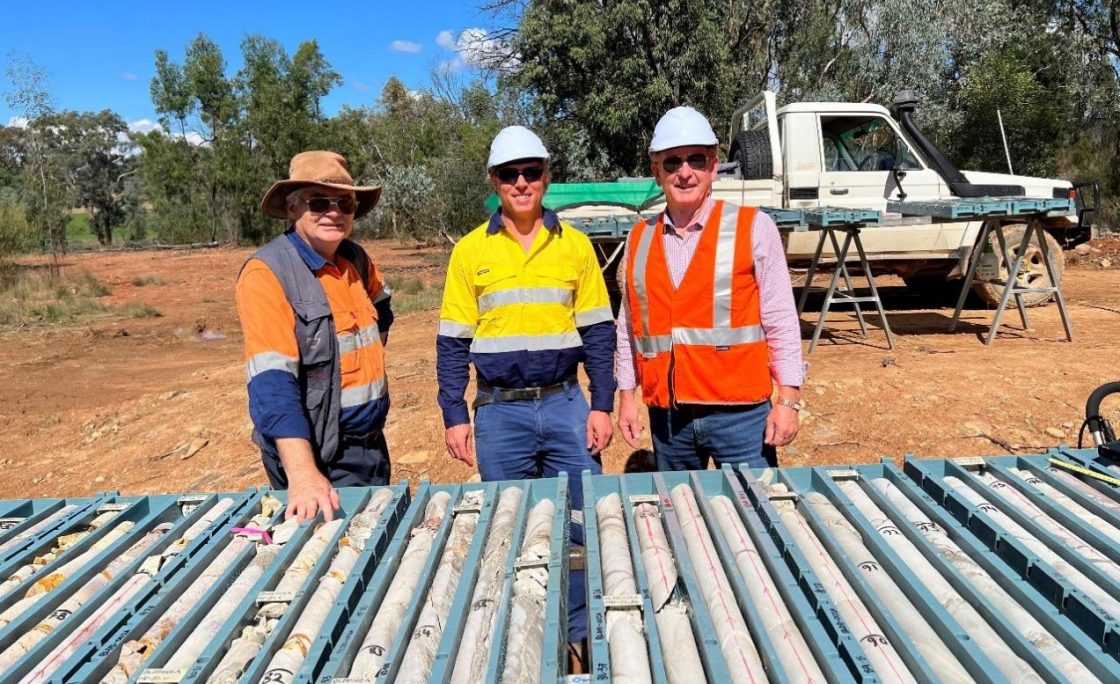
Belararox (ASX:BRX) reports it has continued to receive ‘high-grade’ results from phase one reverse circulation (RC) and diamond core resource drilling at its Belara mine.
A total of 3,728 samples have been sent to the laboratory in Orange since the drilling started at Belara, with 571 assay results pending. These results should be available in the coming weeks.
Acquisition of DHEM and FLEM survey data has been completed, with preliminary 3D appraisal of the data to be completed with supporting drilling data as inputs. This technique could prove a viable method to map in 3D, potential strike and depth extensions at both Belara and Native Bee.
The company reports that if successful, this technique will provide a valuable tool to quickly and cost effectively test those targets mapped by the prospectivity modelling and provide more accurate 3D targets for the planned phase two drill planning.
The initial metallurgical flotation test work was completed, with encouraging preliminary results confirming the zinc, copper, and lead bearing sulphide minerals can be recovered using flotation.
Belararox notes it the recovered concentrates are being assayed and follow up test work will be planned once the preliminary metal recoveries are understood.
The drilling aims to build upon historic results to determine the potential of the Belara Project to host significant zinc and copper mineralisation.
Highlights include:
- 10.0 m at 3.80% Zn, 0.25% Cu, 1.26% Pb, 46.50 g/t Ag and 0.49 g/t Au from 203.0m, including 5.0m at 4.95% Zn, 0.44% Cu, 1.84% Pb, 75.94 g/t Ag and 0.75 g/t Au in BLRC019D.
- 4.0 m at 4.19% Zn, 0.40% Cu, 1.44% Pb, 47.55 g/t Ag and 0.27 g/t Au from 69.0m, including 2.0m at 6.12% Zn, 0.79% Cu, 1.79% Pb, 75.60 g/t Ag and 0.30 g/t Au in BLDD029.

Addressing the results, Managing Director Arvind Misra commented: “We are impressed with the continued high quality assay results received from our phase one drilling campaign. Some of the intersections are significantly wider and higher-grade than targeted, confirming the continuity of the interpreted base metal mineralisation in the historic resource model.
“We are impressed with the continued high quality assay results received from our phase one drilling”
We now look forward to the completion of our maiden resource estimation by October and the next stages of exploration work to potentially extend Belara and Native Bee along strike and at depth.”
The Belara and Native Bee mine areas are the first high priority targets for resource drilling. A phased approach is being taken to the drilling of the Belara and Native Bee mine targets.
Phase one aims to deliver the density of drill assay intersections to support an Inferred Mineral Resource estimate prepared in accordance with the JORC (2012) code over the known area of mineralisation at the Belara and Native Bee mines.
A total of 33 drillholes were completed in Phase 1, with new assay results from 14 drillholes received.
BLRC019D intersected significantly wider and higher-grade base metal mineralisation than targeted, confirming the continuity of the interpreted base metal mineralisation in the historic resource model.
BLRC020D, further to the north from BLRC019D, also intersected a 7m wide zone of base metal mineralisation, confirming the continuity of the mineralisation in the historic resource model, and down-dip of BLRC007.
Most importantly, results from BLRC019D and BLRC020D confirm high-grade mineralisation is both open down-dip and along strike to the north of the previously identified mineralisation.
BLRC023 was drilled to confirm base metal mineralisation intersected in B005 (5.94m at 1.73% Zn, 1.63% Cu, 0.37% Pb and 27.73 g/t Ag and 0.28 g/t Au from 102.56m).
BLRC022 was drilled to confirm mineralisation intersected in B001 (1.34m at 5.33% Zn, 0.85% Cu, 1.32% Pb and 82.05 g/t Ag from 61.69m) and was terminated early due to drilling difficulties. As the entire width of the mineralised zone was not tested, it was decided to drill a diamond twin hole (BLDD029) to confirm the mineralisation in BLRC022/B001 and intersect the entire mineralised zone.
At Native Bee, new assay results have been received from four holes of Phase One resource drilling, namely NBRC003, NBRC004, NBRC005 and NBRC006.
The massive sulphide intersections in NBRC003 and NBRC004 are close to the predicted location of the mineralisation in the historic resource model, confirming the continuity and geological interpretation of the geometry of the mineralisation. However, both new intersections contain less combined zinc, copper, lead, silver and gold mineralisation than previously predicted by the historic resource model.
NBRC005 and NBRC006 have returned no significant intersections and indicate the mineralisation is possibly pinching out along strike to the north.
However, the company notes that the width and total metal content of the mineralisation in NBRC002 is significantly better than the interpreted mineralisation in the historic model. This suggests that mineralisation is improving in width and grade at depth and southwards towards the old Native Bee mine workings, located some 400m along strike from NBRC002, and which have not been drill tested to date.
Further, the new assay results confirm the spatial association of higher-grade zinc, copper, lead, silver and gold mineralisation with both the gravity and electrical geophysical anomalies announced on 30 March and 23 March 2022.
There is also further potential to extend the known mineralisation intersected in NBRC001 and NBRC002 a further 2,000m to the south based on the geophysical anomalies and prospectivity mapping results.
This area will also be drill tested by the planned Phase Two drilling program in conjunction with DHEM and FLEM survey data to better understand the size and geometry of any mineralisation intersected.
The results for all the new holes assayed have been entered into the drill hole database and quality control reviews have been completed. All check samples, blanks, and sample weights have been reviewed as part of an ongoing quality control process and returned results within accepted expected statistical ranges, which confirm the validity of the assay results.
Write to Adam Orlando at Mining.com.au
Images: Belararox Ltd