



The Australian Workers’ Union (AWU) is calling for greater regulation around silica exposure in the mining sector.
The AWU wants the sector and governments to introduce regulation on silica exposure that would bring mining into line with stonemasonry and tunnelling to mitigate the current risk of silicosis — a lung disease that is caused by breathing in particles of silica.
According to the Lung Foundation Australia, it is estimated that up to 600,000 Australian workers are exposed to silica dust in the course of their employment.
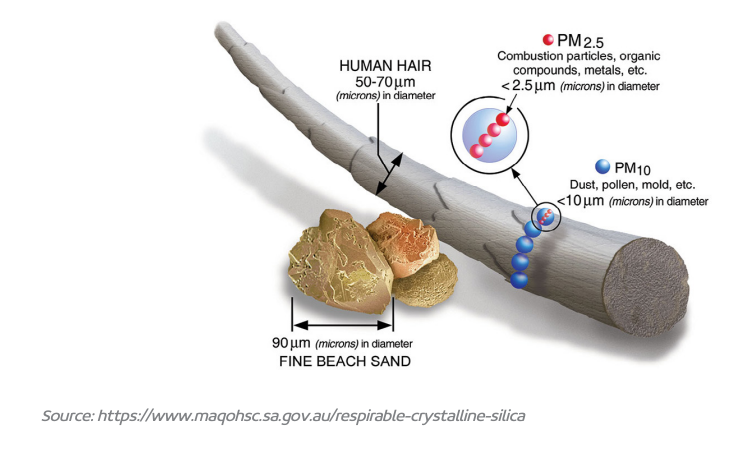
When silica dust is less than 10 micrometres, it is known as respirable. These particles stay in the air and when breathed in, they penetrate deep into the lungs.
The Lung Foundation Australia reports that alongside silicosis, breathing in silica dust can cause lung cancer, chronic obstructive pulmonary disease, rheumatoid arthritis, chronic kidney disease, and other autoimmune conditions.
Brad Gandy, Western Australian secretary of AWU, says falling into line with national safety standards on silica would be an excellent place for the mining sector to start repairing its damaged relationship with workers.
“Over the past year we have seen all states and territories agree to ban the production and supply of high-risk engineered stone products and regulation about exposure to silica in tunnelling,” Gandy says.
As of 1 September 2024, there are now stronger work health and safety (WHS) regulations of all materials containing at least 1% of crystalline silica. A person must not conduct, direct, or allow a worker to carry out work that involves manufacturing, supplying, processing, or installing engineered stone benchtops, panels, and slabs.
“But employers in mining are hiding behind the use of separate laws to regulate this industry to uphold outdated and inadequate WHS standards,” Gandy says.
“The AWU will keep fighting until it has secured justice for all workers exposed to silica-related harms.”
In conjunction, the AWU is also calling out BHP (ASX:BHP), Rio Tinto (ASX:RIO) and the Minerals Council of Australia on their anti-union stance in the Pilbara region, which the union says risks mining’s social licence.
The AWU calls for these companies to reassess their campaign against the Western Mine Workers Alliance (WMWA).
AWU says the campaign is recognised as “socially and politically unsustainable to extract billions in profit from Pilbara resources, whilst treating Pilbara workers with disrespect.”
The union wants the mining lobby to recognise how its “disproportionately aggressive campaigning against mainstream unions and reasonable enterprise agreements in the Pilbara is contributing to the rise of disillusionment and political extremism among blue collar Australians”.
Paul Farrow, National Secretary for AWU, says both resolutions are critical to the union’s agenda.
“The sooking we’ve seen from BHP and Rio Tinto about very normal union activity in the Pilbara is testament to how much they’ve been allowed to get away with in recent years,” Farrow says.
“They’re having a tough time coming to terms with the fact we now have an Australian Government that wants to help real Australians — instead of just being the obedient servant of mining corporate interests.”
Farrow adds that if the resources lobby wants to maintain the profitable social licence granted by Australia, it would need to make sure that Australians employed are “shown genuine respect.”
“BHP and Rio like to make out that everyone in iron ore mining is making great money and it’s a total lie,” he says.
As ore prices reached all-time highs, pay rises offered by both companies did not keep up the pace with inflation.
“Pilbara mine workers used to enjoy coverage under enterprise agreements and that’s the situation we need to get back to,” Farrow adds.
The Australian Workers Union works to ensure working Australians get better deals through safety, industrial, community, policy, and political campaigns. The union supports steel workers to gold miners, and fruit pickers to offshore gas workers.
Write to Aaliyah Rogan at Mining.com.au
Images: Oizom, Lung Foundation Australia & South Australian Government


