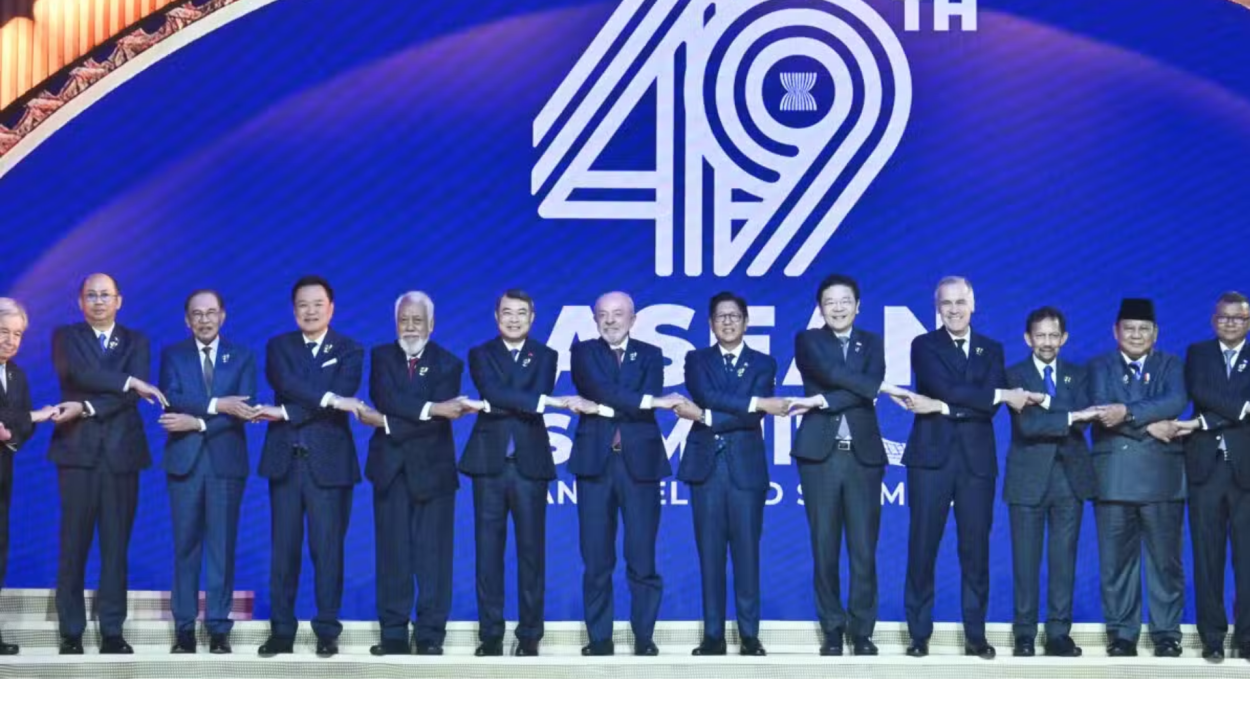
The Association of Southeast Asian Nations (ASEAN) is seeking to strengthen its position in the global critical minerals supply chain by attracting greater investments and expanding regional production capabilities, the Philippine Daily Inquirer reports.
In a declaration adopted during the 49th ASEAN Summit in Manila on Sunday 15 November 2026, ASEAN leaders committed to developing an ASEAN Critical Minerals Strategy to guide cooperation across the minerals value chain. This encompasses exploration and extraction, processing, refining, manufacturing, and recycling.
ASEAN recognises the region’s “significant critical mineral endowment” and its growing role as a producer, refiner, and consumer of minerals essential to industrial development, the global energy transition, digital transformation, and emerging technologies.
The declaration cites the need for “secure, resilient, diversified, and sustainable critical mineral supply chains” to support the region’s long-term development, competitiveness, and economic security.
Under the proposed strategy, ASEAN aims to identify priority regional value chains and investment opportunities, strengthening its position as a “resilient, competitive, and sustainable critical minerals hub” in the region.
To support these efforts, the bloc will seek to mobilise responsible public and private investments and financing for critical minerals development, including through the ASEAN Minerals Investment Forum and ASEAN Minerals Connect.
The declaration also calls for greater cooperation in research and development, technology transfer, geological knowledge, and human capital development to improve the region’s capabilities across the value chain. ASEAN likewise commits to advancing “circularity and resource efficiency” through efficient resource use, recycling, secondary recovery of minerals, and other circular economy approaches.
Meanwhile, the ASEAN Ministerial Meeting on Minerals is tasked with developing and implementing the regional strategy, including priority actions, initiatives, investment opportunities, and measurable outcomes, while regularly reporting progress through appropriate ASEAN mechanisms.
Separately, the US-led Pax Silica initiative — which seeks to secure global supply chains for artificial intelligence, semiconductors, and critical minerals while reducing dependence on China for manufacturing and rare-earth processing — includes plans to establish an industrial hub in Central Luzon, Philippines.
However, US Ambassador to the Philippines Lee Lipton says there will be no announcement on the Pax Silica project “during or after” the ASEAN events.
Coalitions press ASEAN leaders for binding mining safeguards
Civil society coalitions are pressing Southeast Asian leaders to establish legally binding human-rights and environmental safeguards as the Philippines hosts the summit.
According to a report by BusinessMirror, The Asia Pacific Transition Mineral Accountability Working Group (AP-TMA WG) warns that surging critical mineral demand threatens communities unless strict protections are enforced.
Southeast Asia supplies over two-thirds of global nickel and holds 60% of rare-earth reserves, making regional regulatory shifts a primary concern for international resource investors and project developers.
In its warning, the coalition highlights resource and trade negotiations involving the Philippine Government, including the proposed US-Philippines Pax Silica framework, bilateral free-trade talks with Canada, and the broader Canada-ASEAN trade deal.
Despite statutory protections under the 1997 Indigenous Peoples’ Rights Act, weak enforcement in the Philippines leaves indigenous and rural communities exposed, with nickel extraction opponents facing heightened risks and harassment.
The coalition calls on Manila to use its ASEAN chairmanship to embed enforceable human-rights standards, corporate accountability, contract transparency, and equitable benefit-sharing directly into the ASEAN Critical Minerals Strategy.
The groups also demand strict adherence to free, prior, and informed consent (FPIC) for indigenous peoples, a full fossil fuel phase-out by 2030, and dedicated financing for a just energy transition.
National coordinator of Publish What You Pay Indonesia and Asia Pacific representative on the Global Board of the Resource Justice Network Aryanto Nugroho says “the Critical Minerals Strategy is where they must keep that promise”.
“Rights, consent, and fair benefit-sharing must sit at the heart of the region’s mineral strategy — not as an afterthought to investment deals,” he adds.
The Association of Southeast Asian Nations is an 11-member regional intergovernmental organisation promoting economic, political, and security cooperation across Southeast Asia.
Write to Paula Fabe at Mining.com.au
Main image: Philippine Daily Inquirer