


Concerns over rare earth supply are back in the spotlight. Geopolitical tensions have exposed the West’s continued dependence on China for some of the world’s most strategically important minerals.
The issue has gained renewed attention, following reports that some Chinese suppliers have stopped shipping rare earth products to US customers — just weeks before Chinese President Xi Jinping’s planned visit to Washington.
The timing is significant, with the US-China trade truce approaching its expiry and rare earths becoming increasingly important to advanced military systems.
China accounts for around 60% of global rare earth mine supply. Its influence, however, is even greater further downstream, leaving countries such as the US exposed to Chinese export policies and restrictions.
New era of resource security
The world is entering what Sprott analyst Justin Tolman describes as a “new era of resource security”, characterised by increasingly fragmented supply chains.
Few commodities illustrate that shift more clearly than rare earth elements.
Their specialised magnetic, optical, and thermal properties can be difficult to replicate with alternative materials without sacrificing performance, weight, or reliability.
As a result, rare earths have become critical to technologies, ranging from electric vehicles and robotics to wind turbines, artificial intelligence infrastructure, and advanced industrial automation.
Their strategic importance means rare earths have become as relevant to corporate boardrooms and capital markets as they are to policymakers and military planners.
Nowhere is that importance more apparent than in defence.
Global defence spending exceeds US$2.7 trillion ($3.7 trillion) annually, according to World Bank data. The US Department of Defense (DoD) requires an estimated 3,000–4,000 tonnes of specialised rare earth magnets each year.
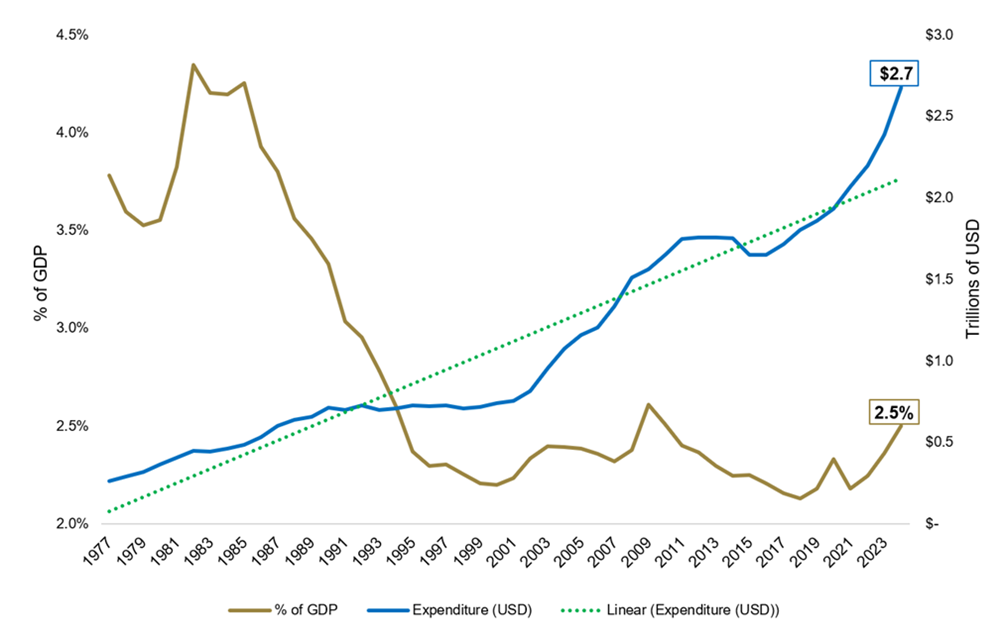
That figure is expected to rise to 10,000 tonnes by 2030. While relatively small compared with a roughly 250,000-tonne global market, it is significant against ex-China rare earth magnet production of just 20,000–25,000 tonnes today.
The vulnerability of these supply chains has already been demonstrated. Deliveries of new F-35 fighter jets were temporarily halted after a Chinese-sourced alloy used in an engine magnet was discovered in the aircraft’s supply chain.
Defence demand adds urgency
With geopolitical tensions elevated and weapons systems becoming more technologically advanced, defence demand for rare earths is likely to become increasingly important.
NATO has classified rare earth elements among its 12 defence-critical raw materials, while members have pledged to lift defence spending to 5% of GDP by 2035.
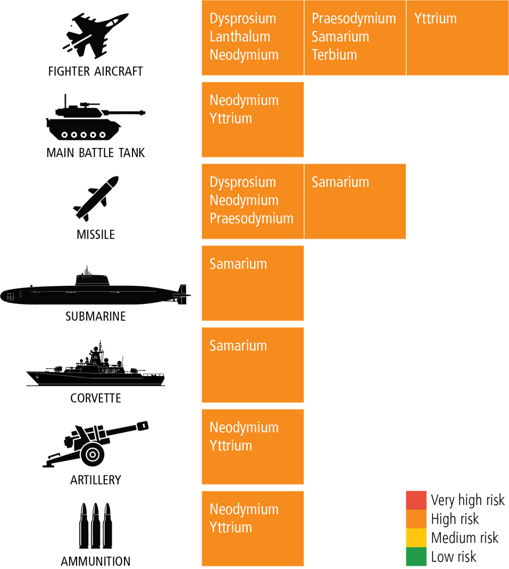
The composition of that spending matters too. Warfare has become increasingly electrified, autonomous, and sensor-driven. As such, it requires greater use of advanced electronics, precision systems, and high-performance components.
For defence buyers, security of supply can, therefore, outweigh price considerations.
“Reliability and source of supply matter more than cost to a buyer,” Tolman writes.
“In a market where China administers rare earth prices through quotas and export controls, the US is carving out a parallel market in which supply security can take precedence over prevailing market prices.”
Breaking China’s grip on the supply chain
Reducing reliance on China, however, requires far more than opening new rare earth mines.
A US Geological Survey (USGS) report this year showed Washington has become increasingly dependent on foreign mineral imports, highlighting the challenge of reversing decades of Chinese investment in mineral supply chains.
“This report underscores just how hard it is to put a dent in China’s decades-long strategy to dominate the world’s minerals markets,” National Mining Association President and CEO Rich Nolan says.
China’s dominance is particularly pronounced beyond the mine gate.
Rare earth production involves several stages, including mining, separation, refining, metal and alloy production, and, ultimately, magnet manufacturing.
According to the International Energy Agency (IEA), China refined 91% of the world’s magnet rare earths and produced 94% of finished rare earth magnets in 2024.
That means developing a mine outside China does little to improve supply security if its output must still be shipped to China for processing or magnet manufacturing.
Sprott Director, ETF Product Management, Jacob White sees China’s control over the world’s rare earth supply as a problem that spans almost every high-tech sector.
“They’re in AI and data centres, robotics, and defence programs — everything from your F-35s to radars, satellites, and naval ships — as well as the energy grid, specifically electric vehicles and motors, and wind energy,” he said in a recent interview with Mining.com.au.
Even the smallest amounts of these minerals can make a huge difference. As White points out:
“Even though you only need very small amounts of them, you don’t have a fighter jet that really works without the permanent magnets that rare earths are critical within. There’s really no substitution.”
For investors and policymakers, the challenge is, therefore, not simply finding more rare earth deposits. It is in creating integrated supply chains capable of converting those resources into finished products.
Building an ex-China supply chain
Governments and industry are now pouring capital into building those capabilities outside China.
In the US, MP Materials (NYSE:MP) operates the Mountain Pass Rare Earth Mine in California and a magnet manufacturing facility in Texas. Energy Fuels (TSX:EFR) and USA Rare Earth (NASDAQ:USAR) are among companies pursuing similar integrated strategies.
Last year, MP Materials secured an offtake agreement and price-floor guarantee from the US Department of Defense. The agreement would help protect the company against prices falling below an agreed level in exchange for supporting domestic supply.
Still, processing rare earth concentrates into usable materials is highly technical and requires specialised facilities, expertise, and significant investment. Rebuilding these capabilities — particularly magnet manufacturing — will require time, capital, and sustained cooperation between government and industry.
As a result, some US rare earth producers have been selling products into Japan and South Korea, where magnet manufacturing capacity is more established.
The gap presents both an opportunity and a challenge, according to Sprott.
New projects must overcome permitting hurdles, high capital costs, technical complexity, long development timelines, and volatile commodity prices. Strategic importance alone also does not make every project economically viable, meaning some developments will require government support.
That support is already growing. Since 2020, the Pentagon has awarded close to US$1 billion to establish domestic rare earth supply chains spanning separation, refining, metals, and magnet manufacturing.
Last month, the DoD launched a further US$1.55 billion critical minerals initiative, including US$750 million aimed at rare earth production and processing capacity in Brazil.
US policy is increasingly moving beyond simply funding new capacity towards price support, long-term offtake agreements, and financing mechanisms. These tools are designed to improve project economics and reduce investment risk.
Canada emerges as another potential source
Canada could also play an important role in building an ex-China rare earth supply chain.
While the country does not yet have commercial rare earth production, it hosts several advanced exploration and development projects and some of the world’s largest rare earth resources.
Among them is Defense Metals’ (TSX-V:DEFN) Wicheeda Project in British Columbia. A Prefeasibility Study released last year outlined potential production of around 5,000 tonnes of neodymium-praseodymium (NdPr) annually, which the company says could represent approximately 7–8% of global output.
Further north, Vital Metals (ASX:VML) is advancing Prefeasibility work on the surface resources at the Nechalacho Project in the Northwest Territories.
The deeper Nechalacho resources are owned by Avalon Advanced Materials (TSX:AVL), which is undertaking new economic studies building on a 2013 Definitive Feasibility Study (DFS).
Avalon’s preliminary economic assessment (PEA) incorporates an updated resource released last month containing 58.6 million tonnes in the measured and indicated categories grading 1.494% total rare earth oxides.
Nechalacho also contains a broad range of rare earth mineralisation. Its updated resource reports grades for 15 individual rare earth oxides, including principal magnet rare earths NdPr, dysprosium, and terbium.
“At a time when governments and industry are increasingly focused on establishing secure Western supply chains for critical minerals, Nechalacho represents a unique opportunity,” Avalon CEO Scott Monteith said in an August release.
“[The project is] a large, extensively studied Canadian resource containing meaningful concentrations across a broad range of commercially important rare earth elements.”
Avalon plans to release a PEA in Q4 as it builds towards a new DFS.
Another Northwest Territories project to watch is Rackla Metals’ (TSX-V:RAK) South Lened Rare Earths Project. Its exploration target is defined by a 3km-long anomalous cerium and lanthanum stream-sediment trend.
A review of government Regional Geochemical Survey data found that, among 42,000 samples in the database, the most anomalous sample for several rare earth elements — including lanthanum, cerium, samarium, terbium, and ytterbium — came from South Lened Creek.
Québec is another prospective region. Privately held Torngat Metals is advancing the Strange Lake Rare Earth Complex in Nunavik, which is planned to include an open-pit mine and concentration plant targeted for commissioning towards the end of the decade.
Meanwhile, Makenita Resources (CSE:KENY) acquired the roughly 3,642-hectare NTX Rare Earth Project last year, adding another prospective rare earth property to Canada’s growing critical minerals pipeline.
With China retaining overwhelming control of downstream rare earth processing and magnet manufacturing, building an alternative supply chain will take years.
However, rising defence demand, geopolitical tensions, and growing government support are creating a stronger incentive — and potentially a larger opportunity — for projects capable of supplying an increasingly security-focused Western market.
Write to Jackson Chen at Mining.com.au
Images: Sprott