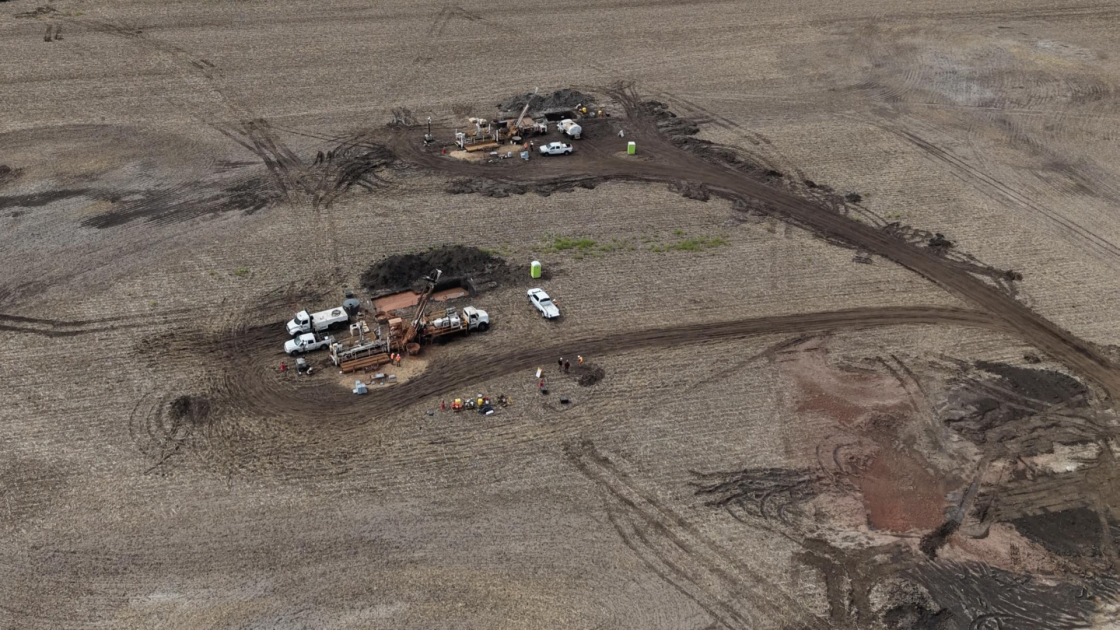
Apex Critical Metals (CSE:APXC) describes monazite and bastnaesite mineralogy at the Rift Rare Earth Project in Nebraska, US, to be ‘favourable’ following results from a quantitative X-ray diffraction campaign.
Mineralogical analysis conducted on drill holes RIFT26-001A, RIFT26-002, RIFT26-003, and RIFT26-005A confirms monazite and bastnaesite to be the dominant rare earth element (REE)-bearing minerals within the Trinity and Neo zones of the Rift Project.
Apex describes these results as ‘favourable’, noting that monazite and bastnaesite are the two REE minerals “responsible for the substantial majority of global rare earth oxide production”.
The findings are believed to derisk the Rift Project as monazite and bastnaesite have ‘well-established’ mineral processing flowsheets for recovery from carbonatite-type deposits.
Data is set to inform preliminary metallurgical test work for the Rift Project. The program will be conducted shortly at SGS Canada’s Metallurgical Centre of Excellence in Lakefield, Ontario, Canada.
CEO Sean Charland says the mineralogical results retrieved in this campaign are an “important confirmation for the Rift Project” that validate historical literature.
“Monazite and bastnaesite are the same two minerals that underpin the majority of the world’s existing REE supply chain,” Charland says.
“Seeing them as the dominant REE hosts at Rift, rather than a complex assemblage of less-understood phases, is a strong signal for the potential metallurgical simplicity of this deposit as we advance toward our inaugural mineral resource estimate.”
SGS Geochemistry will conduct a TESCAN integrated mineral analyser (TIMA) testing on select samples retrieved from the Trinity and Neo zones.
TIMA characterises individual mineral grains, provides quantitative data on REE mineral species, grain size distribution, and degree of liberation from host gangue minerals.
The automated mineralogical technique is expected to refine Apex’s understanding of REE mineral speciation.
Located in southeastern Nebraska, the Rift REE Project is described as a ‘globally significant rare earth and niobium project’, sitting within the Elk Creek Carbonatite Complex.
Elk Creek ranks among the largest carbonatite bodies in the world, with a diameter of between 6–8km.
Rift is positioned within a tier-one mineral jurisdiction, offering nearby infrastructure and geopolitical stability.
As reported by Mining.com.au earlier this month, Apex returned ‘high-grade’ rare earth oxide (REO) intercepts from recent drilling at the project.
Hole RIFT26‑014 intersected 5.27% REO over 10.2m within a broader interval of 148.5m @ 2.09% REO. The hole also returned 4% REO over 21.7m and 3.11% REO over 36.9m within the Trinity zone.
Hole RIFT26‑012 extended Trinity mineralisation 100m west of previously reported results, intersecting 4.48% REO over 8m within a broader interval of 151.4m @ 2.42% REO.
The results represent the ‘strongest grade‑times‑width intercept’ south of the discovery area.
Apex Critical Metals is a Canadian exploration company focused on advancing rare earth and niobium projects in North America.
Write to Maddison Elliott at Mining.com.au
Images: Apex Critical Metals