

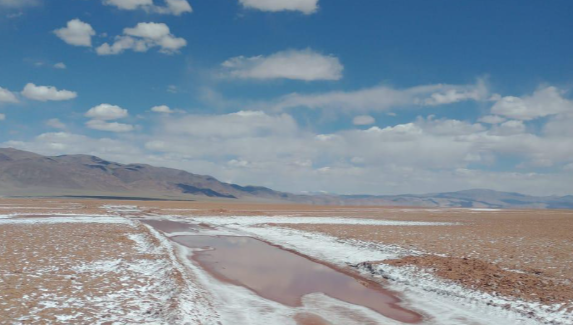
American Salars Lithium (CSE:USLI) has signed a letter of intent with an arm’s-length vendor to acquire the Cauchari Minas Ines 01 lithium salar project, located on the south end of the Cauchari Salt Lake in the province of Salta, Argentina.
The Cauchari Ines 01 claims cover an area of 1,235 hectares, contain concentrations of lithium, and sampled up to 383 parts per million lithium taken from a depth of 30cm below the salt crust.
Access to the project is through the city of Salta, through Road 51, passing the town of San Antonio de Los Cobres and continuing 80km to the nearby Cauchari Salt Lake.
The project area is accessed entering the Salt Lake through existing mining tracks and roads and located 13km from the Rincon salar owned by Rio Tinto (ASX:RIO) (pictured below).
The Cauchari lithium brine project has over 12km2 concession and “stand-alone potential with 50% on salar”. It is adjacent to operators of lithium plants and is within a known geological district with significant lithium-potassium sampling results.
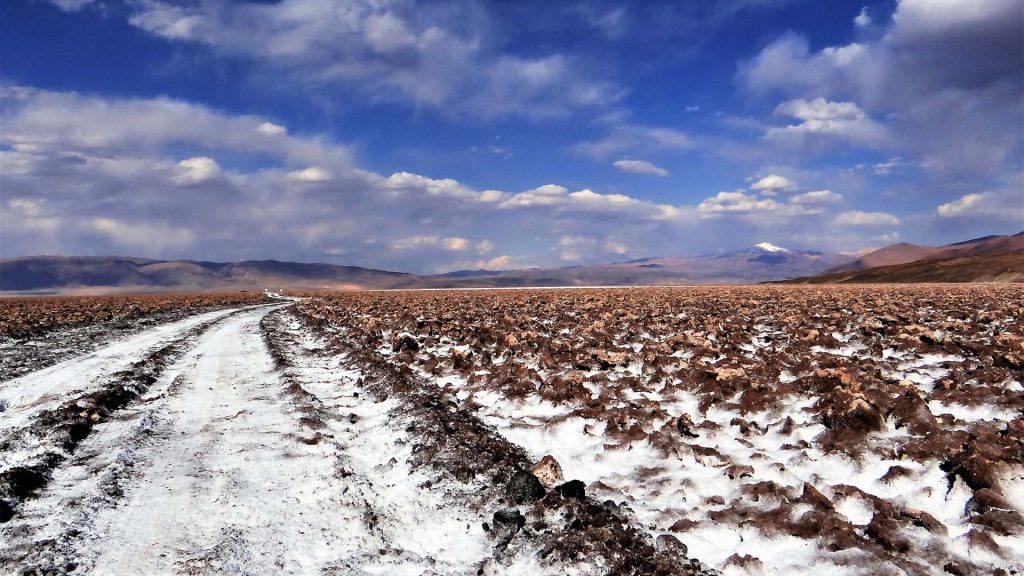
Within immediate proximity to roads, railway, electricity and gas pipeline infrastructure, the project also has easy road access to Chile ports.
American Salars CEO Nick Horsley says the potential of this section of the Salar de Cauchari is immense. Cauchari is a proven producing salar operated by Exar-Ganfeng & Lithium Argentina that produces battery-grade lithium carbonate.
Data from reconnaissance exploration programs suggest that the Cauchari Salt Lake is underlain by a structurally controlled sedimentary basin that forms an aquifer of over 250 square kilometres, and asymmetric, with maximum depths from 100m to 500m along the eastern margins.
No effective porosity determinations have yet been made on the aquifer but by analogy with similar aquifers, may be in the region of 4-20%, the company says.
Structural geology survey suggests a shear fault zone through the concession oriented north-south that could be an aquifer conduit. To the north of the company’s Cauchari Ines 01 claims, two advanced projects are actively being developed – both on Cauchari and Olaroz Salt Lakes – with results from an exploration and pilot plant perspective.
American Salars says the surface of the Cauchari salar is a light brown lime-earthy layer.
“There are typical millimetre-thick salt efflorescence, which includes chloride and sodium sulphate, and, to a lesser extent, calcium carbonate and calcium sulphate (gypsum). The project is located on a carbonate platform generated by the late (geyser) volcanic activity, whose water loaded with minerals decanted in this basin. The geyser activity provided the majority of the chemical elements, which caused the mineralization in these salt lakes,” the company reports.
“Some of these minerals are borates, sulphates, carbonates and brines rich in lithium, potassium, boron and rare earths. Significant concentrations of lithium were determined in brines from the Cauchari Salt Lake area at the northern end of the company’s claim boundary.”
The project area is part of the Cauchari Salt Lake basin. The total area of this basin is approximately 2,550km2. The salt lake is extended, narrow shaped, and submeridian oriented spanning 40km long.
Historically, this salt lake produced the biggest amount of borax minerals, especially ulexite and tincal in a smaller amount. The company notes that mineralisation of ulexite is concentrated along the occidental side of the salt lake. The origin of this mineralisation is directly related to boratiferous spillage, from the fracture located at the bottom of the Cauchari sierra.
The Salar De Pocitos project is located 100km west from San Antonio de Los Cobres, which is the largest city at the top of the puna and approximately 250km west of the provincial capital Salta.
Write to Adam Orlando at Mining.com.au
Images: American Salars