

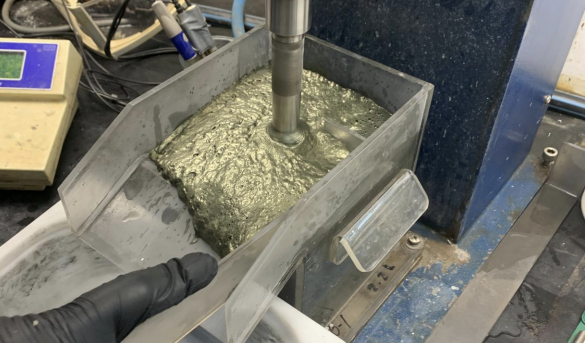
Alma Metals (ASX:ALM) says recent results reinforce that the Briggs Copper Project in Queensland will be a long-life operation following completion of locked-cycle flotation metallurgical testwork programs.
Managing Director Frazer Tabeart says the results confirm the excellent metallurgical properties of the copper and molybdenum mineralisation at Briggs.
The testwork, conducted on two master composites from Briggs, achieved up to 95% copper recoveries grading at 29%, as well as 94% copper recovery grading 23%.
Alma says the results are “encouraging” highlighting recoveries into a marketable copper concentrate at coarse to very coarse primary grind sizes up to 212µm.
The results will be used as inputs into the Scoping Study to evaluate the economics of mining at Briggs. The Scoping Study is anticipated to be completed in mid-2025.

Molybdenum was not specifically targeted in the recovery and will be optimised once the copper flowsheet is confirmed. However, the overall recovery of molybdenum was 62% for the intrusive master composite for the higher grade volcanic-sediment master composite.
Tabeart says: “The ability to produce such high-grade, clean copper concentrates provides a strong competitive advantage for future sales into both domestic and international markets.”
“This further reinforces Briggs as one of Australia’s largest undeveloped copper projects, with the scale and quality to support a long-life operation.”
Exploration and evaluation at Briggs is being funded by Alma under an earn-in joint venture agreement with Canterbury Resources (ASX:CBY). Alma owns a majority (51%) interest and can increase this to 70% by 30 June 2031.
Canterbury Managing Director Grant Craighead says the resources further enhance Briggs’ development potential, as well as confirming the opportunity to achieve high copper and molybdenum recoveries into a clean, marketable concentrate.
“Significantly by achieving these recoveries at a coarse primary grind size, we should be able to drive processing costs towards the lower end of the curve for a porphyry copper project,” Craighead says.
An update to the resource estimate is currently being prepared and is expected to be released in the coming weeks.
Additional testwork to assess copper recoveries at even coarse primary grind sizes of 300µm will begin shortly and may lead to further reductions in estimated power consumption for mineral processing, as well as for input into a Scoping Study.
Thickening testwork, geotechnical testwork, and chemical analysis will take place to assist with establishing tailings storage facility design parameters.
Beyond that, future metallurgical testwork will begin after the Scoping Study and will focus on providing more variability data for both comminution and flotation to improve resolution of the geo-metallurgical domain modelling at Briggs, along with optimisation and improvements to the flowsheet design.
Write to Aaliyah Rogan at Mining.com.au
Images: Alma Metals