

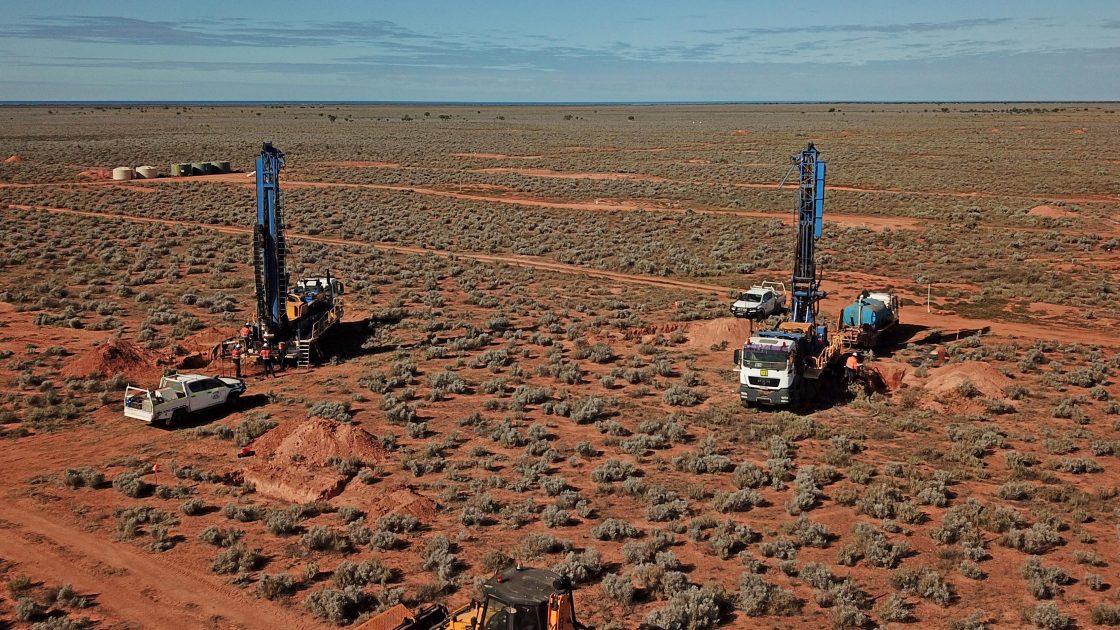
Alligator Energy (ASX:AGE) says the results from its maiden drilling program at the Big Lake Project in South Australia have confirmed the preliminary findings of a “significant new uranium discovery”.
The laboratory chemical assays validate the earlier in-field x-ray fluorescence (XRF) measurements for contained uranium which included 20m @ 110 parts per million (ppm) uranium from 106m, 35m @ 117ppm from 93m, 5m @ 47ppm from 104m and 10m @ 138ppm from 108m.
Additionally, an improved result was noted in drillhole AC24-022 where in-field XRF detected 5m @ 130ppm uranium whereas lab assaying shows a higher grade thickness of 35m @ 117ppm.
Alligator is currently in the process of finalising approvals for follow-up mud-rotary and aircore drilling to begin in Q1 2025, following a Native Title site heritage clearance scheduled for Q4 2024.
Additional drill lines are also planned to test other locations for fertile stratigraphy and interpreted paleochannels.
CEO Greg Hall says the consistency and thicknesses of the aforementioned intersections highlight the significant potential for the Big Lake Project from what was an inaugural drilling program in a frontier and untested portion of the Lake Eyre/Cooper Basin system.
“The assay results validate our initial findings of the uranium discovery at our Big Lake Project and indeed, reflect some improvement on what we had observed in the field,” Hall says.
In mid-August when the discovery was initially announced Hall noted that it was the first significant greenfields discovery of uranium in South Australia since the Samphire Uranium Project in 2007 by UraniumSA.
At the time, Alligator – which has a market capitalisation of $185.9 million – reported evidence of oxidised and reduced sands in holes drilled at Site 10 which is synonymous with roll-front uranium mineralising systems.
The discovery is the first proof of concept that significant uranium is present within the Lake Eyre basin sediments located above the hydrocarbon-rich Cooper Basin and within potentially in-situ recovery (ISR) amenable host and depths, according to Alligator.

The objective of the initial drilling campaign was to investigate the region’s stratigraphy and the potential for uranium mineralisation in the shallow basin sediments that sit above the Cooper Basin – a setting that has many attributes seen in other global hydrocarbon-related ISR uranium fields around the world.
A historical drilling program in the region completed about 15 years ago by TC Developments indicated traces of uranium in thin clay bands in and around existing oil and gas wells.
However, none of the holes were drilled in palaeochannel features within the upper (<300m) sedimentary sequence of the basin.
Alligator is specifically targeting the northern extensions of the same Tertiary Namba and Eyre sedimentary formations that host the Beverley, Four Mile and Honeymoon mines located to the south of the Big Lake Project.
Site 10 was specifically targeted to confirm the presence of interpreted palaeochannel sands and assess if this area showed evidence of the key ingredients of the mineralisation model.
“Having confirmed results, we are eager to move forward with the next drilling round scheduled for early next year,” Hall says.
“Planning for the drill campaigns is always done in consultation with the Traditional Owners, pastoralists and other stakeholders in the region, who have greatly assisted with our exploration endeavours to date.”
Write to Angela East at Mining.com.au
Images: Alligator Uranium