

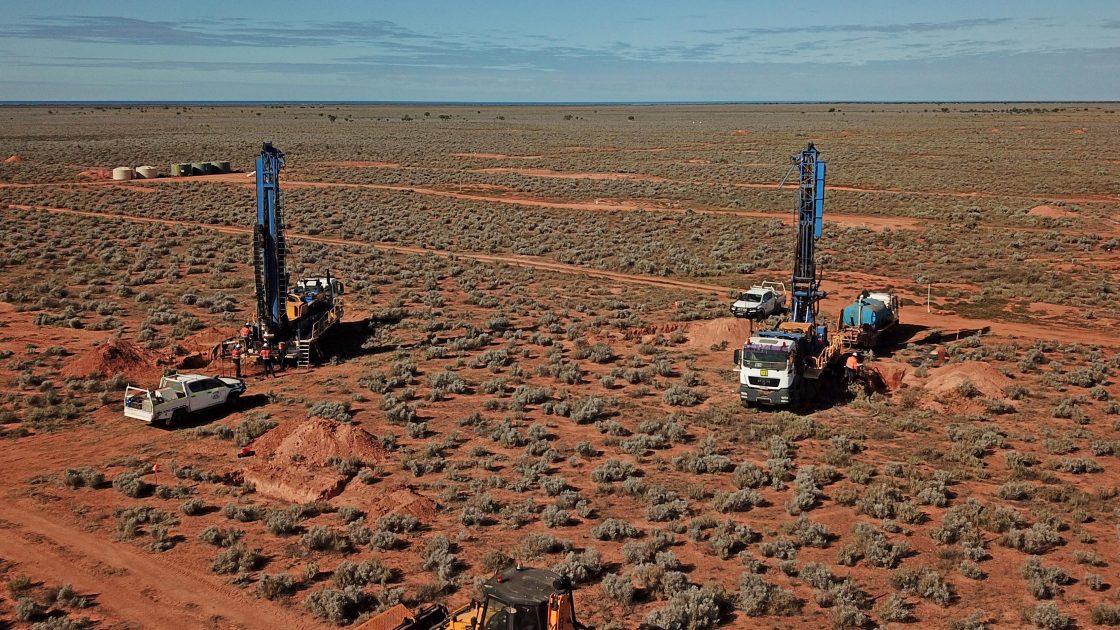
Alligator Energy (ASX:AGE) has made a new uranium discovery in the very first drilling at its Big Lake Project in South Australia.
The news pushed shares up 13.5% on Tuesday (13 August) to an intra-day high of $0.042. Over 7.8 million shares had changed hands by 2pm AEST.
CEO Greg Hall says it the first significant greenfields discovery of uranium in South Australia since the Samphire Uranium Project in 2007 by UraniumSA.
The discovery is the first proof of concept that significant uranium is present within the Lake Eyre basin sediments that lie above the hydrocarbon-rich Cooper Basin and within potentially in-situ recovery (ISR) amenable host and depths, according to Alligator.
Four air-core drill holes intersected palaeochannel sand units hosting anomalous uranium mineralisation located between 90m and 130m below surface.
The initial preliminary estimates of uranium grades, using a portable x-ray fluorescence analyser, show 20m @ 110 parts per million (ppm) from 106m, including 1m @ 241ppm from 123m; 1m @ 185ppm from 129m; 5m @ 130ppm from 107m; 5m @ 45ppm from 104m and 10m @ 120ppm from 180m.
Indicative uranium grades found in these holes are about 10 to 50 times background levels.

“The thickness extent of mineralisation layers ranging up to 20m in these discovery holes is impressive for this style of mineralisation,” Hall says.
“While estimated grades are still on the lower side, to have grade-thickness intersections close to the cut-off used at our Samphire Project from the initial discovery area is very encouraging.”
Hall says the discovery appears to validate the uranium formation model developed by the previous Big Lake geologists from whom Alligator acquired the initial tenement.
“The sediments above the Cooper Basin cover are an extensive area, and we hope this has the potential to develop into a new ISR amenable uranium field, similar to the Curnamona Province which hosts the Beverley, Four Mile and Honeymoon deposits,” he says.
A historical drilling program in the region completed about 15 years ago by TC Developments indicated traces of uranium in thin clay bands in and around existing oil and gas wells.
However, none of the holes were drilled in palaeochannel features within the upper (<300m) sedimentary sequence of the basin.
Alligator is specifically targeting the northern extensions of the same Tertiary Namba and Eyre sedimentary formations that host the Beverley, Four Mile and Honeymoon mines located to the south of the Big Lake Project.
The company, which has a market capitalisation of $143.2 million, is now drilling two additional holes within the limited heritage cleared area of discovery.
Following full analysis of the data, including refinement of the geological model, Alligator will initiate approvals and begin heritage clearances for follow-up drilling.
Uranium prices hit a short-lived peak of US$105 ($159.25) per pound during the March quarter this year, which reflects a market shortfall linked to years of global under-investment, the Australian Government says in its June 2024 Resources and Energy Quarterly.
While prices have since come back to hover just above US$80 per pound, steady gains are expected as the structural shortfall persists.
“Over the outlook higher prices are likely to incentivise the development of new mines and increased output from existing mines, however, this is unlikely to be sufficient to meet the projected supply shortfall,” the report says.
“With a primary market shortfall expected to persist, prices are projected to remain high and to continue rising through till 2026 as inventories and existing mine capacity come under pressure.”
Alligator had $28.4 million in cash at the end of the June 2024 quarter.
Write to Angela East at Mining.com.au
Images: Alligator Energy