
MDF Global MDF Global
Apple’s iPhone boom highlights critical minerals powering smartphones•Presenting a united front for Queensland’s copper sector•Thailand seeks Myanmar mine access amid arsenic pollution•Egypt to set up state-backed company to license artisanal gold miners, free detainees•Brixton closes $7.4 million raise for Thorn, Langis projects•Heliostar banks record $78.7 million for Ana Paula push•Mining giants bet billions on 2030 supply crunch•Gunnison Copper reports Q3 output, revenue surge•Triumph Gold targets $15.46 million for Yukon push•African Rainbow Minerals faces a jobs dispute at Nkomati mine•Angola seeks 10% stake in De Beers under Anglo’s proposed exit•Gold price rebounds but heads for biggest weekly loss since June•Teck copper strike reaches BC port as operator sues union•Copper benchmark rocked by miner-smelter tug-of-war•Zimbabwe mining bill targets community, environmental safeguards•Mount Isa critical minerals hub secures Feasibility Study funding•Eramet initiates $814.5 million capital raise to reduce debt•Richemont backs natural gemstones, declines De Beers comment•‘Tis the season for administration as Comlek falls a second time•OceanaGold Philippines trials wireless blasting at Didipio mine Apple’s iPhone boom highlights critical minerals powering smartphones•Presenting a united front for Queensland’s copper sector•Thailand seeks Myanmar mine access amid arsenic pollution•Egypt to set up state-backed company to license artisanal gold miners, free detainees•Brixton closes $7.4 million raise for Thorn, Langis projects•Heliostar banks record $78.7 million for Ana Paula push•Mining giants bet billions on 2030 supply crunch•Gunnison Copper reports Q3 output, revenue surge•Triumph Gold targets $15.46 million for Yukon push•African Rainbow Minerals faces a jobs dispute at Nkomati mine•Angola seeks 10% stake in De Beers under Anglo’s proposed exit•Gold price rebounds but heads for biggest weekly loss since June•Teck copper strike reaches BC port as operator sues union•Copper benchmark rocked by miner-smelter tug-of-war•Zimbabwe mining bill targets community, environmental safeguards•Mount Isa critical minerals hub secures Feasibility Study funding•Eramet initiates $814.5 million capital raise to reduce debt•Richemont backs natural gemstones, declines De Beers comment•‘Tis the season for administration as Comlek falls a second time•OceanaGold Philippines trials wireless blasting at Didipio mine
ABx Group Rare Earths

ABx’s rare earths project to start within ‘months’ of approval

ABx Group (ASX:ABX) will start work within “months, not years” of securing the green light from authorities for its Deep Leads Rare Earths Project in a pine plantation, 40km west of Launceston.

The company has already launched its project development stage after leach testing drill samples and discovering several new areas where ionic adsorption clay rare earths with high extraction exist.

ABx will continue to conduct in-house leach testing on drill samples, to better define the extent of ionic rare earths in its deposits. Its strategy is to start commercial production of a mixed rare earth carbonate (MREC) as soon as possible, and these leach tests results are a valuable input to the engineering studies underway with external experts.

A JORC-compliant mineral resource of 89 million tonnes has been reported at its Deep Leads, Rubble Mound, and Wind Break deposits. Deposits contain 36 parts per million dysprosium and terbium which are touted to account for 4.3% of total rare earth oxides. This is reportedly the “highest proportion of any clay-hosted rare earth deposit in Australia and among the highest globally”.

The Australian Nuclear Science and Technology Organisation recently tested and found that some bulk samples at Deep Leads achieve extraction exceeding 80%, which is 10% more than ABx found.

ABx describes the discovery as “very rare”, especially in Australia. It predicts ionic rare earths extraction costs will be low and “significantly increase the commercial potential” of the project.

“My jaw dropped when I saw these leach test results. Our in-house assessment and knowledge gained from external experts indicate that ionic deposits are likely to be substantially lower on the cost curve than otherwise equivalent clay-hosted deposits,” CEO Mark Cooksey says.
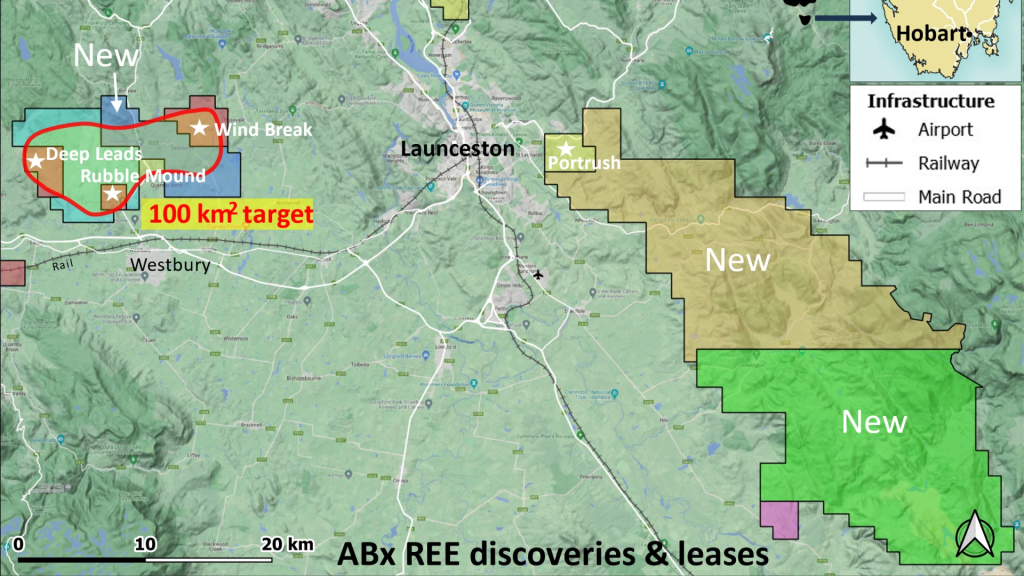
The project has already secured a mining lease for quarrying close to the DL130 bauxite deposit, rail, infrastructure, grid hydropower and water. The mixed rare earth carbonate product will be distributed to rare earth separation plants via “Western supply chains”.

Talks are underway with potential offtake partners. ABx has already executed a new memorandum of understanding with Ucore Rare Metals (TSX-V:UCU), which is developing rare earth processing facilities in North America.

“We have a substantial extent of ionic clay rare earths in our Deep Leads deposit, which will enhance our ability to supply significant volumes of high-quality mixed rare earth carbonate into Western supply chains. We have progressed to the project development stage,” Cooksey says.

The company will next perform in-house leach testing on drill samples, to help determine the amount of ionic rare earths in deposits. It hopes to start commercially producing MREC “as soon as possible”.

ABx aims to establish Australia’s first ionic rare earths project, producing a premium MREC that is sold to rare earth separation plants.

Write to Richard Szabo at Mining.com.au

Images: ABx

Add to Watch List:
Author Image
Written By Richard Szabo
Senior Reporter Richard Szabo has more than 19 years' experience in award-winning journalism, social media marketing and web content management for some of Australasia's fast-growing media companies including News Limited, Business News Australia, iSentia, APRS Media and Wade Business Media. He has also worked for the Crier Media Group in Hungary and Beauty of Life in New York state.