


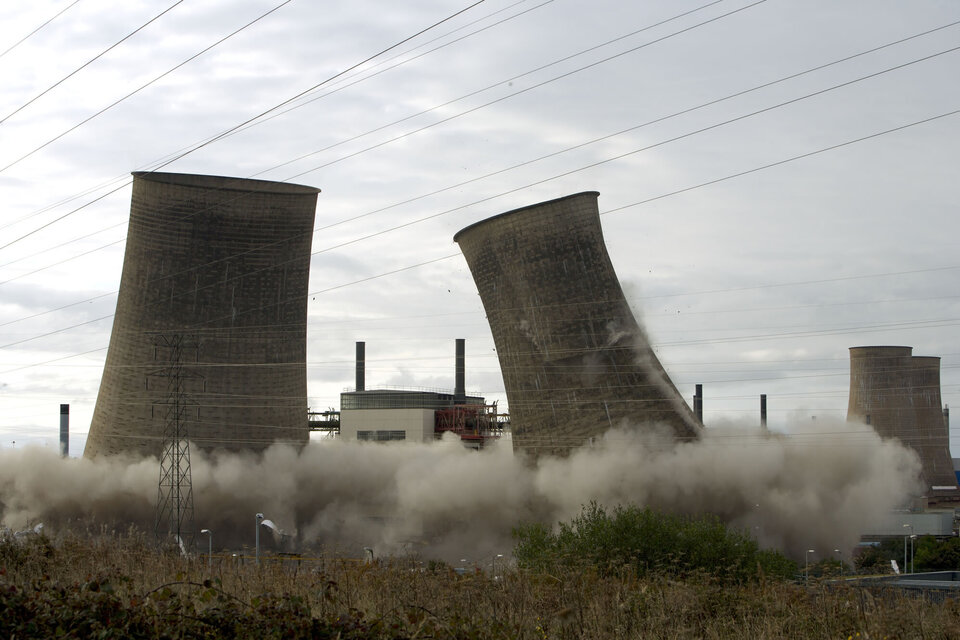
Teams at Sellafield in the UK are preparing to safely decommission the world’s first commercial nuclear power station — Calder Hall — located in Cumbria, North West England.
Since it closed in March 2003, fuel has been removed from the reactors. Work is underway to take down buildings and equipment that are no longer needed. Calder Hall was confirmed free of fuel in 2019.
All 40,000 fuel rods were removed from the four reactors. The cooling towers have been taken down. Teams have also removed thousands of tonnes of asbestos from the station and nearby buildings.
Other redundant plants, pipework, and structures also need to be dismantled.
Decommissioning Calder Hall provides an important opportunity to learn how to safely decommission a nuclear power station. This includes learning how safety plans change as hazards are removed, how demolition work can be carried out safely, and how land can be prepared for future use.
Making space for Sellafield’s future
Land at Sellafield is limited, and Calder Hall’s decommissioning provides additional space for new facilities and infrastructure.
Removing parts of the power station that are no longer needed will create space for the SIXEP Continuity Plant (SCP).
SCP is a major nuclear infrastructure project under construction at the Sellafield site. It is designed to replace the ageing Site Ion Exchange Effluent Plant (SIXEP), which has been operating since 1985.
As of August 2026, SCP has reached 75% completion, with main weatherproofed buildings finished and internal equipment installation underway.
SCP is scheduled to begin commissioning in 2029, with the facility projected to operate and support site clean-up through 2060.
The UK’s nuclear history
The UK generates about 12% of its electricity from nine active reactors across four power stations, with a total net capacity of 5.9 gigawatt-electric (GWe).
Calder Hall opened on 17 October 1956. The nuclear power station comprised four magnox reactors that generated electricity for 47 years before closing.
The UK Government says the station helped develop nuclear power in the UK and around the world. Other magnox power stations were based on Calder Hall’s designs.
Government plans call for up to 24GWe of new nuclear capacity by 2050 to provide roughly 25% of electricity.
Uranium is the primary fuel used to generate energy in conventional nuclear power plants.
A typical 1,000 megawatt-electric (MWe) commercial nuclear reactor requires about 75 tonnes of low-enriched uranium in its core. The reactor uses roughly 27 tonnes of fresh enriched uranium fuel each year.
The UK does not have any commercial uranium mining, as its local mineral deposits are considered too small or low-grade to be economically viable. This means that the nation imports uranium from global suppliers, including Australia, Canada, the Democratic Republic of the Congo, and the US.
In May 2026, the UK banned uranium imports from Russia.
Write to Aaliyah Rogan at Mining.com.au
Main image: The UK Government


