

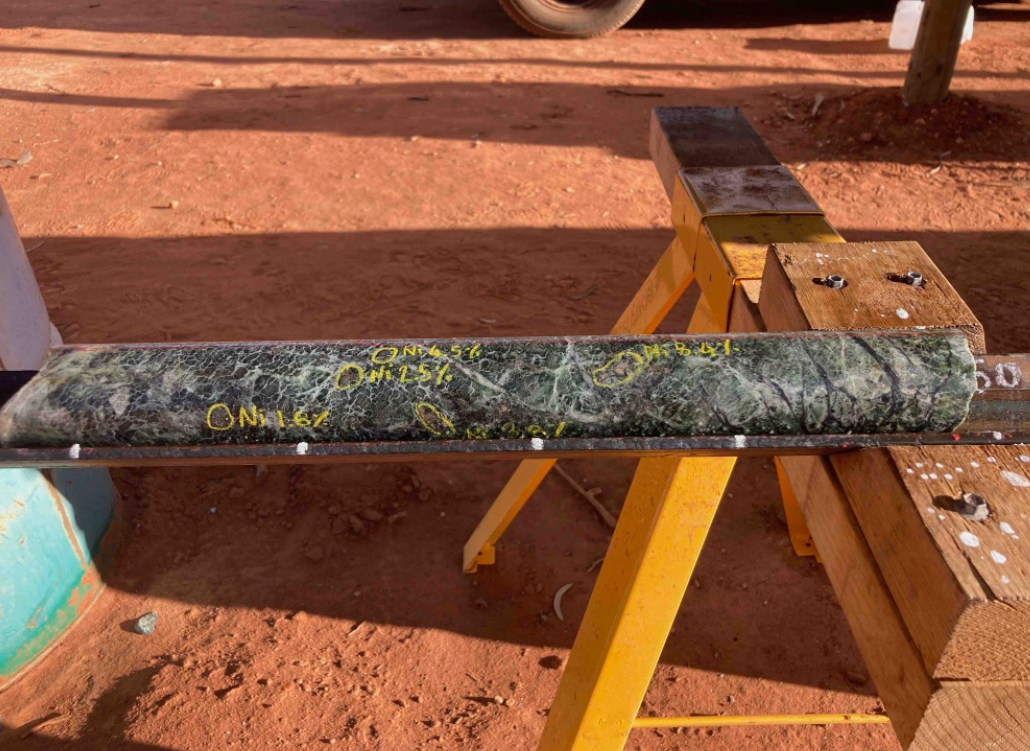
Australian mineral exploration company Western Mines Group (ASX:WMG) reports initial aqua regia testwork has confirmed nickel sulphide association at the Mulga Tank Nickel-Copper-Platinum Group Elements Project in Western Australia.
Assay results were received for selected intervals of observed nickel sulphide mineralisation from holes MTD012, MTD022, and MTD023, while similar work was previously conducted on hole MTD020. A comparison of nickel assay results by 4 acid versus aqua regia digest was undertaken.
The company reports 4 acid is considered a near total digestion technique which breaks down most silicate and oxide minerals whereas aqua regia is considered a partial digestion technique that does not dissolve silicate minerals but does dissolve soluble sulphide minerals.
The results of this comparison testwork suggest a ‘high’ percentage of nickel in sulphide form versus silicate nickel, with intervals from all holes showing higher than 97% similarly in results.
The company’s share price yesterday (5 April ) rocketed more than 170% on the ASX on the back of the recent drill results.
Western Mines says these ‘very positive’ results offer encouragement to conduct further metallurgical beneficiation testwork to demonstrate the recovery of nickel sulphide into a ‘high-grade’ saleable concentrate. The company also reports broad intervals of shallow mineralisation, within the top 200m were deliberately selected for this initial testwork, which forms the first initial steps in demonstrating a viable large open pit scenario for Mulga Tank.

Commenting on the results, Western Mines Group Managing Director, Caedmon Marriott says: “This basic comparison testwork attempts to further confirm the disseminated nickel mineralisation at Mulga Tank and prove that it is clearly hosted in potentially recoverable sulphide form, these very positive results clearly demonstrate this.
We’re conscious of exploring by economics and deliberately selected shallow intervals found in the top few hundred vertical metres that could be amenable to large-scale open pit scenario.
“We’re conscious of exploring by economics and deliberately selected shallow intervals found in the top few hundred vertical metres that could be amenable to large-scale open pit scenario”
These intervals appear laterally continuous between holes MTD012, MTD022, and MTD023 over some 1.6km, though a lot of further drilling is required to confirm this.
Upcoming hole MTP024 will also attempt to step-out halfway between the broad intersections of mineralisation seen in holes MTD023 and MTD020 in the southeast corner of the body and hopefully really highlight the scale of the system.
As a follow-up to this comparison work the team is making plans for metallurgical beneficiation testwork using bulk samples from the remaining drill core. This will aim to demonstrate a payable high-grade nickel concentrate could be recovered from the mineralised interval. This would unlock the project and build confidence in a resource drill-out.”
Western Mines Group reports the phase two diamond drilling program is continuing at Mulga Tank with planned hole MTP025 nearly completed.
The company says the next likely planned hole MTP024, which is located about halfway between holes MTD023 and MTD020, will attempt to test for further disseminated sulphide mineralisation between these holes that both returned visible sulphide intersections of over 300m.
Western Mines Group is an Australian mineral exploration company focused on discovering ‘high value’ gold and nickel sulphide deposits across its portfolio of projects in Western Australia.
The company’s flagship Mulga Tank Project is a major dunite intrusive on the underexplored Minigwal Greenstone Belt. Previous work shows ‘significant’ evidence for a working sulphide mineral system, which Western Mines considers ‘highly’ prospective for nickel-copper-PGE mineralisation.
Western Mines Group also currently holds the Jasper Hill, Melita, Youanmi, Pavarotti, Rock of Ages, Broken Hill Bore, and Pinyalling projects.
Images: Western Mines Group Ltd