



Western Australia has been deemed Australia’s number one economy in Commsec’s State of the States report, fending off Queensland to take the top spot for the second consecutive quarter.
Now in its 16th year, the State of the States report determines which state or territory economy is performing best, by tracking eight key economic indicators and comparing the latest data with decade averages – or the “normal”.
Those indicators include economic growth, retail spending, equipment investment, unemployment, construction work done, population growth, housing finance, and dwelling commencements.
WA led the national performance rankings for the second time in a decade, ranked first on five of the eight economic indicators.
Queensland gave WA a run for its money, climbing up from third spot to place equal second with South Australia. Victoria stayed in fourth place, lagged by Tasmania in fifth position.
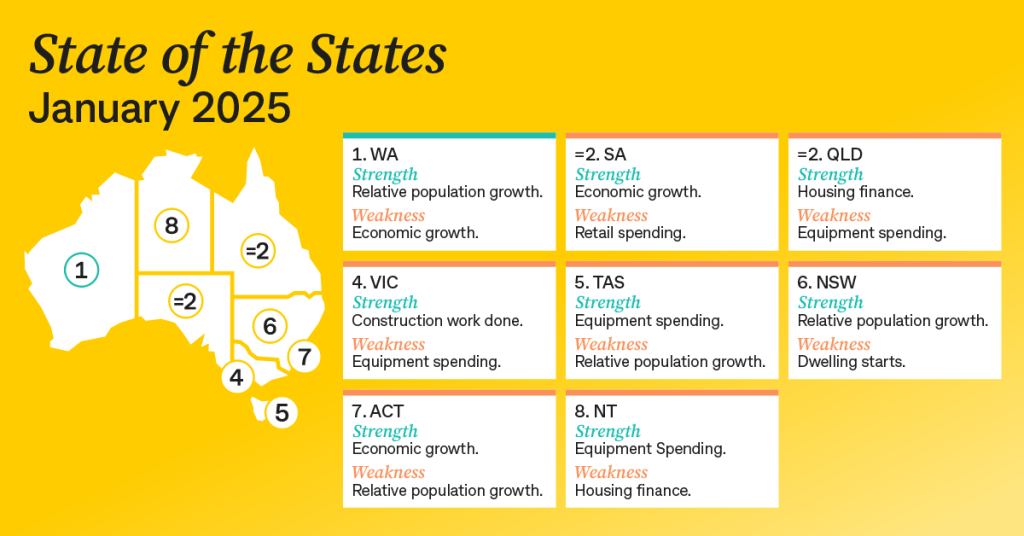
New South Wales passed the Australian Capital Territory to steal sixth, with the nation’s capital sitting in seventh followed by the Northern Territory in last place.
Chief CommSec Economist Ryan Felsman says overall, economies have slowed in response to higher interest rates and inflation, however Australian states and territories are proving resilient due to a strong job market and solid population growth.
“As consumers respond to higher borrowing costs and price pressures, the future path will depend on whether the job market can hold up as well as the trajectory of interest rates over the coming months,” he notes.
“Western Australia’s performance across a number of indicators, namely retail spending, unemployment, population growth, housing finance and dwelling starts powered the state to the top of our economic leaderboard for the second quarter in a row.
“Queensland however is nipping at WA’s heels, having shot up to equal second place alongside South Australia, with solid results across the eight economic indicators and strong economic momentum. As expected, the interest-rate sensitive south-eastern states remained in a tight cluster mid-table.”
Resource-rich Queensland actually outperformed WA in terms of annual growth rates.
Both states have the strongest annual economic momentum, however Queensland ranked first or second on five out of the eight key economic indicators, while WA only ranked top on three indicators.
The biggest mover in terms of annual growth is Victoria, which has jumped to third from seventh place, which CommSec says is a sign of improvement in underlying economic activity. South Australia also edged up the leaderboard from sixth previously to claim fourth place.
The Northern Territory eased back to fifth from third spot and the ACT and NSW are now in joint sixth position, ahead of Tasmania in eighth spot.
CommSec says these jurisdictions are all held back by higher borrowing costs and slower population growth.
Write to Angela East at Mining.com.au
Images: Unsplash & CommSec


