
MDF Global MDF Global
Apple’s iPhone boom highlights critical minerals powering smartphones•Presenting a united front for Queensland’s copper sector•Thailand seeks Myanmar mine access amid arsenic pollution•Egypt to set up state-backed company to license artisanal gold miners, free detainees•Brixton closes $7.4 million raise for Thorn, Langis projects•Heliostar banks record $78.7 million for Ana Paula push•Mining giants bet billions on 2030 supply crunch•Gunnison Copper reports Q3 output, revenue surge•Triumph Gold targets $15.46 million for Yukon push•African Rainbow Minerals faces a jobs dispute at Nkomati mine•Angola seeks 10% stake in De Beers under Anglo’s proposed exit•Gold price rebounds but heads for biggest weekly loss since June•Teck copper strike reaches BC port as operator sues union•Copper benchmark rocked by miner-smelter tug-of-war•Zimbabwe mining bill targets community, environmental safeguards•Mount Isa critical minerals hub secures Feasibility Study funding•Eramet initiates $814.5 million capital raise to reduce debt•Richemont backs natural gemstones, declines De Beers comment•‘Tis the season for administration as Comlek falls a second time•OceanaGold Philippines trials wireless blasting at Didipio mine Apple’s iPhone boom highlights critical minerals powering smartphones•Presenting a united front for Queensland’s copper sector•Thailand seeks Myanmar mine access amid arsenic pollution•Egypt to set up state-backed company to license artisanal gold miners, free detainees•Brixton closes $7.4 million raise for Thorn, Langis projects•Heliostar banks record $78.7 million for Ana Paula push•Mining giants bet billions on 2030 supply crunch•Gunnison Copper reports Q3 output, revenue surge•Triumph Gold targets $15.46 million for Yukon push•African Rainbow Minerals faces a jobs dispute at Nkomati mine•Angola seeks 10% stake in De Beers under Anglo’s proposed exit•Gold price rebounds but heads for biggest weekly loss since June•Teck copper strike reaches BC port as operator sues union•Copper benchmark rocked by miner-smelter tug-of-war•Zimbabwe mining bill targets community, environmental safeguards•Mount Isa critical minerals hub secures Feasibility Study funding•Eramet initiates $814.5 million capital raise to reduce debt•Richemont backs natural gemstones, declines De Beers comment•‘Tis the season for administration as Comlek falls a second time•OceanaGold Philippines trials wireless blasting at Didipio mine
QML

Western Australia pays miners more: Hays

Western Australia’s resources sector pays workers top dollar compared to other states and territories across a wide range of mining roles.

Hays Salary Guide FY25/26 reveals the state pays more for roles from graduate mining engineers to geological technicians and chief geologists.

A registered mine manager in Western Australia typically earns $300,000, while the typical salary for the same role in New South Wales is $270,000, in the Northern Territory it’s $260,000, and $205,000 in Victoria and Tasmania.

A chief geologist in metalliferous geology mining in Western Australia commands about $250,000, ahead of the Northern Territory ($220,000) and well ahead of other states where it ranges from $194,000 to $210,000.

Similarly, the typical salary for a geotechnical engineer in Western Australia is $190,000 (same as the NT), while in other states it ranges from $120,000 to $150,000.
Chief surveyors can earn $200,000 in Western Australia and the Northern Territory, whereas the salary tops $180,000 in other states except for New South Wales, which pays the least at $175,000.

Senior surveyors in Western Australia and the Northern Territory fetch around $190,000, while in other states it ranges from $150,000 to $170,000.

Excavator operators typically earn $30,000 more in Western Australia than other states and territories coming in at $175,000.

Based on a survey of over 12,000 respondents in Australia and New Zealand across more than 25 industries and 1,000 roles, the Salary Guide reveals ongoing tensions between employee expectations and employer offerings, making retention and recruitment ever more challenging.

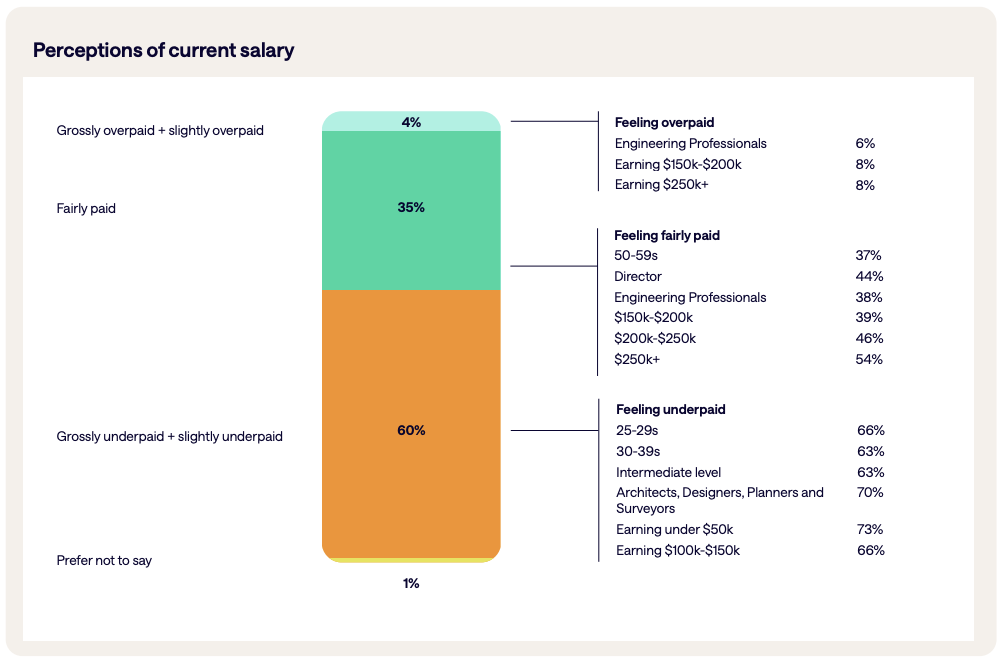
The report finds 61%oof people are planning to change their career path, with most doing this due to a lack of future opportunities in their current role/workplace (45%) and low salary (42%).

The report also shows there is a great disparity in what is viewed as satisfactory pay. Minimal salary rises (2.5% or less) were found to deliver the same satisfaction as no raise at all. Increases up to 14% offer only marginal improvements, while moderate bumps (up to 14-20%) can backfire. The report finds that only transformational increases (20%+) have a significant impact on employee satisfaction. 

Hays (LSE:HAS) is a global specialist in recruitment and workforce solutions.

Write to Adam Orlando at Mining.com.au

Images: Hays & QML

Add to Watch List:
Author Image
Written By Adam Orlando
Mining.com.au Editor-in-Chief Adam Orlando has more than 20 years’ experience in the media having held senior roles at various publications, including as Asia-Pacific Sector Head (Mining) at global newswire Acuris (formerly Mergermarket). Orlando has worked in newsrooms around the world including Hong Kong, Singapore, London, and Sydney.