


Queensland-based environmental solutions company Vital Chemical has launched a trial of its compostable netting product Vital Eco-Nett on the M1 Pacific Motorway extension to Raymond Terrace (M12RT).
The privately held company hopes the innovation will revolutionise the revegetation process around major infrastructure and construction sites.
Founded in 1977, Vital Chemical has expanded in the fields of soil science, revegetation, and erosion control, across sectors including mining, construction, infrastructure, and agriculture.
Its solutions have been deployed on some of the nation’s most challenging landscapes, from remote mine sites to major highway upgrades.
Vital Eco-Nett is part of a new generation of sustainable products being developed by the company to meet growing demand for environmentally responsible solutions in the construction and mining sectors.
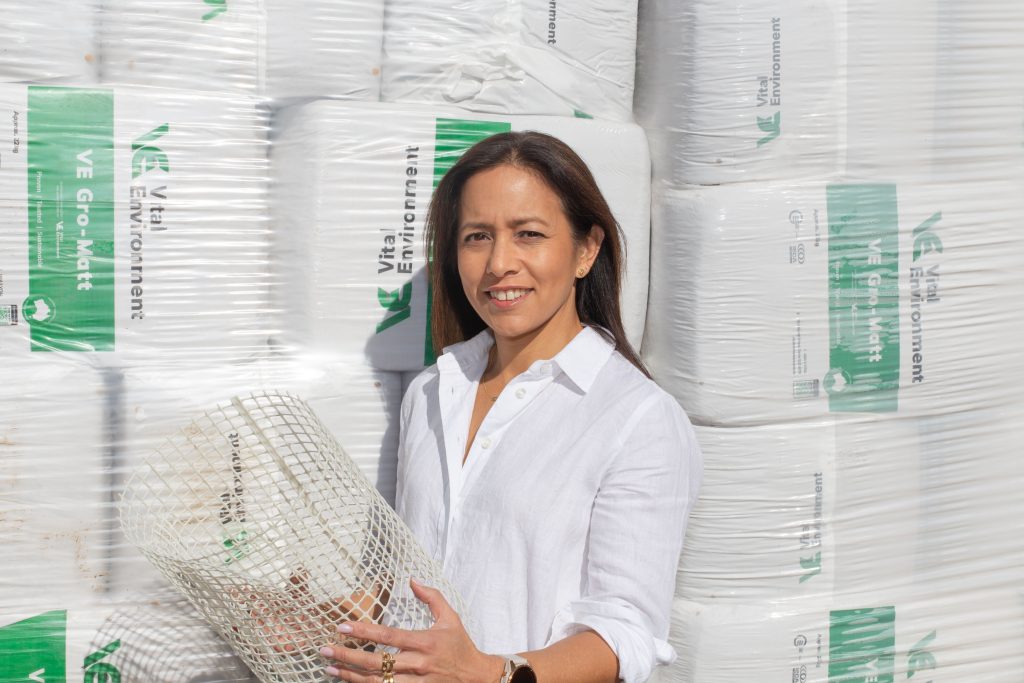
Other products in the suite include advanced hydroseeding technologies, soil stabilisation compounds and biodegradable erosion control mats – all designed to restore and protect the landscape while minimising environmental harm.
Developed by Vital Chemical’s in-house scientific team, Vital Eco-Nett is made from thermoplastic starch, biodegradable polyesters, and natural softening agents.
Both the mesh and its anchor pins are fully compostable, breaking down naturally in the presence of soil microbes, moisture and fungi. The decomposition period varies depending on environmental conditions, but the product is engineered to support revegetation throughout its life cycle.
The trial on the M1 Pacific Motorway extension to Raymond Terrace (M12RT), between Black Hill and Tomago, involves installing the netting in an open drain to support soil stabilisation and vegetation establishment.
The netting can also be customised to include soil conditioners and slow-release fertilisers that boost plant growth as the material breaks down, offering a multifunctional approach to revegetation and land rehabilitation.
Vital Chemical Director and Chief Scientist Letiscia Xavier says the product is a sustainable alternative to traditional jute mesh and synthetic geotextiles, providing a new benchmark for erosion and sediment control in large-scale infrastructure developments.
“This is just the beginning. Our goal is to lead the transition to smarter, more sustainable environmental management, one innovation at a time,” says Xavier.
The trial will be monitored over the coming years to assess performance, longevity, and environmental integration. If successful, the Chief Scientist says it could transform how major infrastructure projects manage erosion, sediment and landscape rehabilitation, both in Australia and worldwide.
“Vital Eco-Nett is more than a product, it’s a step toward a future where erosion control no longer depends on imported or synthetic materials that persist in the environment,” says Xavier.
Write to Adam Orlando at Mining.com.au
Images: Vital Chemical