



A Native American group filed a motion last week that could block Rio Tinto (ASX:RIO) and BHP (ASX:BHP) from accessing the land in Arizona it needs to build a major proposed copper mine.
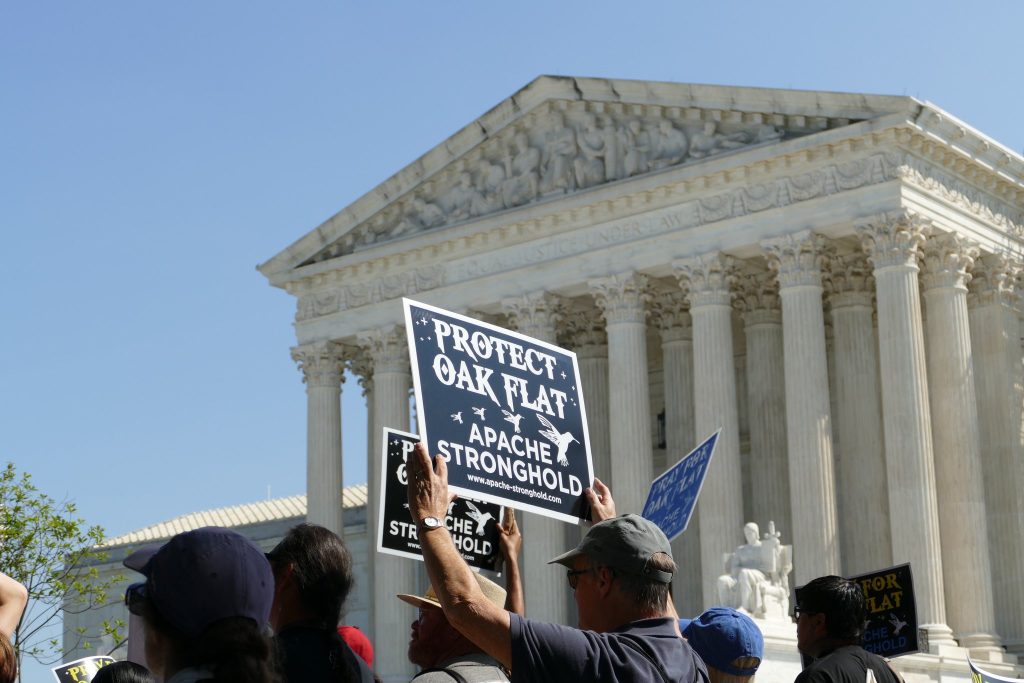
Apache Stronghold, a non-profit comprising conservationists and Arizona’s San Carlos Apache tribe, has asked the US Supreme Court to overturn a ruling in March that allows the federal government to swap acreage with the mining giants for their Resolution Copper Project.
The 6-5 ruling from the San Francisco-based 9th US Circuit Court of Appeals essentially deferred to a 2014 decision made by US Congress and then-President Barack Obama to give the land to Rio and BHP.
Located 97km east of Phoenix, near the town of Superior, the Resolution Project — owned 55% by Rio and 45% by BHP — is thought to have a copper deposit at an average grade of 1.5% and between about 1,500 and 2,100 metres below the surface.
The appeal to the nine justices on Wednesday was delivered by an in-person courier after Apache Stronghold held a ceremony on the Washington court’s steps. It was the culmination of a months-long caravan from their Arizona reservation to the capital.
At least four of the justices would need to agree to hear the appeal, in which attorneys for the group at the Becket Fund for Religious Liberty argue that the government would be violating the First Amendment’s guarantee of religious freedom if the mine were to be developed.
Should the court agree to hear the case, it could hold oral arguments after its term begins next month, and could potentially issue a decision by June next year.
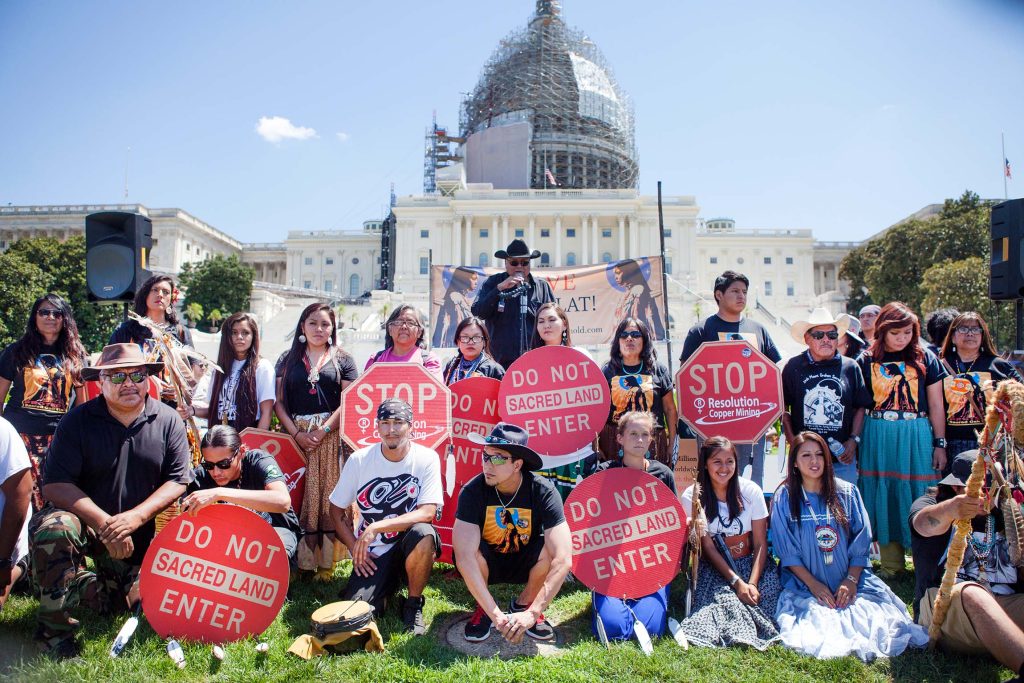
The dispute goes back years, and centres on the federally owned Oak Flat Campground — or Chi’chil Biłdagoteel in the Apache language — which is considered home to deities known as Ga’an. Religious ceremonies are held at the site to celebrate teenage girls coming of age, and many Apache have ancestors buried under the volcanic rock.
The site sits atop more than 18 million tonnes of copper, and the proposed Resolution Project could potentially produce 25% of US copper demand. It would also create a crater 3km wide and 304m deep that would ultimately swallow the Oak Flat Campground.
“If Rio gets this place, then the mine will kill the angels and the deities that live here,” Wendsler Nosie, an Apache tribe member, told Reuters in 2021.
In 2014, the Obama administration set in motion a complex process intended to give Rio 3,000 acres of federal land, including the campground, in exchange for 4,500 acres held by Rio nearby.
The Trump administration supported the plan, but it was ultimately blocked in 2021 by current President Joe Biden, who called for further government analysis of the project.
The US Department of Justice, which is controlled by Biden, has argued in court that the government has the right to give away its land to whomever it chooses, regardless of the religious implications.
“That legal argument is astonishingly broad and harmful to Native Americans and people of all faiths,” Luke Goodrich, a Becket attorney who is leading the appeal, told Reuters last week.
For its part, Rio says the case “does not present any question worthy of Supreme Court review,” given the March ruling that cleared the land swap.
“This case is about the government’s right to pursue national interests with its own land, an unremarkable and longstanding proposition that the Supreme Court and other courts have consistently reaffirmed,” a spokesperson for Rio said.
Rio and BHP have so far spent more than US$2 billion ($2.98 billion) on development and permitting activities for the Resolution Project.
Notably, the date of the appeal coincides with the four-year anniversary of Rio’s decision to fire its former CEO for inadequate consultation with Indigenous groups in Australia.
In May 2020, a sacred Indigenous cave at Jukaan Gorge in the Pilbara region of Western Australia was destroyed with explosives as part of Rio’s expansion of its Brockman 4 iron ore mine.
It was the only inland site in Australia with evidence of continuous human occupation for more than 46,000 years, including through the last Ice Age.
Prior to the blast, Rio had been informed by the Puutu Kunti Kurrama and Pinikura people that the site was one of the ‘top five’ most significant in the Pilbara region, while archaeologist Michael Slack had said one of the rock shelters, Jukaan 2, was of “the highest archaeological significance in Australia”.
Rio announced in September that year that CEO Jean-Sebastien Jacques and two other executives would step down.
Write to Oliver Gray at Mining.com.au
Images: National Indigenous Women's Resource Center, UCC Washington D.C. Office/Twitter


