


The Federal Court has ruled that the lead contractor on the $4 billion EnergyConnect interconnector breached the Fair Work Act by denying union officials the right to consult with lineworkers working under a labour hire arrangement on temporary visas in remote New South Wales.
The Electrical Trade Unions of Australia brought the court application against the lead contractor on the project, Elecnor, after its project and construction managers “repeatedly refused to allow union officials to speak to workers” supplied by a third party on a labour hire agreement at the mixed business and housing complex attached to their worksite, which was overseen by a security guard.
According to the ETU, Elecnor claimed that the workers were not electrical workers and the remote purpose-built camp was not a worksite but a “residential area”. The court dismissed this argument, the ETU reports.
Commenting on the situation, ETU New South Wales and ACT Secretary Allen Hicks says the union has a lawful right to enter workplaces to represent the interests of members working in the transmission construction industry and this has been upheld by the federal court.
ETU National Secretary Michael Wright says the court victory should put energy transition projects on notice that neither the Australian community nor its courts would accept an energy transition powered by exploitation that compromised on safety.
“The message is that Australia’s energy transition will fail unless it is built on reliable, well-paid union jobs that put workers’ safety, communities and families first,” says Wright.
“It is a warning that nobody wants an energy transition that compromises safety, that exploits workers, that locks out workers’ representatives and that breaks the law and disregards workers’ basic rights.
“Any company that thinks it can cut corners on safety, cut wages through labour hire and cut unionised labour out of energy transition should read it very carefully and reconsider their position.”
Mining.com.au has reached out to Elecnor for comment.
In June 2021, Elecnor signed the contract through a 50:50 joint venture with Australian group Clough (ASX:CLO) to build the EnergyConnect project, which includes 700km of high voltage lines and four substations.
EnergyConnect will be Australia’s biggest electricity interconnector built to date in the National Electricity Market and it will help to accelerate Australia’s energy transition by connecting customers with more renewable generation.
The project will also help to abate an estimated one million tonnes of carbon emissions each year contributing significantly to meeting Australia’s climate change targets. EnergyConnect will build the critical electricity transmission infrastructure that will save New South Wales customers $180 million a year and create 1,500 new construction jobs in regional parts of the state.
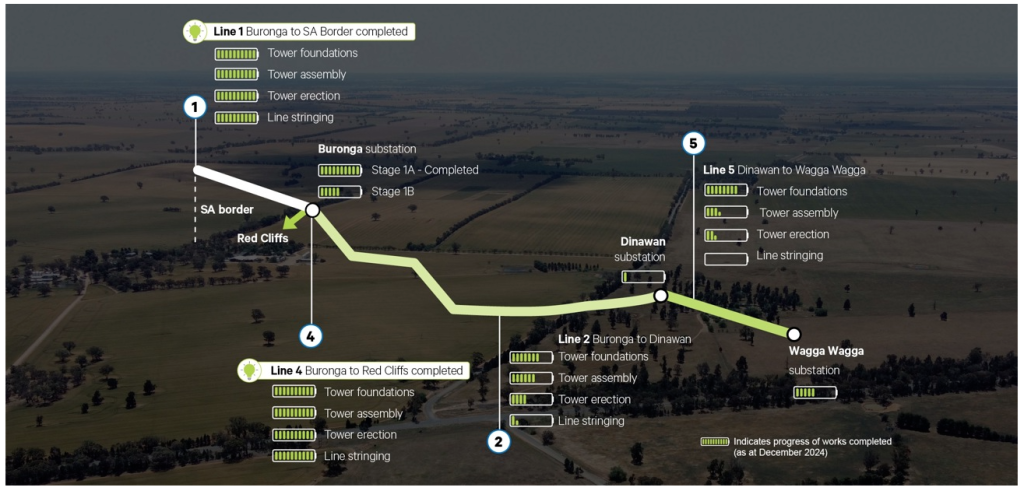
Transmission line construction works (excluding rehabilitation) EnergyConnect West, between Buronga and the South Australian and Victorian borders, is now complete.
Transgrid and construction partner Elecnor Australia finished construction of EnergyConnect’s Line 1, stretching 135km from Buronga to the South Australian border which is currently being tested for energisation and Line 4 between Buronga to Red Cliffs. The 24km line from Buronga substation in NSW to the Red Cliffs substation at Red Cliffs, Victoria was commissioned at the end of August with a second circuit between these two substations commencing testing and commission in the coming weeks.
Works on EnergyConnnect East between Buronga and Wagga Wagga are progressing. Tower foundations, assembly and erections are continuing on Line 2 from Buronga to Dinawan, near Coleambally NSW and Line 5 from Dinawan to Wagga Wagga.
TransGrid’s EnergyConnect is building backbone infrastructure for the future South West NSW Renewable Energy Zone, enabling connection of a further 4950MW of generation capacity. Project construction began in late 2021 and commissioning was underway in 2023.
Write to info@mining.com.au at Mining.com.au
Images: Elecnor & Transgrid

