



Stavely Minerals (ASX: SVY) has announced ‘outstanding’ and ‘extremely high-grade’ new results from drilling targeting deeper extensions of mineralisation in the south‐western sector of the Cayley Lode deposit within its Stavely Copper‐Gold Project in western Victoria.
Diamond drill hole SMD173 intersected a 92.1m zone of inter‐fingered micro‐diorite and Cayley Lode sulphide mineralisation. Importantly, the +90m interval of lode‐style mineralisation is intruded by a 36.7m interval of inter‐fingered late, barren micro‐diorite, potentially displacing an even broader intersection of lode‐style mineralisation.
The post‐intrusion remnant mineralisation includes an upper portion of 3m @ 3.81% Cu, 0.11g/t Au and 457g/t Ag from 328m down‐hole, including 1.10m @ 2.53% Cu, 0.10g/t Au and 1,225g/t Ag.
Below the intrusion, a second thicker interval of lode‐style mineralisation was encountered with 43m @ 2.60% Cu, 0.42g/t Au and 10g/t Ag from 378m down‐hole, including 3m @ 10.38% Cu, 3.00g/t Au and 71g/t Ag, from 396m, including 1m @ 19.65% Cu, 8.29g/t Au and 202g/t Ag from 397m.
The company reports that this lower intersection is amongst the top 10 intersections recorded to date at Cayley.
Commenting on the update, Stavely Minerals Chair and Managing Director Chris Cairns said: “The intersection of 92.1m of inter‐fingered sulphide mineralisation may well be the longest down‐hole intersection of mineralisation recorded at the Cayley Lode to date.
The significance is that, if follow‐up drilling is able to confirm the continuity of these types of widths of mineralisation along strike and up/down‐dip, there is significant capacity for these intersections to contribute material additions to the upcoming Mineral Resource Estimate.
Further, the observed mineralisation in SMD173 has very positive implications for what we have been describing as potential for a Phase 2 underground development. We have a lot of drilling and technical studies to do before we will be able to demonstrate any underground viability, but the foundational building block is demonstrating that the well‐developed Cayley Lode copper‐gold‐silver mineralisation is down there, and a few more hits like this can add tonnes very quickly.
“The intersection of 92.1m of inter‐fingered sulphide mineralisation may well be the longest down‐hole intersection of mineralisation recorded at the Cayley Lode to date”
In short, this is a very important drill hole which highlights the enormous long‐term exploration opportunity across the broader project to delineate a vertically extensive Magma/Butte‐style copper lode system. We have evidence from our earlier drilling that high‐grade mineralisation occurs at depths of up to 1km below surface.
Our challenge, once we post the maiden Mineral Resource Estimate and complete a Scoping Study on a potential Phase‐1 open pit development at the Cayley Lode, is to systematically unlock this potential for what we believe could be a multi‐decade copper operation in Western Victoria.”
Hole SMD173 was designed to test the south‐easterly plunge of Cayley Lode mineralisation below the Low‐Angle Structure.
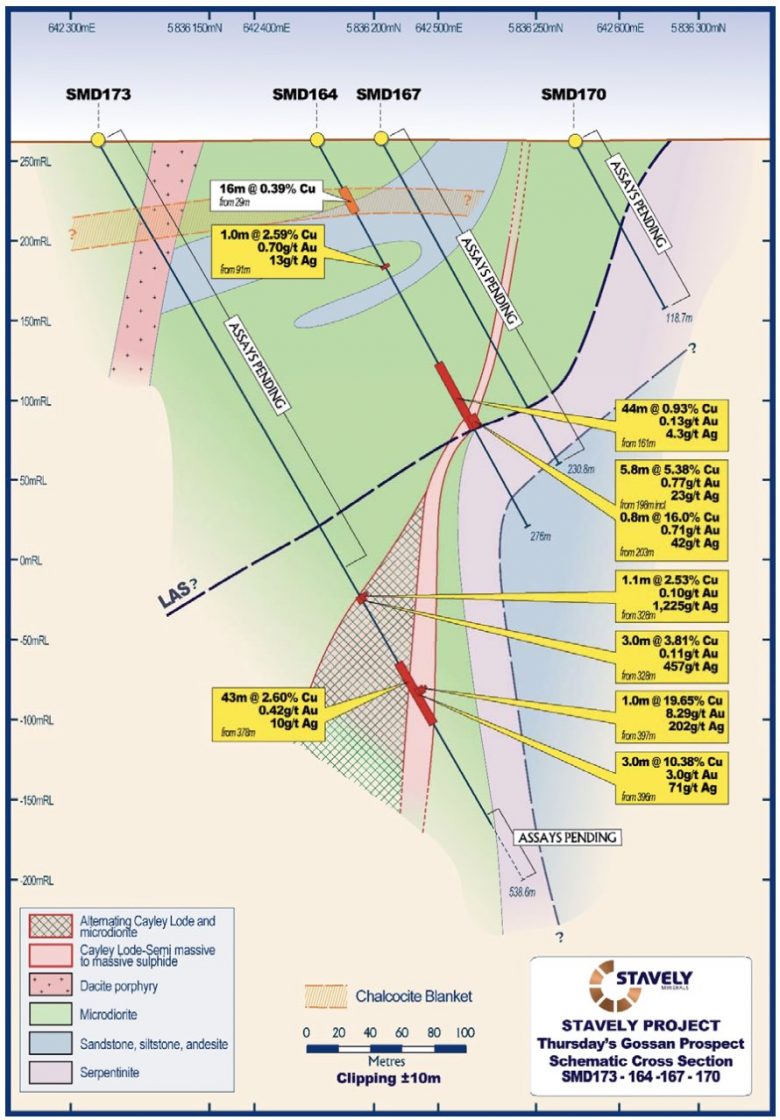 Drill section displaying results from SMD173 and nearby drill holes
Stavely Minerals says that the broad, high‐grade intercept in SMD173 provides further confidence in the interpreted south‐easterly plunge of mineralisation and, significantly, that some very high‐grade mineralisation continues to depths that may be available for potential future underground development.
With the final phase of resource drilling targeting shallow Cayley Lode mineralisation now nearing completion, the company reports that a maiden JORC Mineral Resource Estimate is on track for Q2 2022.
In addition, further drilling is planned to test the lateral and depth extents of the Cayley Lode.
Images: Stavely Minerals Limited

