



There are growing calls for Southeast Asia to ramp up efforts and spending on clean energy with energy demand projected to double by 2050 from 2020 levels.
Conventional energy sources currently make up 77% of the region’s energy mix. Energy demand is also expected to remain strong over the coming 25 years, as reported by this news service.
In March 2025, the US said it is withdrawing from the Just Energy Transition Partnership (JETP) – an accord between various wealthy nations to help develop the transition from fossil fuels to cleaner energy.
The withdrawal is likely to add further pressure for emerging markets and developing economies, including those within Southeast Asia.
Quoting Amy Kong, a researcher at Zero Carbon Analytics, the Financial Times says governments should focus on finding solutions that can catalyse private investments, as the JETP and other programs cannot be soled relied upon.
Multilateral financing, which plays a big role in climate financing in the region, is slowing as US President Donald Trump retreats from climate goals and reduces America’s aid globally, but bilateral public finance could help, the Financial Times reports Kong as saying.
Southeast Asia accounts for 9% of the world’s population, 6% of global GDP, and 4% of world energy consumption. Yet the region’s spending on clean energy represents only 2% of the global total.
The annual average energy investment from Southeast Asia over the past three years totals US$72 billion ($110.50 billion), but will need to increase to more than US$130 billion to align with the Announced Pledges Scenario and in the Net Zero Emissions by 2050 Scenario by the end of the decade.
This is according to the International Energy Agency (IEA), which adds there will also need to be a shift in the allocation of investment towards cleaner technologies – clean power would be the largest share of investment – nearly 40%.
The region’s population is forecasted to grow to nearly 800 million by 2050. Coupled with continued economic growth, this is expected to have strong implications for world energy demand.
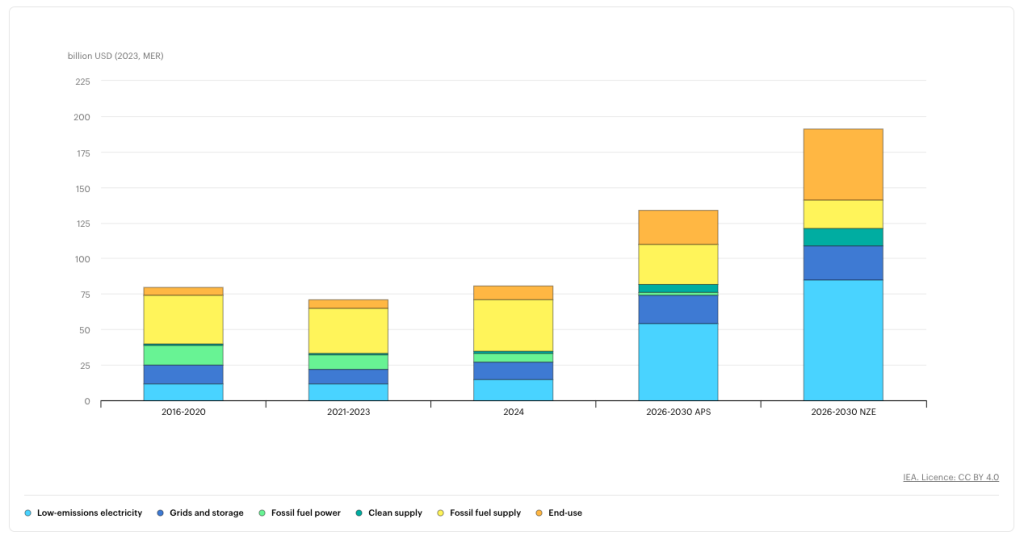
Past and future energy investment in Southeast Asia
The IEA says investment flow imbalances, particularly insufficient clean energy investment outside China, means many of the least-developed economies are being left behind when it comes to clean energy.
Investment will determine how this rising demand is met, with implications for security, affordability and alignment with sustainability goals.
Eight out of 10 countries in the region have announced target dates of carbon neutrality: Singapore, Malaysia and four others in 2050; Indonesia in 2060; and Thailand in 2065.
In 2024, the share of global clean energy investment in emerging markets and developing economies (EMDE) outside China was expected to remain around 15% of the total.
Both in terms of volume and share, the IEA says this is far below the amounts that are required to ensure full access to modern energy and to meet rising energy demand in a sustainable way.
“Investment in energy efficiency and electrification in buildings and industry has been quite resilient, despite the economic headwinds. But most of the dynamism in the end-use sectors is coming from transport, where investment is set to reach new highs in 2024 (+8% compared to 2023), driven by strong electric vehicle (EV) sales,” the IEA reports.
“The rise in clean energy spending is underpinned by emissions reduction goals, technological gains, energy security imperatives (particularly in the European Union), and an additional strategic element: major economies are deploying new industrial strategies to spur clean energy manufacturing and establish stronger market positions.
“Such policies can bring local benefits, although gaining a cost-competitive foothold in sectors with ample global capacity like solar PV can be challenging. Policy makers need to balance the costs and benefits of these programmes so that they increase the resilience of clean energy supply chains while maintaining gains from trade.”
Write to Adam Orlando at Mining.com.au
Images: IEA & iStock


