



Nova Scotia-based Silver Tiger Metals (TSX-V:SLVR) is confident it can now move quickly to advance its El Tigre Silver-Gold Project in Mexico following the outcome of a Prefeasibility Study.
The PFS focused on the conventional open pit mining economics of the Stockwork Mineralisation Zone which is forecast to have a net present value of US$222 million and an internal rate of return of 40%, with a two-year payback period.
This is based on a 10-year operation recovering 43 million silver equivalent ounces, or 510,000 gold equivalent ounces, comprising 9 million silver ounces and 408,000 gold ounces.
Annual production is expected to amount to 4.8 million silver equivalent ounces or 56,700 gold equivalent ounces.
The estimated total undiscounted after-tax cash flow came in at US$318 million ($476.2 million), while initial capital costs are expected to total US$86.8 million, including US$9.3 million of contingency costs, over an expected 18-month build.

Silver Tiger anticipates it will require US$20.1 million of expansion capital in the third year of operation and sustaining capital costs will total US$6.2 million over the life of mine.
These metrics are based on forecast average life-of-mine operating cash costs of US$973 per gold equivalent ounce or US$12 per silver equivalent ounce, and all in sustaining costs of US$1,214 per gold equivalent ounce or US$14 per silver equivalent ounce.
CEO Glenn Jessome says the open pit delivers “robust economics” using metal prices greatly discounted to the spot price.
The base case scenario in the PFS used a silver price of US$26 an ounce and a gold price of US$2,150 per ounce.
Silver is currently trading at just under US$35 an ounce, while gold is fetching over US$2,750 an ounce.
“This is a pivotal point for our company as we now have a clear path forward to making a construction decision for the open pit,” Jessome says.
“The open pit has good grade (48 grams per tonne silver equivalent), low strip ratio (1.7:1), and wide benches (~150 m) with mineralisation at surface.
“With such positive parameters and with our VP of Operations Francisco Albelais, a career expert in the construction of large heap leach mines in Mexico, we are confident we will be able to advance the project very quickly.”
At the same time as announcing its PFS results, Silver Tiger has also updated the resource for the El Tigre Project, which now includes an out-of-pit resource that the company plans to study in a Preliminary Economic Assessment in H1 2025.
The updated measured and indicated resources now total 68 million tonnes @ 92 grams per tonne (g/t) for 200 million silver equivalent ounces, while the inferred resources now stand at 14.5 million tonnes @ 180g/t for 84 million silver equivalent ounces.
This marks a 132% increase in the higher confidence measured and indicated silver equivalent ounces and a 59% higher measured and indicated grade.
The revised resource includes an out-of-pit 5.3 million tonnes in the measured and indicated categories @ 255g/t silver and 10.1Mt inferred mineral resource grading 216g/t
Jessome says the open pit is only one component of El Tigre with Silver Tiger having now also defined over 113 million silver equivalent ounces in underground resources.
Additionally, the company – which has a market capitalisation of C$102.2 million ($110.7 million) – also outlined an exploration target of 10-12 million tonnes @ 225 to 265g/t for 73-100 million ounces silver equivalent.
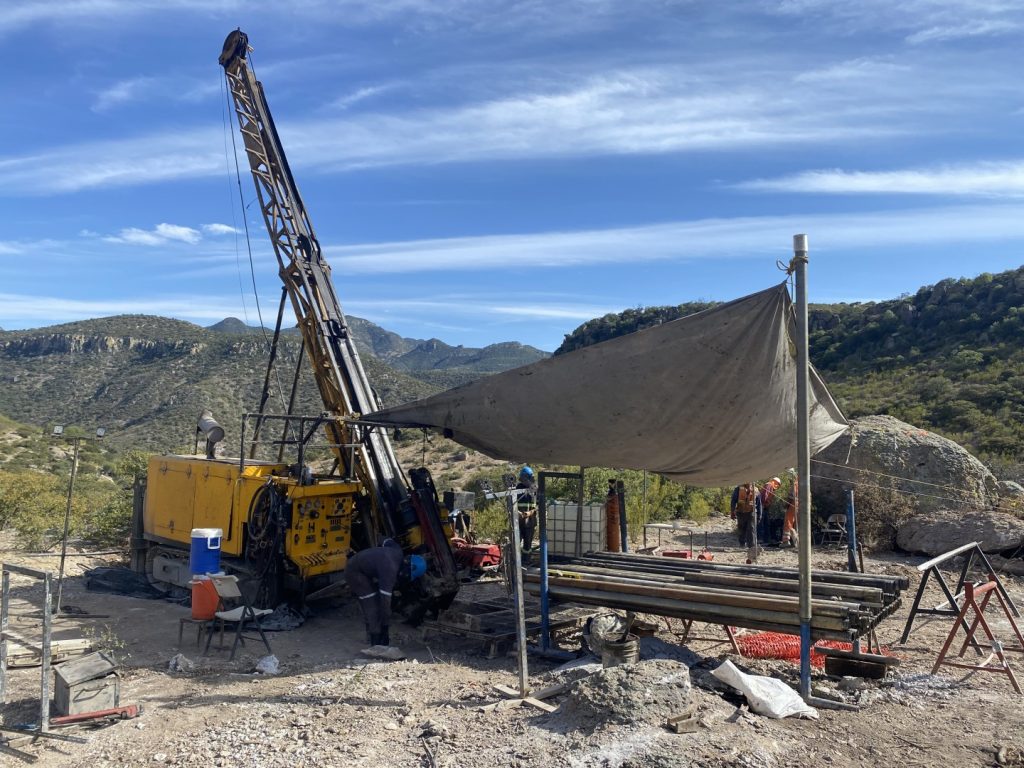
“This disclosed ‘near-mine’ mineral resource and potential, when coupled with the fact that only 30% of this prolific property has been explored, shows the value of the El Tigre Project,” Jessome says.
“The company will also continue to work on this substantial underground mineral resource by starting underground drilling immediately, and plan to release an underground PEA in H1 2025.”
The El Tigre historic mine district is located in Sonora, Mexico within the Sierra Madre silver and gold belt that hosts several epithermal silver and gold deposits, including Dolores, Santa Elena and Las Chispas at the northern end.
Gold was first discovered on the property in 1896 in the Gold Hill area and mining started with the Brown Shaft in 1903. The focus soon changed to mining high-grade silver veins in the area with production coming from three parallel veins: the El Tigre Vein, the Seitz Kelley Vein and the Sooy Vein.
Mining abruptly stopped on all three of these veins when the price of silver collapsed to less than US$0.20 per ounce at the start of the Great Depression.
By the time the mine closed in 1930, it reportedly produced a total of 353,000 ounces of gold and 67.4 million ounces of silver from 1.87 million tons, at an average mined grade of over 2 kilograms silver equivalent per ton.
Write to Angela East at Mining.com.au
Images: Silver Tiger Metals


