


This article is a sponsored feature from Mining.com.au partner Signature Resources Ltd. It is not financial advice. Talk to a registered financial expert before making investment decisions.
Signature Resources (TSX-V:SGU) controls 85% of the Lingman Lake Greenstone Belt in the prolific Red Lake District of Ontario, but has only just scratched the surface of the 32km-long belt.
At the end of July, the explorer released a maiden gold resource for Lingman Lake of 2.15 million tonnes @ 1.38 grams per tonne for 95,200 ounces in the indicated category and 18.4 million tonnes @ 1.14g/t for 674,320 ounces in the inferred category.
Signature Resources has also built up a pipeline of 14 regional targets, identified during airborne geophysical work over the 24,821-hectare landholding, but has explored just 1.5km of this extensive belt.
While wildfires that occurred in the area a few years ago initially hampered exploration, the reduced vegetation has exposed surface expressions in regional locations that are similar to what the company is seeing at the Lingman Lake property.
Although historical exploration in the area only took into account the near-surface, higher grade gold, Signature Resources decided to take a look at the broader potential of its vast landholding.
Last year, geological consultant Watts, Griffin & McOuat updated the geological model to incorporate drilling completed in the 1980s which further expanded the high-grade mineralisation zones.
It also identified moderate grade mineralisation between 2g/t and 5g/t that had not been a focus of past efforts despite being less than 200m from surface.
Lingman Lake has also witnessed only sporadic historical exploration over 80 years because of its remote location.
Strong gold price dynamics unlock district-scale potential
CEO Dan Denbow says the focus has long been on the higher grade while the moderate grade was never looked at, but with the new gold price dynamics, the moderate grade is also quite profitable.
“Historical assaying had been very selective, targeting just the high grade areas, but there is a profitable gold envelope surrounding the high grade that had never been studied,” he explains.
“While the high-grade is the most interesting from a headline potential, from a capital return perspective, understanding the ability of the envelope to be a contributor makes the belt more interesting and adds to the district potential.”

The Red Lake District is one of Canada’s highest-grade Archean gold camps, having produced nearly 30 million ounces of gold at grades of over 20g/t.
The northwestern Ontario region is home to several major mines, including Evolution Mining’s (ASX:EVN) underground Red Lake Complex, Orla Mining’s (TSX:OLA) Musselwhite Mine and West Red Lake Gold Mines’ (TSX-V:WRLG) flagship Madsen Mine.
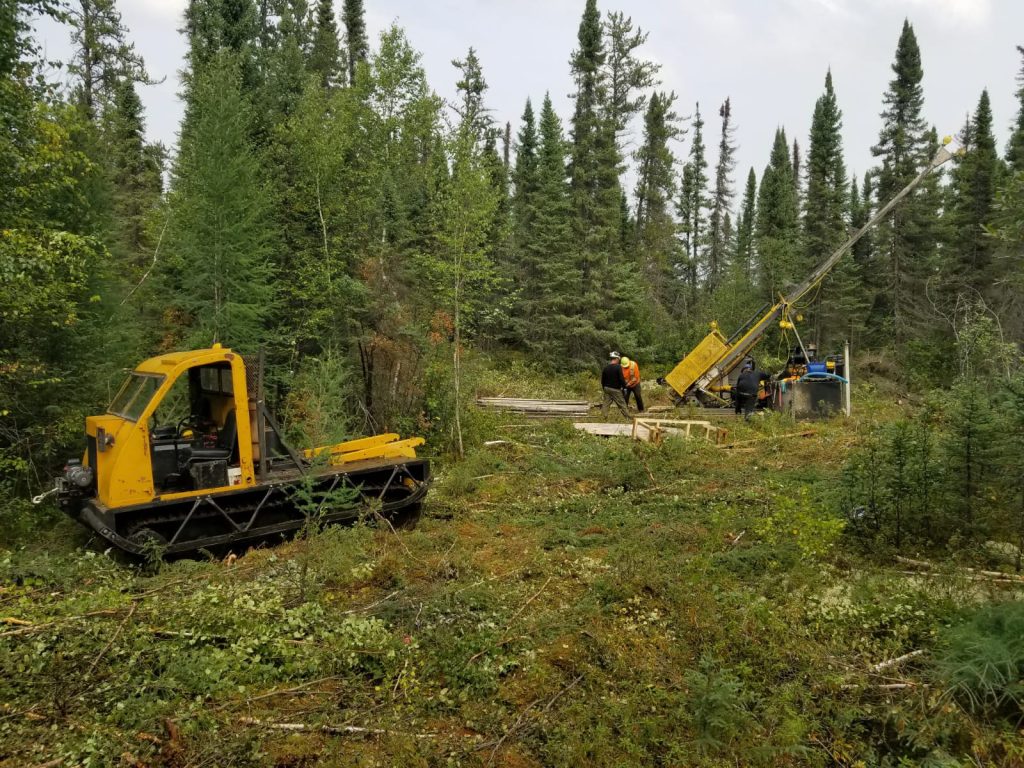
Signature Resources completed over 43,000m of drilling to define the initial Lingman Lake resource, which currently sits within a pit shell extending 1.6km west to east and down to about 340m below surface.
Structures hosting the mineralisation, however, remain open to drilling to the east, west and at depth.
Red Lake comparisons point to district scale
The recently published technical report outlining the maiden resource points to similarities between Signature Resources’ Lingman Lake Project and the area hosting West Red Lake’s Madsen Mine.
The Madsen and Starratt-Olsen gold deposits located within the Red Lake Mining Camp are classified as strata-bound replacement style disseminated gold deposits – the same style of deposits found along Nevada’s Carlin Trend, one of the world’s richest gold mining districts.
However, Denbow says exploration at Lingman Lake is still relatively shallow and Signature Resources will be watching closely to see how the mineralisation changes as the company explores deeper.
“Throughout we have a number of higher grade results and it is one of the reasons that when you look at the recent resource, when raising the cutoff grade to 1g/t you still have over 500,000 ounces at a grade of 1.99g/t,” he says.
“With that near-surface gold grade you have a nice starter area when you advance to mining Lingman Lake.
“But from an exploration strategy our goal is to continue seeking the deeper vectors for the grade and follow it down. As with many deposits in northwest Ontario, grade can be traced deeper and sometimes gets better/more consistent.
“We hope that the same can occur at the Lingman Lake Project. Having grade at surface is a good benefit and we hope a good sign of more to come.”
The use of artificial intelligence (AI) has assisted in improving the targeting of the gaps in the drilling.
As Signature Resources expands its database, AI is also expected to become more useful in building a pipeline of targets.
“With little data on the regional targets, I think field programs and mapping will be the more useful tools to start the drilling on those targets, but with early results it should make it easier to start making targeting decisions as you expand on new discoveries,” Denbow says.
“As we continue to build the database it will lead to more useful targeting from new methodologies, but we are breaking new ground and we need something to feed the models.”
Next drilling phase aims at resource growth
To expand the existing resource at Lingman Lake, Signature Resources plans to undertake deeper drilling, infill drilling and drilling to the west of the diabase dike.
Denbow says following the identified gold zones deeper will quickly add to the resource by capturing modelled ounces outside of the pit shell.
The explorer is also aiming to identify the deeper contacts to see if Lingman Lake looks like other Red Lake deposits that go deeper and demonstrate higher grades at depth.
“Infill drilling will allow us to upgrade the resource and also capture areas that were not previously assayed, or areas only selectively assayed, into the model,” Denbow says.
Meanwhile, increasing the drilling density to the west of the dike will allow Signature Resources to connect areas in the model and potentially extend the resource laterally.
Signature Resources sees potential to grow the resource to 2-3 million ounces and is aiming to complete a further 15,000m of drilling before releasing a resource update.
Around 3,000m of that drilling is expected to be undertaken through to the end of this year.
“Naturally, it still has to be proven. But we have only explored 1.5km of the 32km wide belt,” Denbow says.
“We see lots of signs for prospective exploration but until you do the hard work you never really know.”
Write to Angela East at Mining.com.au
Images: Mining.com.au & Signature Resources