



The RIU Explorers Conference in Fremantle, Western Australia tends to accurately depict how the junior exploration mining industry will fare in the year ahead.
Held last week from 17-19 February, the event attracts both junior and mid-cap sized ASX-listed mining companies and has the perfect balance of the main industries that make up the resources sector. It has a large number of the firms that provide the service and equipment for miners to operate, and importantly, it attracts a large and diverse range of investors.
As such, the vibe and sentiment of the conference offers a window into the true state of mining in Australia. Mining.com.au was an official media partner and on the floor at this year’s event and a theme to emerge is that mining’s in a bull market – although it feels different to the last boom.
And the numbers back the sentiment. Jaxon Crabb – General Manager of RIU Conferences and Business Development Manager for Vertical Events (event organiser) – prefers not to disclose official exhibitor and attendee figures. However, he tells this news service that RIU Explorers 2026 received a record number of registered delegates that is “north of 2,600”.
“We had 149 booths and 105 presentations. But importantly, due to the popularity of the conference, we had 80 more companies on our waitlist,” Crabb tells Mining.com.au.
“I am so pleased by the positive vibe and enthusiasm at the conference. In my 14 years of working for RIU, this event had the most upbeat feeling.
“Although we do operate in an industry that can throw up some very volatile moments, the consensus from the majority of delegates I spoke to over the three days, is that we should all be very excited about the year ahead – and that covers all commodities.”

Crabb says this year’s event has set the tone for RIU Sydney Resources Round-up held from 5-7 May at Hyatt Regency. Mining.com.au is again a media partner for that event.
“RIU Sydney will also have an action packed 90 plus company program. And if and hopefully, our resources market remains equal to what it is now, I am confident RIU Sydney will be a massive success with a huge number of east coast based investment suits walking and engaging with the 130 booths because the investment sentiment in resources looks very strong,” Crabb continues.
Australia’s last mining boom is estimated to have boosted real per capita household disposable income by 13% over the decade to 2013. The world price of Australia’s mining exports more than tripled over the 10 years to 2012, while investment spending by the mining sector increased from 2% of GDP to 8%.
In a 2014 report to the Reserve Bank of Australia, author Peter Tulip from the Economic Research Department says the previous mining boom can be viewed as a confluence of events that boosted mineral commodity prices, mining investment, and resources production.
“This combination of shocks has boosted the purchasing power and volume of Australian output. It has also led to large changes in relative prices, most noticeably an appreciation of the exchange rate,” Tulip writes.
“The combination of changes in income, production and relative prices has meant large changes in the composition of economic activity. While mining, construction and importing industries have boomed, agriculture, manufacturing and other trade-exposed services have declined relative to their expected paths in the absence of the boom.
“Households that own mining shares (including through superannuation) or real estate have done well, while renters and those who work in import-competing industries have done less well.”
‘All commodity’ bull market
The positive vibe and enthusiasm at the conference reflects the broad consensus by RIU attendees that the mining sector is seeing the emergence of an ‘all commodity’ bull market. This was touted by Canaccord Genuity Head of Mining Research Reg Spencer in the morning of day one who was also quick to note that this time around market volatility still exists – something not really seen during the past boom.
The causes of this volatility are many and interlinked, according to Spencer, yet he remains bullish not only in 2026 but for the years ahead.
“Now, despite the fear, loathing and uncertainty that this volatility typically brings, and I will say this, knowing that it very much well may be the kiss of death, but I think we are still very much in the middle of a major commodity bull market,” Canaccord’s Head of Mining Research says.
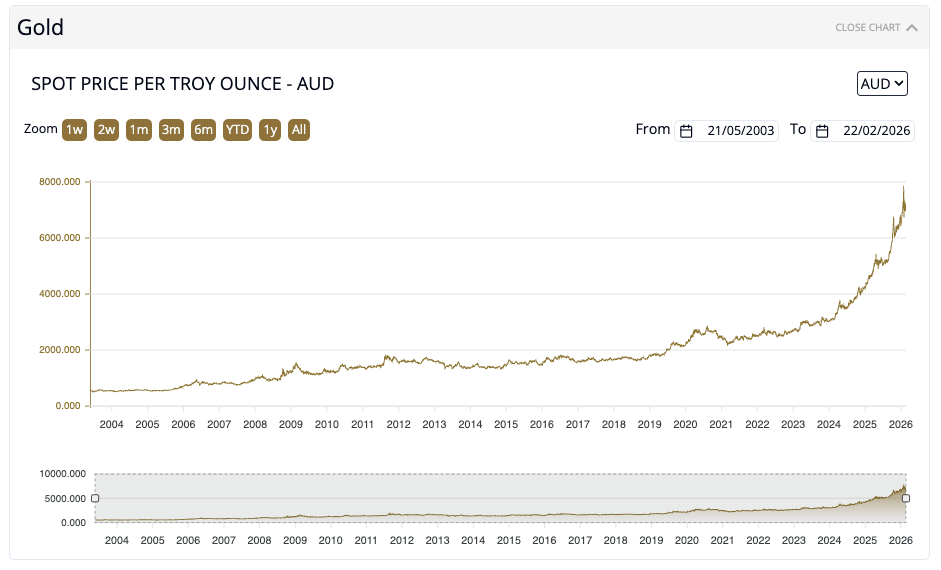
This bull market is very much being driven by gold and Spencer notes the precious metal’s impressive rally took it past the US$5,000 mark in January – although prices fell about 14% late last month.
“Now, despite the fear, loathing and uncertainty that this volatility typically brings … I think we are still very much in the middle of a major commodity bull market”
The key drivers of gold’s rise are all well known “but for the few uninitiated in the (RIU) audience, you can put these down to geopolitical uncertainty, safe haven demand, Fed rate policy, US dollar weakness, record levels of government debt, currency and bond debasement, and associated central bank buy”.
Echoing these sentiments is Hedley Widdup, Managing Director of specialist mining investment company Lion Selection Group (ASX:LSX). Speaking to this news service on the sidelines of RIU, Widdup says “it’s pretty easy to see we’re in a bull market” and there’s consensus gold in particular is having a run although “mostly everything in commodities is going up”.
As Lion’s Managing Director explains, gold bull markets tend to have legs although the dynamics are different for other commodities – even other precious metals like silver.

Silver lining
Widdup says silver can be a volatile metal, something certainly seen in the past three weeks alone. While silver prices rose 240% from October 2025 to $117 an ounce in late January 2026 its correction “far outpaced” gold’s when as of mid-February 2026 prices experienced a significant, sharp drop of almost 40%.
This drop follows a rapid, speculative, and historically high rally that’s been driven by profit-taking, a stronger US dollar, lower liquidity, and by cooling yet still significant industrial demand, Widdup adds.
“I feel like I offend someone every time I say this – it comes with an apology and it’s an opinion. But you look at the gold market, and part of the reason why the gold market will go up, as long as they’re pricing sensitive buyers, which is what gold buyers are, they want to own the gold, they’re not so worried about the price. That doesn’t exist so much in silver,” Widdup tells this news service.
“(About) 70% of the gold which is bought gets put in the bars and hoarded and people just want to own it (whereas) 70% of silver that gets bought gets used. That same thing that caps the price of things like copper kicks in with silver at some stage.
“This volatility that we see is an interplay between speculators going wild and buying silver – maybe to make their meme coins, and the people who use it to make solar panels. Do you think they want to pay 100 bucks an ounce to put it into solar panels? No.”
Canaccord’s Head of Mining Research agrees, saying: “Now, the drivers of that have primarily been a catch-up to gold, while you’ve actually got market deficits in physical, and that’s caused by strong industrial demand growth right up against flat mine supply growth.”
“So unlike gold, where we see it (silver) more as a currency – silver’s dual role as a precious and industrial commodity gives it an edge in our view.
“Meanwhile, while we’ve got expectations for continued deficits in the physical market, and that is driven by strong demand from high-growth industries such as electronic, solar, EV, AI infrastructure, and recently introduced Chinese export control against flat mine supply growth, we think silver prices can recover to recent highs.
“Now, especially noting that the gold-silver ratio has actually fallen to 40% below its 15-year average. To us, that implies a possible reemergence of that gold catch-up trade.”
Spencer adds that unlike gold, which is seen more as a currency, silver’s dual role as a precious and industrial commodity gives it an edge.
“Meanwhile, we’ve got expectations for continued deficits in the physical market, and that is driven by strong demand from high-growth industries such as electronic, solar, EV, AI infrastructure, and recently introduced Chinese export control against flat mine supply growth, we think silver prices can recover to recent highs,” he continues.
“Now, especially noting that the gold:silver ratio has actually fallen to 40% below its 15-year average. To us, that implies a possible reemergence of that gold catch-up trade.”
Same but different bull market
Speaking to Mining.com.au on the sidelines of RIU, Andy Tudor, Managing Director of Nexus Minerals (ASX:NXM) says this bull market does feel different in that the sector – and juniors in particular – aren’t having money thrown at them like the boom of the early noughties.
“The industry, whilst there’s a lot of money being raised, again it’s tending to lean towards more that producer end of town,” Tudor tells this news service.
“Don’t forget if I’d have sat here with Nexus say three years ago and just spoken about (heading towards production), I would have been crucified. ‘There’s no way your junior will go mining, are you mad? That’s not what you do.’
“And so the sentiment changes and we can’t really change at the speed that that changes. We’ve just stuck to getting through the process.”
Tudor’s history is very much about executing within a seven to 10 year window to make discoveries, pull projects together (which he’s done at Crusader-Templar and the Wallbrook project) “pull it together from multiple parties, do the exploration work, make the discoveries, start the mine”.
“The industry, whilst there’s a lot of money being raised, again it’s tending to lean towards more that producer end of town”
“And if you hit it at the right time, you’re a hero. If you get into the opposite part of the cycle – we can’t work like that and we don’t – so we are where we are now. We’ve done that work.”
Tudor notes gold is at an all-time high and obviously much higher than when he started at Wallbrook in 2018, which bodes well for the near-term producer to be this advanced within such a positive market.
Ben Vallerine, CEO of Koba Resources (ASX:KOB), concurs with Tudor that “money isn’t being thrown around as recklessly as it was back then” during the last boom.
“Certainly I think we’re in a bull market, certainly a long commodities bull market. So the commodities are running hard but I don’t think some of the explorer stocks are running quite as hard yet,” Vallerine says on the sidelines of RIU.
“I think that’s going to filter down as the commodity prices stay strong and continue to rise, it’s going to filter much further down to the junior explorers. Normally the producers see it first and then it goes down the chain.”
Bellavista Resources (ASX:BVR) Managing Director Glenn Jardine tends to agree, saying with gold at least it’s clear “we’re in the midst of a bull market”, which is timely for the company’s recent acquisition of the Pickle Crow Gold Project.
On 2 February Bellavista announced it entered into a binding share sale and purchase deed to acquire FireFly Metal’s (ASX:FFM) 70% interest in Pickle Crow and a parcel of highly exploration assets in Ontario, Canada.
Speaking to Mining.com.au on the sidelines of RIU, Jardine says the Pickle Crow deposit is one of Canada’s highest-grade historical gold mines, having operated from 1935 until 1966, during which time it produced around 1.5 million ounces of gold at an average grade of 16.14g/t.
Meanwhile, Golden Horse Minerals (ASX:GHM) CEO Nicholas Anderson was taking full advantage of the RIU platform to highlight visible gold from its first diamond drillhole in 2026 and to encourage people to “get on the horse” to ride the bull market.
Of the 156 re-assays from drilling at its Hopes Hills Project in the Southern Cross Greenstone Belt, Anderson says over half graded above 5g/t gold with multiple +10g/t assays to 63.3g/t gold highlighting the upside of the project in a high price environment.
Given the current gold price environment exceeding $7,000 (US$5,000) an ounce, Golden Horse will expedite its 125km drill program for 2026 by turning on an additional reverse circulation rig for regional prospects and a second diamond rig to further test and follow-up the high-grade mineralisation intercepted at Hopes Hill and regionally across its Southern Cross Gold Project.
Golden Rule for bull markets
Mining.com.au began writing about the resources bull market back in July 2025 when renowned natural resource investor Rick Rule declared to this news service: “Make no mistake, we’re in a gold bull market.”
In a wide-ranging interview at the time, the legendary investor highlighted how bull markets tend to follow predictable patterns, often starting with gold and the rest of the sector to then follow.
“We’re going to see a bull market that’s reminiscent of the bull market that we enjoyed in the early part of the decade of the 90s. Bull markets follow predictable patterns. The market is led by the commodity,” Rule said at the time.
“We saw that in 2023 in gold. Gold led, but the gold stocks went nowhere. That’s easy to understand. The buyers were foreign central banks and they didn’t buy shares, right?
“So, the asset class that had a buyer went up and the asset class that didn’t have a buyer didn’t go up. Surprise, surprise. But that follows an age-old pattern because gold bull markets are led by fear buyers and fear buyers don’t buy stock, they buy the gold.”
“Bull markets follow predictable patterns”
The veteran investor suggests two things happen when gold itself establishes the momentum. First is the inertia of the precious metal reinforces the gold narrative and makes the whole sector around it “more interesting”.
Second is that the increase in the precious metal’s price, once momentum is underway, is faster than the increase in the input cost to produce it. Rule says the biggest and the best producers start to deliver “absolutely blowout earnings” – something witnessed in 2024 when most gold miners exceeded their own optimistic performances about their quarters. And investors were newly conditioned to that by the increase in the price.
According to Rule, an analogy to best visualise the impending bull market is by envisaging a circus master’s whip. Picturing the handle of the whip, the front of the whip moves first – that’s gold. The next thing that whips past the circus master’s shoulder are the biggest and highest quality companies in the world to move next, pulled by gold.
“Then the best of the rest move. Then the developers move. Then the penny dreadfuls move. This follows a predictable pattern with each stage of the rip whip.”
“When they move, they move faster and they move further. But the whip moves qualitatively. But the move will come very quickly to the best of the rest.”
Peak Asset Management founder Niv Dagan also flagged the bull market to Mining.com.au in July last year, noting that the capital inflows already seen mid-2025 with commodities like antimony, copper, palladium, platinum, rare earths, and tungsten, would continue in H2 2025 and beyond.
Spencer’s RIU presentation in fact was echoing Dagan’s sentiments, which were amid various conflicts around the world, a then falling US dollar, and China’s restrictions on metals such as antimony, germanium, palladium, and tungsten, the outlook looks positive as capital will continue to flow towards commodities, as they are denominated in USD.
Write to Adam Orlando at Mining.com.au
Images: Mining.com.au


