


Ramelius Resources (ASX:RMS) is reporting positive key developments from exploration projects within its portfolio of gold assets in Western Australia.
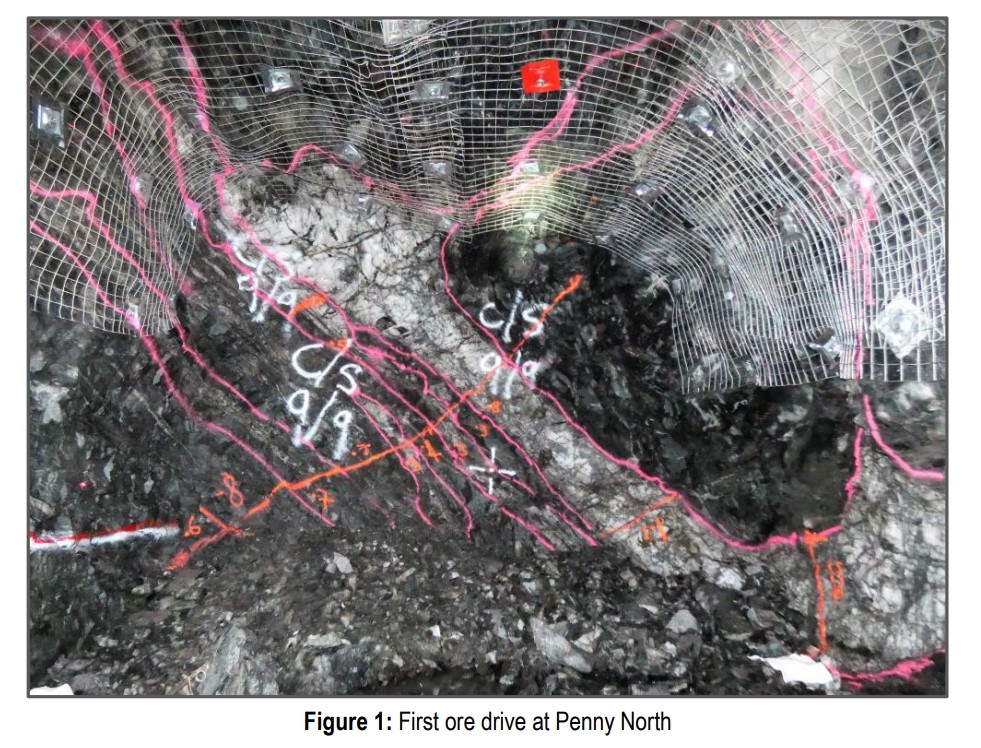
Ramelius Managing Director Mark Zeptner said it is pleasing to see the Penny mine intersected first ore with the ‘high-grade’ lode easily identified and the rapid progress of the Galaxy decline rehabilitation such that development across to the Mars and Saturn orebodies may commence shortly.
“it is pleasing to see the Penny mine intersected first ore with the ‘high-grade’ lode easily identified”
“In addition, our exploration and resource development teams continue to hit high-grade material at Galaxy, Bartus East, Symes Find and in particular the 470 gram-metre result at Rebecca, reinforcing our view on the quality and potential of that project, all of which stands Ramelius in excellent stead for the future.”
The open pit cutback at Penny West was completed in March 2022 with transition to the underground team taking place over late March to early April.
The first blast into the underground portal was carried out in late April 2022 and the first ore drive intersected in late August 2022.
Ramelius is reporting surface infrastructure is largely complete including the new airstrip, which will be in use soon reducing both the flight costs and commute times from the previously used Youanmi airstrip located 25km north of the mine.
At Galaxy Underground, ongoing decline rehabilitation has progressed to 550m from the portal and is progressing ‘rapidly’.
The top ore level access drive for the Mars orebody is a further 160m from the current position.
Deeper exploration and resource definition diamond drilling has progressed at Galaxy (Mars and Saturn deposits) into areas outside the current mine design.
Results for three drillholes at Mars have been returned with significant intercepts including:
- 6m @ 25.2g/t Au from 387m in GXDD0132, and 1m @ 5.48g/t Au from 531m.
- 6.7m @ 3.16g/t Au from 288.6m in RDDD0018, and 2.6m at 3.01g/t Au from 358m, and 4m @ 2.97g/t from 369m.
- 4.7m @ 5.23g/t Au from 238.6m in GXDD0143, and 1.7m @ 13g/t Au from 313.9m.

Drilling is targeting extensions of banded iron formation (BIF) hosted ‘high-grade’ shoots beneath the Mars and Saturn open pits.
Several BIF stratographic horizons have been historically identified including narrower but frequently mineralised BIF horizons in the footwall and hangingwall of the main BIF.
Recent deep drilling in Saturn has also revealed a mineralised BIF breccia target at depth in that area.
Structural complexity also provides the opportunity for previously unrecognised fault bounded BIF blocks to create blind ‘high-grade’ shoots with no near surface expression.
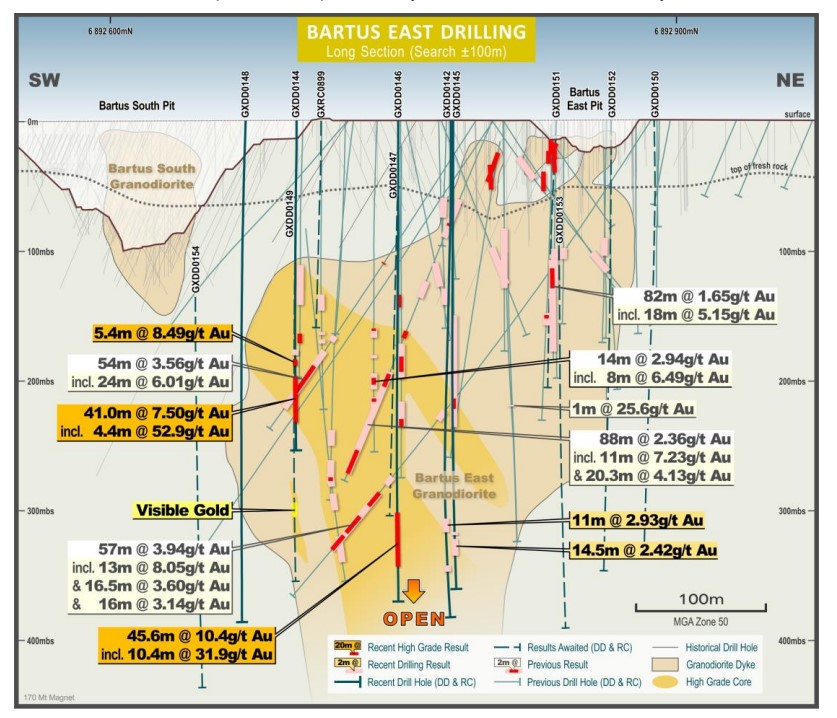
At the Bartus East Prospect, ‘high-grade’ results continue from reverse circular (RC) drilling, and new results include:
- 45.6m @ 10.4g/t Au from 328m in GXDD0146, including 10.4m @ 31.9g/t Au from 351.2m.
- 5m @ 2.68g/t Au from 200m in GXDD0144, and 5.4m @ 8.49g/t Au from 208.65m, and 41m @ 7.50g/t Au from 233m, including 4.4m @ 52.9g/t Au from 234.8m.
- 11m @ 2.90g/t Au from 324m in GXDD0142.
- 5.6m @ 3.00g/t Au from 251m in GXDD0145, and 10m @ 1.10g/t Au from 265.5m, 2.9m @ 7.20g/t from 295.1m, and 1.9m @ 5.70g/t Au from 327m, and 14.5m @ 2.42g/t Au from 354m.
- 5m @ 9.46g/t Au from 127m in GXRC0903.
- 7m @ 1.93g/t Au from 46m in GXRC0904.
Recent drilling has defined the strike extent of the intrusive granodiorite host and continues to define grade distribution within the granodiorite.
Ramelius reports key recent outcomes include confirmation of ‘high-grade’ core zone at the southern end of the prospect at depth, and the conclusion that ‘high-grade’ mineralisation remains open at depth, albeit within a strike constrained zone.
Results for several diamond holes remain pending, and an updated Mineral Resource is expected to be produced by the end of the year.
At Symes Find, a resource definition RC drilling program has been completed, including the Mt Hampton resource area located immediately north of the main Symes Find pit.
A series of predominantly shallow infill and extensional holes have targeted surficial laterite hosted mineralisation and shallow infill definition of primary lode structures.
An extensive veneer of surficial laterite mineralisation has been previously exploited in part by a shallow pre-existing pit and some adjacent surface scraping.
Laterite mineralisation extends laterally away from previously mined areas and is underlain by shallow dipping to flat lying primary mineralised lodes, with a gross east to southwest plunge in the main mineralised area.
Ramelius is working with local landowners and regulatory authorities to put in place necessary agreements and approval for mining commencement and production feeding the Edna May mill in FY24.
At the Rebecca Gold Project, resource definition infill and extensional RC and diamond drilling is continuing at all prospects, including Rebecca, Duchess and Duke resource areas and the Cleo Prospect.
Drilling has covered a broad range of different targets/lodes across each deposit.
Recent results include:
Rebecca:
- 13m @ 9.76g/t Au from 78m in RCLR0983, and 11m @ 1.34g/t Au from 95m.
- 9m @ 2.13g/t Au from 42m in RCLR0991.
- 6m @ 1.56g/t Au from 45m in RCLR0992.
- 8m @ 59.3g/t Au from 108m in RCLR0997.
- 21m @ 1.17g/t Au from 49m in RCLR1011.
Duchess:
- 18m @ 1.40g/t Au from 193m in RCLR2038.
- 6m @ 1.80g/t Au from 26m in RCLR2039.
- 17m @ 0.95g/t Au from 22m in RCLR2045.
- 34m @ 0.84g/t Au from 95m in RCLR2048.
Duke:
- 10m @ 1.67g/t Au from 95m in RCLR2048.
Cleo:
- 20m @ 1.53g/t Au from 80m in RCLR0985, and 8m @ 1.03g/t Au from 92m.
The ‘high-grade’ result from Rebecca drillhole RCLR0983 is from an infill position towards the northern end of Rebeccca, with a historically drilled and reported adjacent up-dip hole recording 24m @ 5.57g/t Au.
Rebecca drillhole RCLR0997 lies on the southern extremity of the current conceptual pit design and highlights further potential to the south where the next pre-existing drill fence is located 250m away.
All results post-date the recent resource update.
Testing of near-mine exploration targets will commence towards the end of the year on conclusion of resource definition, geotechnical and waste-dump sterilisation drilling.
Ramelius Resources Limited owns and operates the Mt Magnet, Edna May, Viven, Marda, Tampia and Penny gold mines, all of which are located in Western Australia.
Ore from the ‘high-grade’ Viven underground mine located near Leinster is hauled to the Mt Magnet processing plant where it is blended with ore from both underground and open pit sources at Mt Magnet.
The Penny Project is currently under development with first ore in early FY2023.
The Edna May operation is currently processing ‘high-grade’ underground ore, ‘low-grade’ stockpiles, as well as ore from the satellite Marda and Tampia open pit mines.
Ramelius completed the take-over of Apollo Consolidated Limited in January this year, taking 100% ownership of the Lake Rebecca Gold Project, now called the Rebecca Gold Project.
Images: Ramelius Resources Ltd