


Canadian junior exploration company Power Nickel (TSX-V:PNPN) is powering ahead by strengthening its exploration strategy, which will include downhole electromagnetic (EM) surveys and ground-based geophysics at its Nisk Property in Québec.
Power Nickel today (13 August 2024) reports valuable scientific and technical inputs received from renowned Australian geoscientist Dr Steve Beresford has led to revamping the exploration strategy. The new approach is aiming to identify the best resources growth potential at both discoveries and to understand the nature of the ground between them.
Beresford was brought on as a special advisor by the company in early May, as reported by Mining.com.au.
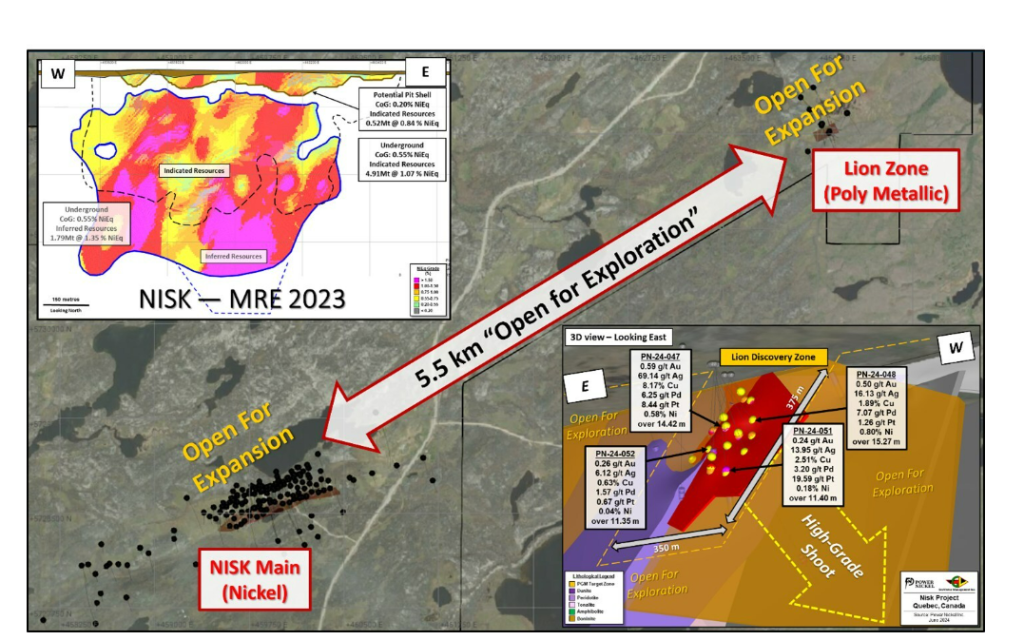
Power Nickel is seeking to develop a robust framework for identifying new prospective sub-surface target areas and is aiming at defining a possible continuity over the 5.km strike-length separating Nisk Main and the Lion Zone.
From Beresford’s expertise, Power Nickel reports the system appears to behave similarly to a vein system, to the difference that the key controlling parameters are the thickness of the zone and its proximity to the ‘source’, as both factors play a role in the mineralogy and grade of the different mineralized pods.
The renewed exploration program is poised to also benefit from his experience by putting emphasis on a proper use of geophysics in the company’s targeting strategy.
Moving forward, the exploration strategy will include downhole EM surveys from specially designed “platform holes”, with the aim of identifying favourable areas for high grade sulphides mineralisation within the target plane itself.
The strengthened strategy incorporates ground-based geophysics, which includes both ground gravity and EM surveys on a tight grid, providing another layer of information order to better understand the sub-surface architecture.
Moving forward these new datasets will be integrated, allowing updating of the current litho-structural component of the 3D model with enhanced gravity data. The 3D model can then be used to filter out false-positive targets interpreted from the geophysical surveys.
Power Nickel CEO Terry Lynch says with the addition of the C$20 million of exploration capital raised in June, and Beresford appointment to the board and technical team, the company has significantly enhanced its ability to follow up exploration success at Nisk.
“We are most encouraged with this summer’s progress and believe our strategic approach will maximise the speed and size of our exploration discoveries,” Lynch says.

Details on the exploration program released today further note that while the 2024 summer drill program at the Lion Zone continues to intersect polymetallic mineralisation, to the west, the Nisk Main zone extends over 650m and to a depth of 500m below surface.
The 2023 mineral resource estimate (MRE) presents a combined ‘in-pit’ and underground indicated resource of 5.43 million tonnes grading 1.05% nickel equivalent, and 1.7 million tones @ 1.35% nickel equivalent of underground inferred resource.
Nisk Main remains open at depth along what has been identified as high-grade mineralisation shoots.
To the northeast, the Lion Zone is currently followed on about 300m to a depth of 350m. The Lion Zone is a polymetallic sulphides-rich zone presenting a “high-grade” content in platinum group metals, gold, and silver, as well as in copper and nickel.
Platform holes are voluntarily drilled to follow and to remain at a constant distance from the target plane, rather than intersecting it. The main purpose of such holes is to provide a “consistent platform” on which downhole geophysics tools can generate a profile of EM responses along the vertical extent of the target plane.
Mineralised sulphides contained within the target plane, especially when massive and/or as interconnected stockwork of stringers are sensitive to EM interferences, and therefore can be “seen” by the geophysical survey, with a precise depth location.
Power Nickel says the intention is to align several platform holes along strike of the target plane, providing then a continuous survey coverage along both the vertical and lateral extents. For the technique to work best, platform holes are designed to be hosted by non-EM responsive rocks to avoid any background interferences.
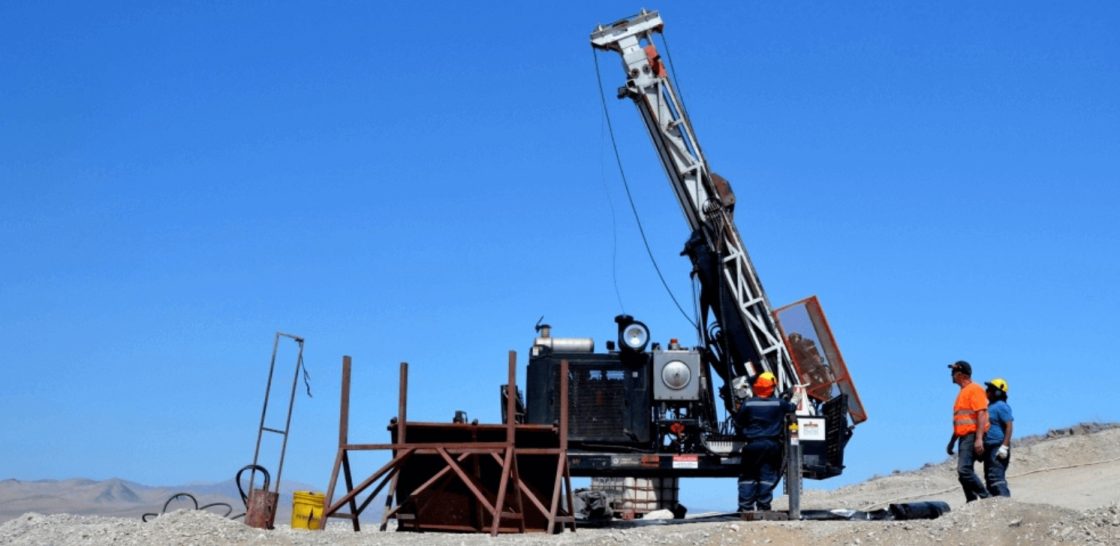
A second drill has been deployed at the eastern margin of Nisk Main, and the first platform hole, PN-24P-001, is collared with the barren paragneiss. From there, the hole will be drilled to some 1,000m depth.
With the combination of traditional high-resolution airborne geophysics and Fleet Space Technologies’ ANT gravity surveys, it was recognised that more precise ground-based surveys were required to further refine Power Nickel’ targeting strategy.
Write to Adam Orlando at Mining.com.au
Images: Power Nickel


