

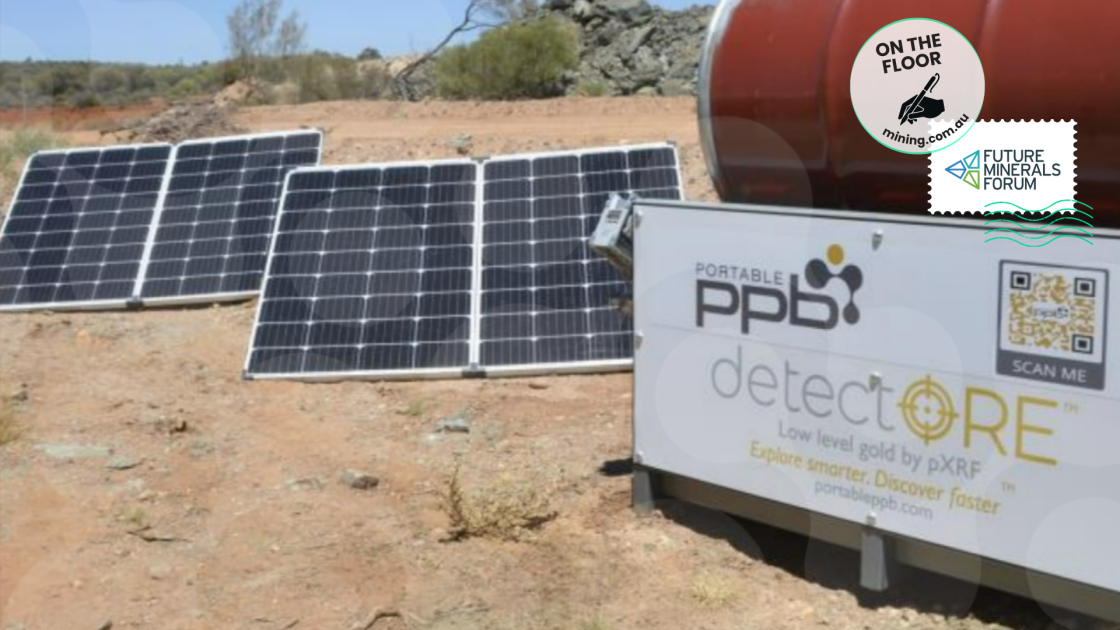
Australian exploration technology developer Portable PPB marks a decade in business by taking its gold detection technology to one of the world’s fastest-growing mining jurisdictions.
Speaking to Mining.com.au at the Future Minerals Forum (FMF) in Saudi Arabia, Managing Director Simon Bolster says the company’s presence at the Riyadh-based event reflects both the maturity of its technology and the scale of opportunity emerging in the Kingdom.
Founded in 2016, Portable PPB commercialises a gold detection method originally developed by Australia’s national science agency CSIRO. The technology enables gold to be detected at very low concentrations using portable XRF units, a capability Bolster describes as a step-change for mineral exploration.
“The company started out of a conversation during PDAC after hearing that CSIRO had invented a method for doing low-level gold by portable XRF,” Bolster tells this news service.
“As soon as I heard about it, I thought, wow, that’s a game changer.”
Bolster and co-founder Peter Williams went on to secure the underlying intellectual property from CSIRO and build a company around the concept. Since then, Portable PPB has focused on refining the technology and applying it in real-world exploration environments.
Now, with Saudi Arabia pushing to unlock its mineral endowment under Vision 2030, Bolster says the timing to enter the market is right.
“Saudi Arabia is obviously one of the hotspots for exploration around the world, so it makes complete sense to be here,” he says. “They’re also looking for innovative solutions, and we believe we’ve got the best innovative solution for gold explorers.”
At the centre of Portable PPB’s offering is its detector technology, which the company describes as world-first. The system allows exploration teams using XRF devices to identify gold at concentrations that were previously below detection limits for portable instruments.
“DetectORE enables, for the first time, people with our XRF units to get gold at very, very low concentrations,” Bolster says. “Previously, that wasn’t possible.”
In practical terms, the technology aims to reduce the reliance on slower and more expensive laboratory assays during early-stage exploration. By identifying subtle geochemical signatures in the field, explorers can make faster decisions about where to drill next.
Portable PPB positions this capability as particularly valuable in greenfields environments, where targets are often deeply weathered or covered and traditional surface sampling struggles to deliver clear signals.
Bolster says the technology sits within a broader push to remove inefficiencies from the discovery process.
“We’ve been working in the industry now for 40 years in gold exploration, principally in geochemistry,” he says. “What we’re doing as a company now is knocking out all the pain points towards discovery.”
Integrating technology
The company’s longer-term ambition is to speed up exploration timelines by integrating technology, workflows and analytical techniques into systems that accelerate decision-making.
“We want to speed up the exploration process,” Bolster says. “We’re building systems and processes that enable a rapid acceleration in discovery.”
That focus aligns closely with the themes emerging from the Future Minerals Forum, which brings together governments, miners and technology providers to discuss how innovation can reshape the global mining industry.
Saudi Arabia has made no secret of its ambitions.
Under Vision 2030, the Kingdom is seeking to diversify its economy away from hydrocarbons, with mining identified as a key pillar of future growth. Gold exploration forms a central part of that strategy, alongside copper, phosphate and other critical and industrial minerals.
Bolster says the Saudi Government’s appetite for innovation makes the market particularly attractive for technology providers like Portable PPB.
“It fits fully in the wheelhouse of the main ethos of this conference,” he says.
“It’s innovation and changing the way that exploration and mining takes place.”
In terms of the competitive landscape, Bolster acknowledges that Portable PPB operates alongside a growing number of advanced analytical technologies emerging from Australia’s research ecosystem. He points to photon-based analytical systems, also originating from CSIRO research, as examples of complementary innovation.
“Our technology is one of a number of new analytical techniques coming through,” he says. “But in terms of analytical capability, it’s unique in the marketplace for what it’s able to do.”
That differentiation, he says, comes down to portability and sensitivity — two attributes that are increasingly valued as exploration companies look to do more with less.
With global exploration budgets under pressure and investors demanding capital discipline, technologies that reduce cost and improve targeting efficiency are gaining traction.
For Saudi Arabia, the stakes are higher still. Accelerating discovery is seen as critical to building a domestic mining industry capable of supporting downstream processing, job creation and long-term economic diversification.
Bolster says Portable PPB’s presence in Riyadh is as much about listening as it is about showcasing technology.
“We’re here to understand what the market needs and how our technology fits into that,” he says. “Saudi Arabia is moving quickly, and they’re serious about doing things differently.”
As Portable PPB celebrates its 10-year anniversary, the company’s journey from a PDAC conversation to the global stage reflects a broader trend in mining – the growing role of applied science and innovation in unlocking the next generation of discoveries.
For Bolster, the message is straightforward. “If you can find gold faster, cheaper and with more confidence, everything else flows from that,” he says. “That’s what we’re focused on delivering.”
Portable PPB is headquartered in Western Australia and continues to work closely with CSIRO as it rolls out its technology to new jurisdictions. With Saudi Arabia emerging as a focal point for exploration investment, the company sees the Kingdom as a key market in its next phase of growth.
FMF is organised by Saudi Arabia’s Ministry of Industry and Mineral Resources and took place from 13-15 January 2026. Mining.com.au had a team on the floor at the King Abdulaziz International Conference Centre and was also an official media partner.
Write to Adam Orlando at Mining.com.au
Images: PPB